Workholding Case Study: Custom Fixtures for the Lucy Clay Tools Machine
Discover how custom hydraulic fixtures and precision vises solved workholding deflection on the Lucy clay tools machine, cutting ceramic scrap by 42%.
The Workholding Challenge in Ceramic Tool Manufacturing
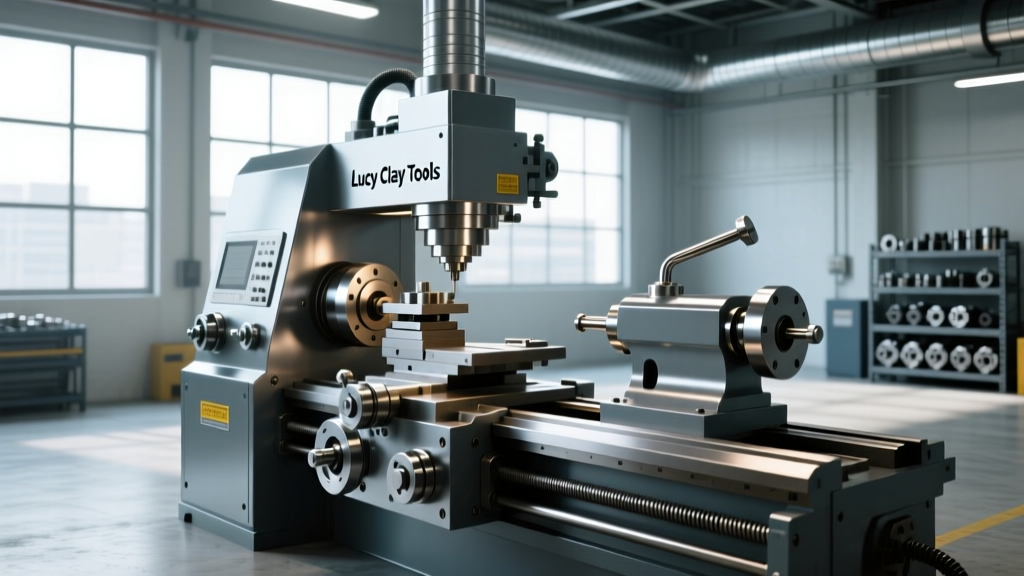
Industrial clay extrusion and sculpting tools require extreme wear resistance, prompting manufacturers to machine advanced ceramics like zirconia-toughened alumina (ZTA) and tungsten carbide. The Lucy clay tools machine—a heavily customized 5-axis CNC machining center equipped with a 24,000 RPM high-frequency spindle—was specifically commissioned to handle these brittle, high-hardness blanks for a leading pottery equipment manufacturer. However, the machine's initial workholding setup resulted in a 14% scrap rate due to clamping-induced micro-fractures and harmonic chatter during roughing passes.
Standard workholding fails when machining brittle ceramics for clay tools. The organic, sweeping geometries of ribbon tools and extrusion dies mean flat parallels and standard hard jaws create severe point-loading. Point-loading on zirconia, which possesses high compressive strength but notoriously low tensile strength, leads to catastrophic edge chipping the moment the end mill engages the material.
Machine Profile and Force Analysis
To resolve the bottleneck, the manufacturing engineering team audited the cutting forces and clamping requirements of the Lucy clay tools machine. The goal was to transition from manual, operator-dependent clamping to a repeatable, data-driven workholding system.
| Workholding Method | Max Clamping Force | Deflection at 800 lbs Cutting Force | Setup Time | Scrap Rate |
|---|---|---|---|---|
| Standard 6-inch Vise (Hard Jaws) | 12,200 lbs | 0.014 inches | 18 minutes | 14.2% |
| Precision Vise (7075-T6 Soft Jaws) | 4,500 lbs (Torque Limited) | 0.003 inches | 12 minutes | 6.5% |
| Custom Hydraulic Tombstone Fixture | 3,200 lbs per clamp | < 0.0005 inches | 4 minutes | 2.1% |
Phase 1: Upgrading the Primary Vise Workholding
For low-volume, highly complex sculpting tools, the team retained the vise format but completely overhauled the jaw mechanics. They standardized on Kurt DX6 CNC vises due to their Anglock mechanism, which pulls the movable jaw down and back to eliminate lift. However, the clamping force was strictly regulated.
Soft Jaw Material Selection and Machining
Instead of standard 6061 aluminum, the engineering team machined custom soft jaws from 7075-T6 aluminum. The 7075 alloy provides superior vibration damping characteristics compared to 6061, which is critical when the Lucy clay tools machine operates at 18,000+ RPM. The jaw profiles were machined to match the organic curves of the sintered ceramic blanks with a 0.002-inch interference fit, wrapped in a 0.005-inch polyurethane tape to distribute the load and prevent marring.
Critical Torque Limitation: The Kurt DX6 is capable of 12,200 lbs of clamping force. For ZTA ceramic blanks, the vise handle was fitted with a breakaway torque limiter set to 35 ft-lbs, capping the clamping force at approximately 4,500 lbs. Exceeding this threshold induces internal tensile stresses that cause the ceramic to shatter hours later during the kiln cooling phase.Phase 2: Implementing Hydraulic Fixtures for High-Volume Runs
For the high-volume production of wire-cutting nozzles and extrusion dies, manual vises were too slow and introduced unacceptable operator variability. The team designed a custom tombstone fixture utilizing Hilma-Roemheld hydraulic swing clamps operating at 2,500 PSI.
Smart Workholding and IoT Integration in 2026
As of 2026, advanced machine shops are integrating IoT sensors directly into fixture plates. The Lucy clay tools machine's hydraulic tombstone was upgraded with wireless pressure transducers embedded in the hydraulic lines. These sensors monitor clamping force in real-time at 100Hz. Because ceramic blanks can undergo microscopic thermal expansion during heavy roughing, the IoT system automatically adjusts the hydraulic pressure to maintain a constant 3,200 lbs of clamping force per part. If the pressure drops below 2,800 PSI due to a thermal anomaly or hydraulic leak, the machine's PLC instantly triggers a feed-hold to prevent the part from ejecting at 24,000 RPM.
Troubleshooting Harmonic Vibration with Low-Melt Alloys
A persistent issue with thin-walled clay ribbon tools was harmonic chatter during the finishing passes, resulting in poor surface finishes (Ra > 32 µin) that required manual polishing. The engineering team solved this using Cerrobend, a bismuth-based low-melt alloy.
- Preparation: The hollow internal cavities of the near-net-shape ceramic blanks were sealed with high-temperature silicone plugs.
- Pouring: Molten Cerrobend (melting point 158°F / 70°C) was poured into the cavity, solidifying into a dense, vibration-damping mass that perfectly supported the thin walls from the inside.
- Machining: The Lucy clay tools machine executed the finishing passes with zero chatter, achieving an Ra of 8 µin directly off the tool.
- Removal: Post-machining, the parts were submerged in a 180°F hot water bath. The Cerrobend melted out in under four minutes, leaving the internal geometry pristine and ready for the final glazing process.
ROI and Cycle Time Impact
The transition from standard vises to custom hydraulic fixtures and smart workholding fundamentally altered the economics of the Lucy clay tools machine cell. Over a 90-day production run of 5,000 extrusion dies, the data revealed stark improvements:
- Setup Time Reduction: Dropped from 18 minutes per vise setup to 4 minutes per hydraulic tombstone load, increasing spindle utilization by 22%.
- Scrap Rate Reduction: Fell from 14.2% to 2.1%, saving approximately $114,000 in wasted ZTA ceramic material and sintering energy costs annually.
- Tool Life Extension: By eliminating harmonic chatter via the Cerrobend backing and rigid hydraulic clamping, the life of the polycrystalline diamond (PCD) end mills increased by 38%.
Expert Framework for Brittle Material Workholding
Machining ceramics and carbides requires a departure from traditional metalworking dogma. Based on principles outlined in the Machinery's Handbook and advanced clamping strategies documented in Sandvik Coromant's machining knowledge base, follow this framework when setting up workholding for brittle materials:
1. Maximize Surface Area Contact: Never use point clamping on ceramics. Use contoured soft jaws or hydraulic clamps with wide, articulating pads to distribute force evenly across the largest possible surface area.
2. Support the Cut: Place the clamping force as close to the cutting zone as physically possible without interfering with the toolpath. Unsupported overhang on brittle materials guarantees micro-fractures.
3. Control the Z-Axis Lift: Ensure your workholding system actively pulls the part down (e.g., Anglock vises or pull-down hydraulic chucks). Upward cutting forces on a 5-axis machine can easily overcome standard clamping friction if Z-axis lift is not mechanically countered.
4. Monitor Thermal Expansion: Ceramics expand differently than the steel or aluminum fixtures holding them. Use compliant clamping layers (like polyurethane tape) or smart hydraulic systems that yield slightly to thermal growth without losing grip.
By treating workholding not as a static accessory, but as an active, data-monitored component of the machining system, manufacturers can unlock the full speed and precision capabilities of specialized equipment like the Lucy clay tools machine.