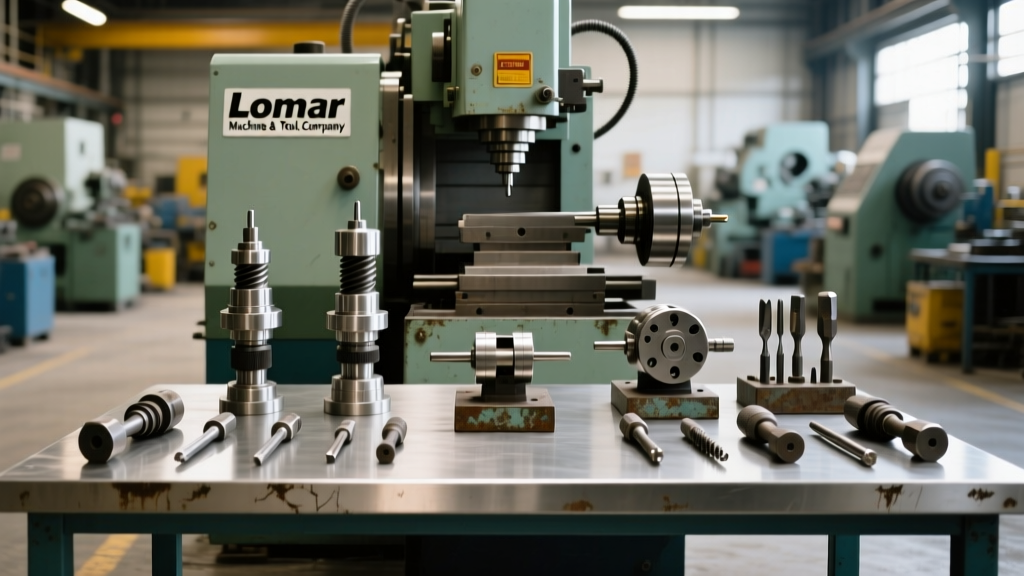
Lomar Machine & Tool Company: Used Tool Inspection & Cost Checklist
Master used CNC budget planning with this rigorous inspection checklist. Learn how to forecast hidden repair costs and negotiate like the pros.
Purchasing a used vertical machining center (VMC) or CNC lathe can yield capital savings of 40% to 60% compared to new equipment. However, a flawed inspection process routinely turns a $45,000 bargain into a $90,000 liability. When evaluating procurement standards, industry benchmarks often point to the rigorous quality control protocols utilized by precision manufacturers like Lomar Machine & Tool Company. Their approach to tooling and machine integrity highlights a critical reality: the physical inspection must be directly tied to a financial risk matrix.
For shop owners and procurement managers, inspecting used machine tools is not merely about verifying that the spindle turns; it is an exercise in cost forecasting. This guide provides a comprehensive, budget-focused inspection checklist to help you identify hidden defects, estimate 2026 repair costs, and negotiate purchase prices with empirical data.
The 30% Contingency Rule
Never finalize a used CNC budget based solely on the asking price. Financial best practices dictate allocating an additional 25% to 30% of the purchase price for immediate refurbishment, rigging, calibration, and tooling integration. If a used Mazak VCN-530C is listed at $60,000, your working capital requirement is $78,000.
Pre-Inspection Financial Vetting & Documentation
Before touching a dial indicator, audit the machine's paperwork. Missing documentation is a leading indicator of deferred maintenance and directly impacts your post-purchase budget.
- Parameter & Macro Backups: Request the most recent CNC parameter backup file. For Fanuc and Mitsubishi controls, losing parameters due to a dead SRAM battery can result in $1,500 to $3,000 in OEM support fees and days of lost production to restore machine geometry and spindle orientations.
- Spindle Hours vs. Power-On Hours: A machine with 40,000 power-on hours but only 8,000 spindle-cutting hours is vastly preferable to the inverse. High spindle hours on a grease-packed cartridge (common in 12,000+ RPM spindles) mean a $4,500 rebuild is imminent.
- Maintenance Logs: Look for records of way lube filter changes and coolant system flushes. Neglected way lubrication leads to catastrophic stick-slip conditions and premature ball screw failure.
Mechanical Geometry & Spindle Health Checklist
The mechanical core of the machine dictates its ability to hold tolerances. Use a calibrated test bar and a 0.0001-inch resolution dial indicator to measure spindle runout. According to Renishaw machine tool performance standards, geometric errors compound rapidly during multi-axis interpolation.
Spindle Drawbar Retention Force
A weak drawbar causes tool pullout and poor surface finishes. Use a spindle force gauge to measure retention. For a standard CAT40 taper, new Belleville washers should generate 2,000 to 2,500 lbs of pull force. If the reading drops below 1,500 lbs, budget $800 for a washer replacement kit and the labor to swap them.
Axis Backlash & Ball Screw Wear
Perform a reversal error test on the X, Y, and Z axes. Command the machine to move 1.000 inch in one direction, mount a dial indicator, and command a 0.001 inch reversal. If the indicator does not move immediately, you have backlash. While CNC controls can compensate for minor backlash (up to 0.0003 inches), anything exceeding 0.0005 inches indicates severe ball screw or thrust bearing wear.
| Component | Inspection Method | Failure Threshold | Est. 2026 Repair Cost |
|---|---|---|---|
| Spindle Cartridge | Runout test at 300mm | > 0.0003 in. | $4,500 - $8,500 |
| Ball Screw Assembly | Reversal error / Backlash | > 0.0005 in. | $3,500 - $6,000 / axis |
| Way Covers (Bellows) | Visual / Manual compression | Tears / seized hinges | $900 - $1,800 / cover |
| ATC Carousel Arm | Tool swap timing & alignment | Misalignment / dropped tools | $1,200 - $2,500 |
CNC Control & Electrical Infrastructure
Electrical failures are notoriously difficult to diagnose during a brief on-site visit, yet they carry some of the highest replacement costs. Reference FANUC America CNC product and service documentation for specific drive and control architecture details when inspecting used assets.
Servo Drive & Amplifier Health
Open the main electrical cabinet. Look for oil contamination, excessive dust buildup, and signs of overheating (discolored wires or melted insulation). Check the cooling fans on the servo amplifiers. A failed Fanuc Alpha series servo amplifier will cost between $2,500 and $4,500 to replace, not including the downtime required to source the unit.
Heat Exchanger vs. Cabinet AC
Machines equipped with simple heat exchangers (fan-to-ambient cooling) are highly susceptible to internal condensation and electrical shorts if operated in humid environments. Machines retrofitted or factory-equipped with closed-loop cabinet air conditioners (e.g., Rittal or McLean) preserve the lifespan of the CNC motherboard and drives. Budget $1,500 to install a cabinet AC unit if one is missing and your shop lacks strict climate control.
Lubrication Systems & Chip Management
The way lubrication system is the lifeblood of the machine's geometry. Most used VMCs utilize a Bijur or Meto volumetric resistive lubricator.
- Check the Reservoir Fluid: The oil should be clear. A milky appearance indicates coolant infiltration, which destroys way coatings (like Turcite) and causes rust.
- Verify Distributor Function: Cycle the lube pump manually. Inspect the metering units (distributors) on each axis. If the Z-axis distributor pin does not pop out and retract, the line is clogged or the metering unit has failed, meaning the Z-axis has been running dry.
- Chip Conveyor Augers: Inspect the chip conveyor hinge belt or auger system. Replacing a seized hinge-belt conveyor can exceed $3,500. Ensure the torque limiter clutch is functional and not bypassed by previous owners.
Tooling Interface Compatibility Budgeting
According to Sandvik Coromant machining fundamentals, the toolholder-to-spindle interface is critical for rigidity. Inspect the internal spindle taper using a bright light and a pristine master gage. Look for 'fretting corrosion' (a rust-like dust) or galling. If the previous owner ran the machine with unbalanced toolholders at high RPMs, the taper may be bell-mouthed. A spindle taper grind requires a specialized in-situ service call, typically costing $2,800 to $4,000.
Turning Inspection Data into Negotiation Leverage
The ultimate goal of this checklist is not just to walk away from a bad machine, but to accurately price a flawed one. When you find discrepancies, document them with time-stamped photos and dial indicator videos. Present this data to the seller or broker as a formalized 'Remediation Deduction Schedule'.
For example, if a used Okuma Genos M460-VE is listed at $85,000, but your inspection reveals 0.0008 inches of X-axis backlash ($4,500 repair), a failing ATC arm ($1,800 repair), and missing parameter backups ($1,500 risk), you have empirical justification to submit a revised offer of $77,200. By treating the used machine tool market as a data-driven financial exercise rather than a mechanical gamble, you protect your shop's capital expenditure budget and ensure the equipment generates ROI from day one.