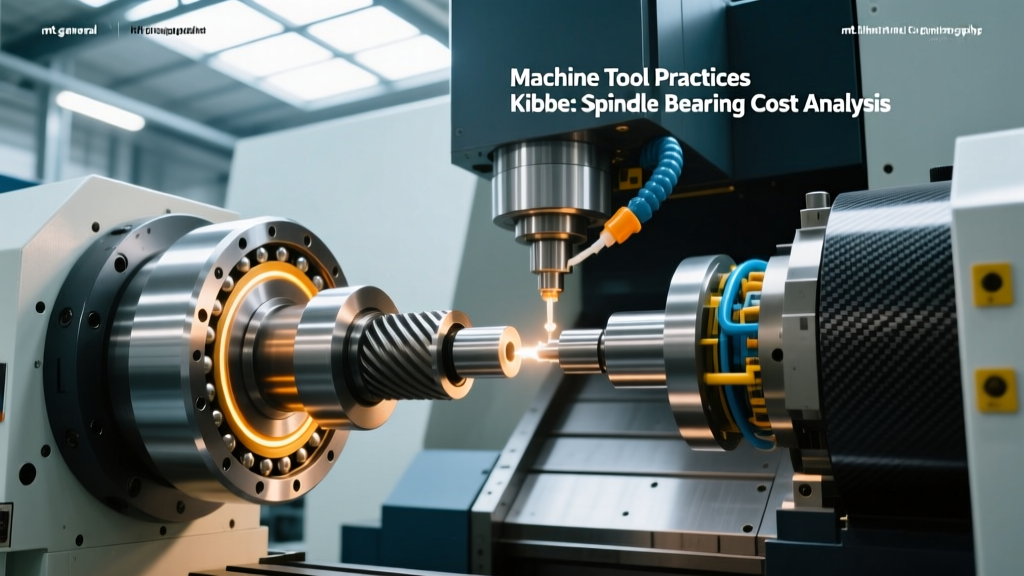
Machine Tool Practices Kibbe: Spindle Bearing Cost Analysis
Analyze spindle bearing costs and TCO using Machine Tool Practices Kibbe principles. Compare electro, direct-drive, and belt-driven spindle budgets.
The Financial Reality of Spindle Configurations
When applying the foundational principles found in Machine Tool Practices (Kibbe et al.) to modern 2026 CNC budgeting, shop managers quickly realize that spindle selection is not merely a mechanical decision—it is a long-term financial commitment. Kibbe’s textbook emphasizes the critical relationship between spindle rigidity, bearing preload, and thermal stability. Today, these exact mechanical variables dictate the Total Cost of Ownership (TCO) for machine tools.
A spindle failure in a high-mix production environment does not just cost the price of a replacement unit. With average machine burden rates ranging from $150 to $350 per hour, and OEM spindle lead times frequently stretching 8 to 14 weeks, the secondary costs of downtime dwarf the initial capital expenditure. Understanding the cost implications of different spindle drives and bearing configurations is essential for accurate budget planning.
⚠️ The Hidden Cost of Improper Preload: Kibbe’s principles warn against arbitrary bearing preload adjustments. Over-preloading angular contact bearings to increase rigidity generates excessive friction heat. In 2026, replacing a set of overheated, preloaded ABEC-7 (P4 class) bearings on a standard VMC costs roughly $2,400 in parts and 12 hours of specialized labor, easily resulting in a $6,000+ unbudgeted expense.Spindle Drive Types: CapEx vs. OpEx Breakdown
The drive mechanism transferring power to the spindle nose fundamentally alters both the upfront machine cost and the long-term maintenance budget. Below is a comparative analysis of the three dominant spindle drive configurations used in modern machining centers.
| Drive Type | Initial CapEx Premium | Rebuild / Replacement Cost | Expected Lifecycle | Primary Cost Driver |
|---|---|---|---|---|
| Belt-Driven | Baseline ($0) | $3,500 – $6,500 | 8,000 – 12,000 hrs | Belt wear, vibration-induced bearing fatigue |
| Direct-Drive | +$12,000 – $18,000 | $8,000 – $14,000 | 15,000 – 20,000 hrs | Coupling failure, motor cooling system maintenance |
| Electro-Spindle (Motorized) | +$25,000 – $45,000 | $18,000 – $35,000 | 10,000 – 15,000 hrs | Stator burnout, complex rotary union failures |
While belt-driven spindles offer the lowest barrier to entry and the cheapest rebuild costs, they suffer from torsional vibration at high RPMs, which accelerates bearing degradation. Electro-spindles eliminate transmission losses and provide superior surface finishes, but their integrated motor rotors make them highly susceptible to thermal damage if the chiller unit fails, turning a minor maintenance oversight into a $30,000 replacement event.
Bearing Configurations and Lifecycle Costing
The heart of any spindle is its bearing configuration. Following the alignment and load-distribution theories outlined in Kibbe’s texts, modern shops must choose between standard steel rolling elements and advanced ceramics. According to SKF’s technical data on angular contact ball bearings, the shift toward hybrid configurations has fundamentally altered spindle economics.
Standard Steel Angular Contact (ABEC-7 / P4)
Standard high-precision steel bearings remain the workhorse for heavy-duty, lower-RPM applications (e.g., 8,000 RPM max on 40-taper spindles). A matched set of three P4-class bearings for a standard VMC spindle costs between $1,200 and $2,200. However, steel balls generate significant centrifugal force at high speeds, increasing the contact angle stress on the outer race and limiting grease life to roughly 8,000 hours before repacking or replacement is required.
Hybrid Ceramic Bearings (Silicon Nitride Balls)
Hybrid bearings utilize silicon nitride (Si3N4) balls with steel races. Si3N4 is 40% lighter than bearing steel, drastically reducing centrifugal loading at high RPMs.
- Cost Premium: Expect to pay 2.5x to 3x the cost of steel equivalents ($3,500 – $5,500 per matched set).
- Financial Payoff: The reduced friction allows hybrid bearings to run 10°C to 15°C cooler. This thermal stability extends grease life by up to 50%, pushing maintenance intervals past 15,000 hours. For a shop running three shifts, the $3,000 upfront premium is recovered within 14 months through deferred rebuild costs and reduced thermal growth compensation errors.
Hydrostatic Bearings
Found almost exclusively in high-end jig grinders and precision turning centers, hydrostatic spindles use a pressurized film of oil to separate the rotating and stationary elements. There is zero metal-to-metal contact. The initial CapEx is massive ($45,000+ for the spindle and dedicated hydraulic filtration unit), but the mechanical lifespan is theoretically infinite. Budgeting for hydrostatic systems requires shifting focus entirely from mechanical rebuilds to fluid maintenance—specifically, replacing $800 filter elements every 2,000 hours and monitoring oil viscosity.
"Rigidity in a machine tool spindle is not achieved by brute force, but by the precise balancing of preload against thermal expansion. Exceeding the thermal equilibrium of the bearing race guarantees premature failure." — Adapted from core principles in Machine Tool Practices.
Applying Kibbe’s Maintenance Principles to Extend Bearing Life
Theoretical knowledge of bearing loads must be translated into strict shop-floor protocols. The most common cause of premature spindle failure is not normal wear, but improper run-in procedures and contamination. Implementing a strict thermal stabilization protocol protects your capital investment.
Step-by-Step Spindle Run-In Protocol
Whenever a spindle is rebuilt or a machine has sat idle for more than 72 hours, the grease inside the bearings settles, leaving the rolling elements partially starved. Running the spindle at high RPM immediately will cause metal-to-metal scoring. Execute this run-in sequence to ensure proper grease distribution and thermal expansion matching:
- Phase 1 (Lubrication Distribution): Run at 10% of maximum RPM for 30 minutes. Monitor the spindle housing temperature with an infrared pyrometer.
- Phase 2 (Thermal Acclimation): Increase to 25% of max RPM for 30 minutes. The temperature rise should not exceed 2°C per 10-minute interval.
- Phase 3 (Preload Stabilization): Step up to 50% of max RPM for 45 minutes. This allows the inner race to expand and settle into its designed interference fit.
- Phase 4 (Operational Speed): Run at 80% of max RPM for 20 minutes, then cycle to 100% for 10 minutes. If the housing temperature stabilizes below 45°C (113°F), the spindle is cleared for heavy cutting.
Decision Framework: Selecting the Right Spindle for Your Budget
Use the following matrix to align your spindle specification with your actual production requirements, avoiding the trap of over-specifying and inflating your maintenance budget.
- If your shop runs heavy roughing in steel/titanium (High Torque, Low RPM): Stick to a Belt-Driven Spindle with Standard Steel P4 Bearings. The high mass of the steel balls absorbs shock loads better than ceramics, and the belt acts as a mechanical fuse, protecting the motor and bearings from catastrophic crash shocks. Rebuilds are cheap and fast.
- If your shop runs high-speed aluminum aerospace structural parts (High RPM, Low Torque): Invest in an Electro-Spindle with Hybrid Ceramic Bearings. The lack of belt slip ensures precise cornering, and the ceramic bearings will survive the 24,000 RPM centrifugal forces without overheating. Budget for a dedicated chiller maintenance contract.
- If your shop performs micro-machining or jig grinding (Extreme Precision, Low Load): Specify Hydrostatic Bearings. The upfront cost is severe, but the elimination of thermal growth and the infinite mechanical life eliminate the need for annual calibration and rebuilds, stabilizing long-term OpEx.
By grounding your purchasing and maintenance decisions in the mechanical realities outlined by Kibbe’s foundational texts, you transition spindle management from a reactive, high-cost burden into a predictable, optimized line item in your annual manufacturing budget.