Ingersoll Machine Tools Workholding: Aerospace Case Studies
Explore how aerospace manufacturers use advanced hydraulic fixtures and modular tombstones to maximize Ingersoll machine tools productivity and reduce chatter.
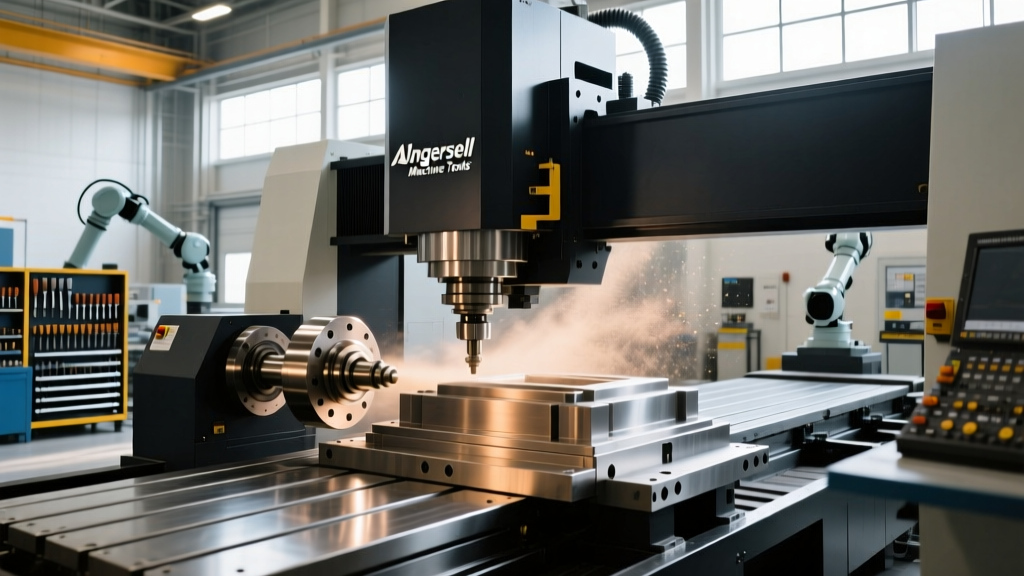
When machining massive aerospace structures, standard machine shop workholding is entirely inadequate. Ingersoll machine tools—renowned for their heavy-duty gantry mills, horizontal boring mills, and automated fiber placement systems—operate in a realm where workpieces routinely exceed 3,000 pounds and cutting forces generate thousands of Newton-meters of torque. Attempting to secure a 20-foot titanium wing spar or a deep-pocketed aluminum bulkhead with conventional vises or standard 3-jaw chucks is not just inefficient; it is a recipe for catastrophic chatter, tool breakage, and scrapped forgings.
For shops operating Ingersoll MasterMill or PowerMill platforms, workholding strategy must evolve from simple clamping to engineered fixturing systems. This article examines two real-world aerospace case studies demonstrating how advanced hydraulic fixtures, modular tombstones, and vibration-dampening technologies are deployed to unlock the full material removal rates (MRR) of large-format Ingersoll CNC machines.
Data Highlight: The Scale of Ingersoll WorkholdingA typical Ingersoll Gantry Mill machining aerospace aluminum (7050-T7451) at 1,200 IPM requires fixturing capable of withstanding lateral cutting forces exceeding 4,500 lbs without microscopic deflection. Standard mechanical strap clamps yield at approximately 1,200 lbs of lateral force before slipping, necessitating a shift to high-pressure hydraulic point-support systems.
Case Study 1: Titanium Wing Spar Machining on an Ingersoll Gantry Mill
Machining long, slender titanium (Ti-6Al-4V) wing spars presents a severe deflection challenge. A Tier-1 aerospace supplier utilizing an Ingersoll 5-axis Gantry Mill with a 30-meter bed was experiencing severe harmonic chatter during roughing operations. The existing workholding relied on manual mechanical strap clamps and adjustable jack screws.
The Failure Mode of Mechanical Clamping
The primary issue was inconsistent clamping pressure. Manual torque wrenches applied to strap clamps resulted in a 15% variance in holding force across the 20-foot part. Furthermore, as the end mill removed material and relieved internal forging stresses, the spar would shift minutely against the jack screws, altering the part geometry and causing the final semi-finishing passes to miss tolerances by up to 0.004 inches.
The Solution: Hydraulic Point-Support Fixturing
The shop replaced the manual grid plate with a custom Hilma-Römheld hydraulic fixturing system operating at 350 bar (5,000 PSI). The new fixture utilized a sequenced clamping protocol:
- Stage 1 (Support): Hydraulic support cylinders rise to meet the raw forging, locking in place with zero upward lifting force, effectively mirroring the part's natural resting state.
- Stage 2 (Clamping): Low-profile hydraulic swing clamps engage sequentially from the center outward, applying a uniform 2,200 lbs of clamping force per point.
| Metric | Manual Strap Clamps | 350-Bar Hydraulic Fixtures |
|---|---|---|
| Setup Time per Spar | 3.5 Hours | 45 Minutes |
| Roughing MRR (Cubic In/Min) | 18 in³/min | 34 in³/min |
| Scrap Rate (Dimensional Shift) | 6.2% | 0.4% |
| Tool Life (Carbide End Mills) | 45 Minutes | 85 Minutes |
By eliminating part movement and dampening the harmonic vibrations through the hydraulic fluid's inherent compressibility, the shop doubled its roughing feed rates and virtually eliminated dimensional scrap.
Case Study 2: High-Mix Bulkheads on Ingersoll Horizontal Boring Mills
While gantry mills handle long spars, Ingersoll PowerMill horizontal boring mills are the workhorses for deep-pocketed titanium and aluminum bulkheads. A defense contractor needed to machine a high mix of 14 different bulkhead configurations on a single Ingersoll HMC with a rotary pallet pool.
The Quick-Change Tombstone Strategy
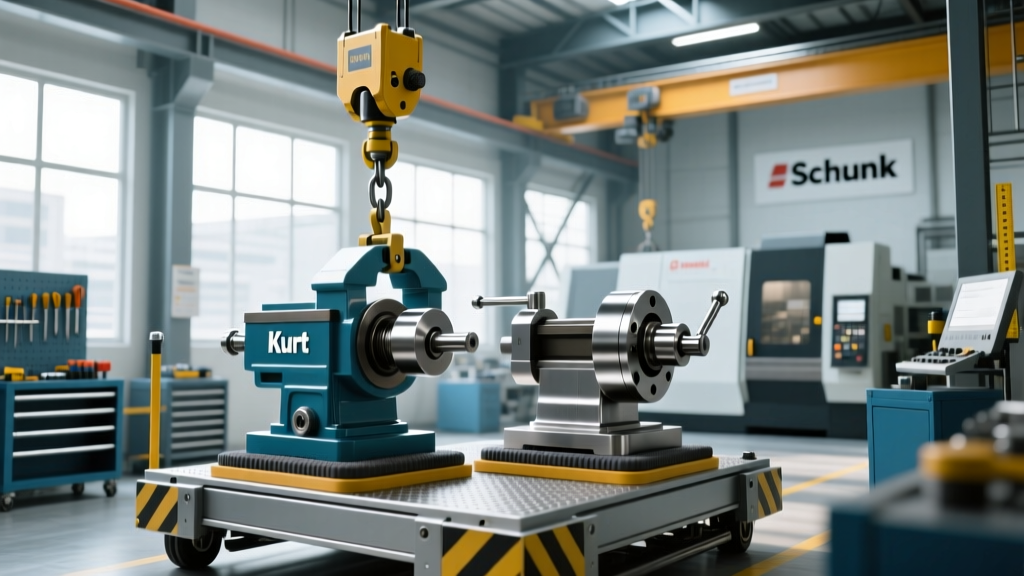
Dedicated fixtures for 14 different part numbers would require massive floor space and over $2 million in capital tooling. Instead, the manufacturer engineered a universal modular tombstone system using the Schunk clamping technology ecosystem combined with Jergens Ball Lock mounting plates.
- Base Tombstone: A massive, stress-relieved ductile iron tombstone (weighing 4,500 lbs) permanently mounted to the Ingersoll rotary pallet.
- Tooling Plates: Jergens Ball Lock sub-plates featuring a 50mm grid pattern. These sub-plates are swapped out in the machine enclosure using an overhead crane in under 12 minutes.
- Workholding Modules: Standardized hydraulic vise blocks and edge clamps that bolt into the 50mm grid, allowing rapid reconfiguration for different bulkhead geometries.
When deploying hydraulic tombstones on Ingersoll rotary B-axis tables, internal hydraulic line routing is critical. External hoses will snag on the machine column during rapid traverses. Always specify multi-passage hydraulic rotary unions (capable of 350 bar) integrated directly into the tombstone base, and use internal manifold blocks rather than external hose bundles to prevent catastrophic pressure loss during pallet rotation.
Technical Deep Dive: Dampening Harmonic Vibration in Heavy Fixtures
One of the most overlooked aspects of workholding on massive Ingersoll machine tools is fixture resonance. When a 500mm face mill engages a titanium forging, it generates low-frequency, high-amplitude vibrations (typically between 150Hz and 400Hz). If the natural frequency of the fixture aligns with the cutting frequency, destructive chatter occurs.
To combat this, advanced fixture builders are now integrating Tuned Mass Dampers (TMDs) directly into the base of heavy-duty milling fixtures. A TMD consists of a secondary mass suspended by elastomeric springs inside a cavity within the fixture body. When the primary fixture begins to vibrate, the TMD oscillates out of phase, absorbing the kinetic energy and neutralizing the chatter.
In a recent application machining Inconel 718 engine mounts on an Ingersoll MasterMill, integrating a 40-lb TMD into the fixture base allowed the machinist to increase the axial depth of cut (DOC) from 0.150 inches to 0.450 inches without triggering chatter, reducing cycle time by 28%.
Cost-Benefit Analysis: Upgrading Workholding for Heavy Gantry Mills
Transitioning from mechanical clamping to engineered hydraulic fixturing requires significant capital. Below is a realistic ROI breakdown for a mid-sized aerospace machine shop upgrading workholding for a single Ingersoll Gantry Mill operating two shifts.
Investment Costs
- Custom Hydraulic Grid Plate & Manifold: $85,000
- 350-Bar Hydraulic Power Unit (HPU) & Chillers: $32,000
- Hilma-Römheld Cylinders & Swing Clamps (40 units): $28,000
- Total Capital Investment: $145,000
Annual Financial Gains
- Spindle Uptime Increase: Reducing setup time from 3 hours to 45 minutes per part yields 350 additional spindle hours annually. At a fully burdened shop rate of $250/hour, this equals $87,500.
- Scrap Reduction: Eliminating deflection-induced scrap on $15,000 titanium forgings saves an average of $65,000 annually.
- Tooling Savings: Reduced chatter extends carbide tool life by 40%, saving $18,000 annually.
Total Annual Gain: $170,500. The ROI payback period is approximately 10.2 months, making the upgrade financially mandatory for high-volume aerospace contractors.
Sourcing and Specifying Heavy-Duty Fixtures for Ingersoll Envelopes
When requesting quotes from fixture builders for Ingersoll machine tools, vague specifications lead to tool collisions and sub-optimal clamping. Your RFQ must explicitly define the following parameters:
- 5-Axis Collision Envelopes: Provide the exact 3D STEP file of the Ingersoll machine's spindle head, tool changer, and maximum tool length. The fixture builder must run clearance simulations to ensure the hydraulic manifolds do not interfere with the B-axis and C-axis head rotations.
- Chip Shedding Geometry: Flat fixture surfaces trap titanium chips, which can weld to the fixture under high pressure. Specify that all horizontal clamping surfaces be machined with a minimum 15-degree draft angle and feature high-pressure coolant wash-down ports (minimum 70 bar) to clear chips automatically.
- Hydraulic Pressure Ratings: Standard shop air-over-oil intensifiers max out at 150 bar. Specify that all fixture components, hoses, and O-rings be rated for continuous 350 bar (5,000 PSI) operation to ensure clamping force does not degrade during heavy roughing passes.
Expert Takeaways for Machine Shop Managers
Maximizing the ROI of an Ingersoll machine tool requires treating workholding as an engineered system rather than an afterthought. Mechanical clamps and standard vises cannot manage the extreme cutting forces and massive part geometries inherent to aerospace manufacturing. By investing in high-pressure hydraulic point-supports, modular quick-change tombstones, and vibration-dampening technologies, shops can drastically reduce setup times, eliminate chatter, and protect the immense capital investment represented by their heavy-duty CNC gantry and boring mills.