Hummel Machine & Tool Co Guide: Flood vs Mist Cooling Tech
Explore flood vs mist cooling tech with insights inspired by Hummel Machine & Tool Co. Compare MQL, high-pressure flood, and 2026 retrofit costs.
Thermal management remains the most critical variable in precision CNC machining. As shops push spindle speeds beyond 20,000 RPM and tackle exotic superalloys, the choice between traditional flood coolant and Minimum Quantity Lubrication (MQL) mist systems dictates not only tool life but also micron-level workpiece accuracy. Benchmarking against the stringent operational standards often associated with precision manufacturing leaders like Hummel Machine & Tool Co, modern machine shops are radically rethinking their coolant delivery architectures in 2026.
The 2026 Coolant Paradigm Shift: Legacy flood systems are no longer the default. Driven by EPA disposal regulations and the demand for Ra < 0.8 µm surface finishes, shops are bifurcating their approach: utilizing 1,000+ PSI high-pressure flood exclusively for deep-hole titanium/Inconel applications, while deploying ester-based MQL mist for 80% of standard aluminum and steel milling operations.The Physics of Thermal Management: Flood vs. MQL
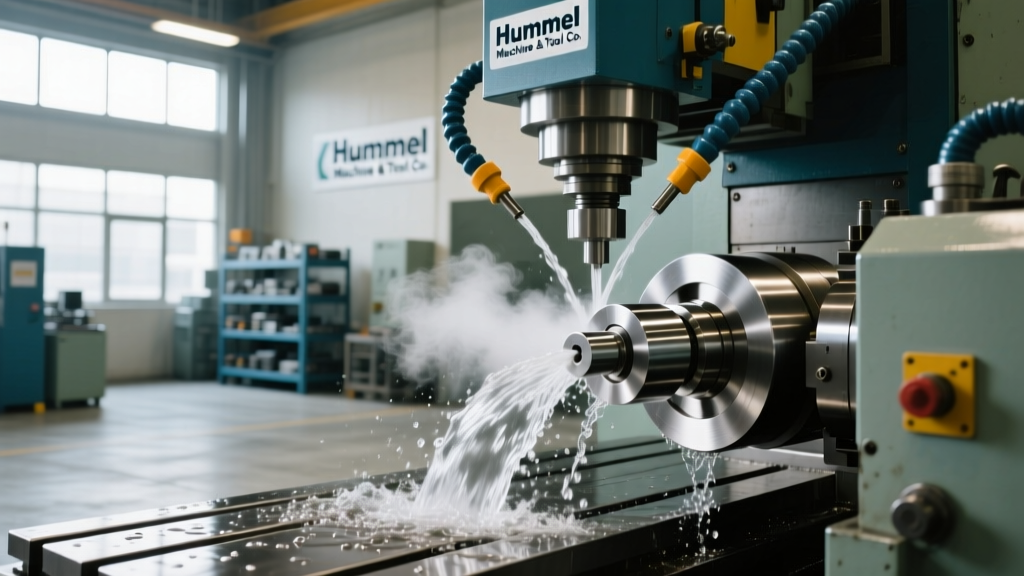
Traditional flood coolant relies on high-volume thermal mass absorption. A standard CNC mill pumps 5 to 15 gallons per minute (GPM) at 20–60 PSI, drowning the cutting zone to carry away heat and flush chips. While effective for bulk heat removal, flood coolant struggles to penetrate the vapor barrier created at high spindle speeds (the 'air shield' effect), often resulting in localized thermal shock that accelerates carbide micro-chipping.
Conversely, MQL (mist cooling) abandons bulk cooling in favor of targeted boundary lubrication. By atomizing 10 to 50 mL/hour of biodegradable ester-based fluid (typically 30–40 cSt viscosity at 40°C) into a 4–6 bar compressed air stream, MQL delivers micro-droplets directly through the tool's flutes. This eliminates the vapor barrier, reducing cutting zone friction and allowing the chips to carry away 85% of the generated heat.
2026 Delivery System Comparison Matrix
| Metric | Standard Flood | High-Pressure Flood (ChipBLASTER) | MQL / Mist (UNIST / Accu-Lube) |
|---|---|---|---|
| Flow Rate | 5–15 GPM | 3–8 GPM | 10–50 mL/hour |
| Delivery Pressure | 20–60 PSI | 700–1,500 PSI | 60–90 PSI (Air Line) |
| Primary Mechanism | Bulk Thermal Absorption | Chip Shearing & Evacuation | Boundary Lubrication |
| Ideal Material | Cast Iron, Low-Carbon Steel | Titanium, Inconel, Deep Hole | Aluminum, Stainless, Composites |
| Fluid Cost (Approx) | $15–$25 / gallon (concentrate) | $20–$30 / gallon (synthetic) | $40–$60 / gallon (ester) |
The Hummel Machine & Tool Co Operational Framework
Precision manufacturers, operating on principles aligned with Hummel Machine & Tool Co's commitment to tight-tolerance machining, evaluate coolant systems based on thermal stability rather than just lubricity. When machining aerospace-grade 7075-T6 aluminum or 316L stainless steel, thermal expansion of the workpiece can easily exceed the ±0.0002-inch tolerance window.
In these scenarios, MQL provides a distinct advantage. Because MQL does not flood the workpiece, the part remains at a stable, predictable ambient temperature rather than cycling through rapid heating and quenching. This thermal predictability is critical for finishing passes where spindle loads are low but surface finish requirements are extreme. Furthermore, MQL leaves parts virtually dry, eliminating the need for secondary aqueous wash stations and reducing post-machining handling time by up to 30%.
Edge Cases and Failure Modes: When Mist Fails
Despite its advantages, MQL is not a universal panacea. Shops attempting to run MQL on heavy interrupted cuts or deep cavity milling frequently encounter two specific failure modes:
- Chip Welding in Deep Pockets: Without the high-velocity fluid stream of a flood system to evacuate chips from deep cavities, recutting occurs. This leads to built-up edge (BUE) on the carbide insert and catastrophic tool failure.
- Thermal Cracking in Superalloys: Materials like Ti-6Al-4V possess poor thermal conductivity. If MQL is used without sufficient through-spindle air pressure to penetrate the cut, the heat concentrates at the tool tip, causing plastic deformation of the carbide substrate within minutes.
Environmental Compliance and Operator Safety
The shift toward mist cooling is heavily influenced by tightening environmental and occupational health regulations. Traditional flood systems, particularly when tramp oil infiltrates the sump, become breeding grounds for anaerobic bacteria, generating endotoxins and volatile organic compounds (VOCs).
MQL systems utilize plant-based, biodegradable ester fluids that do not require biocides or pH stabilizers. However, aerosolizing any oil introduces respiratory risks. Shops must adhere strictly to OSHA guidelines on metalworking fluid exposure, ensuring that the mist is captured at the source. Modern 2026 MQL setups integrate closed-loop aerosol extraction hoods directly over the cutting zone, maintaining ambient oil mist concentrations well below the NIOSH recommended exposure limit (REL) of 0.4 mg/m³ for thoracic particulate mass.
"The biggest mistake shops make when retrofitting to MQL is relying on external nozzles for complex 5-axis geometries. To maintain the thermal stability required for aerospace tolerances, you must invest in dual-channel through-spindle lubrication (TSL) systems that allow independent control of air and fluid volume directly at the cutting edge."
Step-by-Step Guide: Retrofitting a VMC for MQL
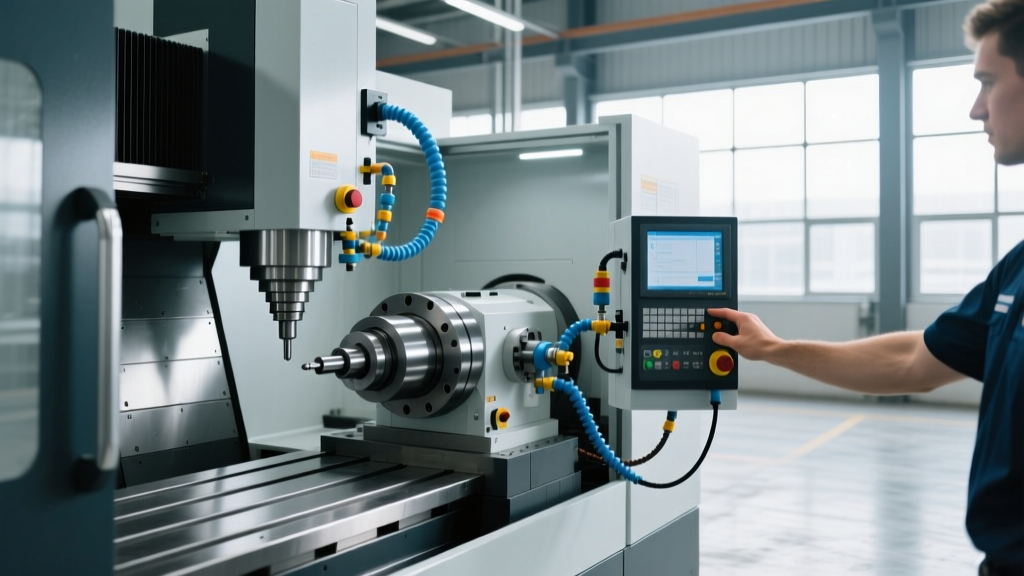
Upgrading a standard Vertical Machining Center (VMC) from flood to MQL requires precise calibration. Follow this framework to ensure optimal boundary lubrication without sacrificing chip evacuation:
- Install a Positive Displacement Micro-Pump: Replace gravity-fed drip systems with a pressurized micro-pump (e.g., SKF or UNIST) capable of delivering exact 0.01 mL pulses. Mount the reservoir outside the machine enclosure to maintain a stable 68°F (20°C) fluid temperature, which is critical for maintaining consistent viscosity.
- Upgrade the Air Delivery Network: MQL requires clean, dry air. Install a coalescing filter and desiccant dryer on the main air line to achieve a dew point of -40°F. Moisture in the air line will emulsify the ester fluid, destroying its lubricity and causing nozzle clogging.
- Configure Dual-Channel Nozzles: For external spray, use siphon-spray nozzles with independent air and fluid adjustments. Position the nozzle exactly 1.5 to 2.0 inches from the cutting edge, angled at 45 degrees to the tool flank, ensuring the aerosol stream intersects the chip-tool interface.
- Recalibrate CNC Feeds and Speeds: MQL requires different cutting parameters than flood. Increase surface feet per minute (SFM) by 15–20% to leverage the reduced friction, but decrease the feed per tooth (FPT) slightly to prevent overloading the thin lubrication film during heavy radial engagement.
- Integrate Vacuum Chip Evacuation: Because you lack a high-volume fluid stream to wash chips away, install a high-static-pressure vacuum system with automated blow-off cycles programmed into the CNC code at the end of every toolpath to clear the work zone.
Ultimately, the decision between flood and mist cooling is not binary. The most competitive shops in 2026 utilize a hybrid approach, reserving high-pressure flood for aggressive roughing and exotic alloys, while deploying advanced MQL systems for high-speed finishing and near-dry production environments. By applying the rigorous precision standards championed by industry benchmarks like Hummel Machine & Tool Co, manufacturers can optimize their thermal management strategies to maximize both tool life and part accuracy.