Fixing Monitoring and Control Machine Tool Systems on Liquidated CNCs
Learn how to troubleshoot and repair monitoring and control machine tool systems on auctioned CNCs, including Fanuc and Siemens controller diagnostics.
Acquiring liquidated CNC equipment through industrial auctions often means inheriting machines that have sat dormant, unpowered, and unclimate-controlled for 18 to 36 months. While buyers typically focus on mechanical wear like ballscrew backlash or spindle runout, the most catastrophic and expensive failures occur within the electrical cabinet. Specifically, the monitoring and control machine tool systems suffer severe degradation when left without power. Capacitors dry out, CMOS batteries leak and destroy motherboard traces, and proprietary IoT telemetry modules lock out the PLC due to expired cloud handshakes.
⚠️ CRITICAL SAFETY WARNING: Never apply 480V main power to a liquidated CNC control cabinet without first performing a 48-hour desiccant treatment to remove ambient moisture, followed by megger testing the spindle motor windings and axis servo motors. Applying power to moisture-compromised servo drives will instantly short the IGBT transistors, turning a $1,200 repair into a $14,000 replacement.Diagnosing Dead Fanuc and Siemens Control Architectures
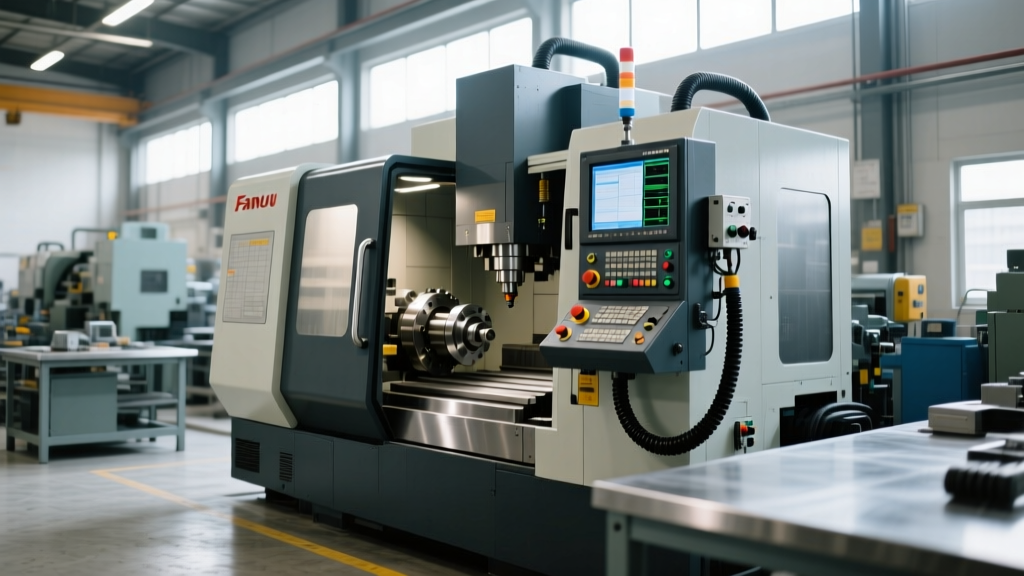
When you first power up an auctioned machining center, a blank screen or immediate servo alarm is the most common failure mode. The approach to troubleshooting depends heavily on the control architecture. For Fanuc systems (commonly the 0i-F or 31i-B series found on liquidated Haas and Doosan machines), the primary culprit is usually the 24V DC power supply unit (PSU) or absolute encoder battery loss. For Siemens Sinumerik 840D sl systems, the issue often lies in corrupted CompactFlash (CF) cards or dead NCU (Numerical Control Unit) batteries.
According to Fanuc America Repair Services, attempting to hot-swap a dead lithium battery while the control is powered down will result in the immediate loss of absolute position data, triggering a Fanuc Alarm 300 (Absolute Position Detector Pulse Error). You must always apply external 24V DC to the encoder battery circuit before removing the old Panasonic BR2/3AGCT4A battery pack.
| Symptom on Power-Up | Probable Cause | Diagnostic Step | Est. Repair Cost |
|---|---|---|---|
| Fanuc Alarm 401 (Servo Amp OFF) | Blown 24V control fuse or failed PSU | Check DC voltage at CXA2A/CXA2B pins | $450 - $1,200 |
| Siemens OP Black Screen | Corrupted CF card or dead CMOS battery | Reseat CF card; check NCU LED status | $150 - $800 |
| Spindle Drive Overcurrent Alarm | Dried DC bus capacitors in the spindle amp | Measure capacitance with ESR meter | $800 (Rebuild) / $6,500 (New) |
Restoring Spindle Vibration and Thermal Monitoring Sensors
Modern CNCs rely heavily on condition-monitoring hardware to prevent catastrophic crashes. When evaluating the monitoring and control machine tool sensor arrays on a liquidated asset, you will frequently find severed cables, corroded M12 connectors, and drifted calibration. The two most critical sensors to verify are the spindle vibration accelerometers and the thermal RTDs (Resistance Temperature Detectors).
Testing IEPE Vibration Accelerometers
Most high-end liquidated machines (like DMG MORI or Makino) utilize IEPE (Integrated Electronics Piezo-Electric) accelerometers, such as those manufactured by PCB Piezotronics or Kistler, mounted directly to the spindle housing. These sensors require a constant 24V DC current source to operate. To troubleshoot a dead vibration monitoring channel:
- Step 1: Disconnect the sensor at the cabinet I/O block.
- Step 2: Set your multimeter to DC Voltage and measure across the signal and ground pins. You should read exactly 24V DC (provided by the machine's signal conditioner). If you read 0V, the internal conditioner relay has failed.
- Step 3: If 24V is present, reconnect the sensor and measure the bias voltage. A healthy IEPE sensor will drop the bias voltage to between 8V and 12V DC. If the bias remains at 24V, the sensor cable is open (broken internally). If it drops to 0V, the sensor is shorted and must be replaced ($350–$600 per unit).
Verifying PT100 Thermal Sensors
Spindle thermal growth monitoring relies on PT100 RTDs embedded in the spindle casting. Over years of thermal cycling and coolant exposure, the internal platinum wire can fracture. Set your multimeter to the Ohms (Ω) setting. At a standard shop temperature of 25°C (77°F), a healthy PT100 sensor should read approximately 109.7 Ω. A reading of infinite resistance (OL) confirms a broken internal wire, requiring the sensor to be carefully extracted and replaced with an identical Class A PT100 probe.
Bypassing Proprietary IoT Telemetry Lockouts
A growing nightmare in the used machine tool market is the "IoT Lockout." Many machines built after 2018 feature proprietary edge-computing gateways (e.g., Mazak iSMART or Haas NetShare modules) designed to feed telemetry to the original owner's cloud dashboard. When a company goes bankrupt and the machine is liquidated, these gateways lose their cloud handshake. Failing to receive a return ping from the server, the gateway's PLC logic intentionally drops the "Cycle Start" enable relay, effectively bricking the machine.
According to documentation available via Siemens Industry Online Support, third-party hardware interlocks can often be traced through the PLC I/O mapping. To bypass this:
- Open the electrical schematic and locate the M-code or PLC output responsible for the "Machine Ready" or "Cycle Enable" handshake.
- Identify the physical Ethernet tap or CANbus gateway (frequently a Moxa industrial switch or a proprietary edge device mounted in the cabinet roof).
- Physically disconnect the gateway from the main PLC I/O loop.
- Install a hardwired 24V jumper across the enable relay terminals to simulate a permanent "handshake received" signal. This strips the machine of its remote telemetry but restores full operational capability on the shop floor.
"The most overlooked cost in auctioned CNCs isn't the mechanical repair; it's the software and parameter recovery. Always negotiate the purchase of the original parameter backup tape or USB drive. Without the machine-specific servo tuning parameters and ball screw pitch error compensation maps, a mechanically perfect machine will still cut oversized parts and chatter during heavy roughing passes."
Decision Framework: Repair vs. Full Retrofit
Sometimes, the monitoring and control machine tool hardware is beyond salvage. If the control cabinet suffered water damage during the liquidation process, or if the main CPU board features severe battery acid corrosion, chasing OEM replacement parts becomes financially unviable. A new Fanuc 31i-B control package can easily exceed $35,000, completely destroying the ROI of an auctioned machine.
In these scenarios, a full aftermarket CNC retrofit is the optimal strategy. Systems like the Centroid Acorn or LinuxCNC-based industrial packages allow you to retain the machine's massive cast-iron structure, high-torque servo motors, and heavy-duty spindle, while replacing the brain. A professional 3-axis or 4-axis retrofit typically costs between $8,500 and $14,000, including new servo drives, a touchscreen pendant, and fresh absolute encoders. This not only resurrectes the machine but upgrades it with modern Ethernet file transfer and conversational programming, often making it more capable than it was on the day it was originally manufactured.