Machine Tool Technology Salary Trends & Chip Conveyor ROI Analysis
Analyze how advanced chip conveyors and swarf management offset rising machine tool technology salary costs through maximized spindle uptime and coolant ROI.
The 2026 manufacturing landscape is defined by two colliding forces: the escalating machine tool technology salary required to retain skilled CNC mechatronics technicians, and the relentless demand for uninterrupted spindle uptime. As shops compete for talent, the median compensation for advanced machine tool technicians has pushed well past $75,000, with specialized automation techs commanding over $95,000 in high-cost manufacturing hubs. When you are paying a premium for a technician's expertise in 5-axis kinematics and macro programming, having them spend 45 minutes a day clearing chip jams from an undersized auger conveyor is a catastrophic misallocation of capital.
This analysis compares modern swarf management and chip conveyor alternatives, framing the capital expenditure (CapEx) of advanced systems directly against the labor burden and productivity losses associated with outdated chip evacuation methods.
The Hidden Labor Cost of Swarf Jams
A standard hinge-belt conveyor jam on a horizontal machining center (HMC) takes an average of 22 minutes to diagnose, lock out, clear, and reset. If this occurs just twice a week across a 10-machine cell, the shop loses 381 hours of productive labor annually. At a fully loaded machine tool technology salary rate of $45/hour, that equates to $17,145 in pure labor waste—not including the $120/hour overhead cost of the idled CNC machine.
Swarf Management Systems: Comparison Matrix
Selecting the right chip conveyor is not a one-size-fits-all decision. The material being cut dictates the chip morphology, which in turn determines the necessary conveyor mechanics. Below is a comparative analysis of the three dominant conveyor technologies utilized in modern CNC cells.
| Conveyor Type | Est. CapEx (per unit) | Ideal Chip Morphology | Failure Mode / Weakness | Required Tech Skill Level |
|---|---|---|---|---|
| Standard Hinge-Belt | $4,500 - $7,000 | Brittle, short chips (Cast iron, 6061 Aluminum) | Stringy chips wrap around sprockets, stalling the motor. | Low (Basic mechanical clearing) |
| Scraper / Slat (e.g., Mayfran ConSep) | $9,000 - $14,000 | Stringy, ductile chips (304/316 SS, Titanium) | High initial cost; requires precise coolant level maintenance. | Medium (Sensor calibration, VFD tuning) |
| Auger / Screw | $2,500 - $4,000 | Fine, powdery chips (Brass, Graphite, Cast Iron) | Long chips bridge the auger flights, causing catastrophic motor burnout. | Low (Motor replacement, flight clearing) |
Why Advanced Conveyors Justify Higher Technician Salaries
Modern machine shops are transitioning away from basic hinge-belt conveyors toward advanced scraper systems and integrated high-pressure filtration units. This shift directly impacts the machine tool technology salary landscape, as these systems require technicians with mechatronics and fluid dynamics knowledge rather than simple mechanical aptitude.
The Stringy Chip Problem: 304 Stainless vs. Hinge Belts
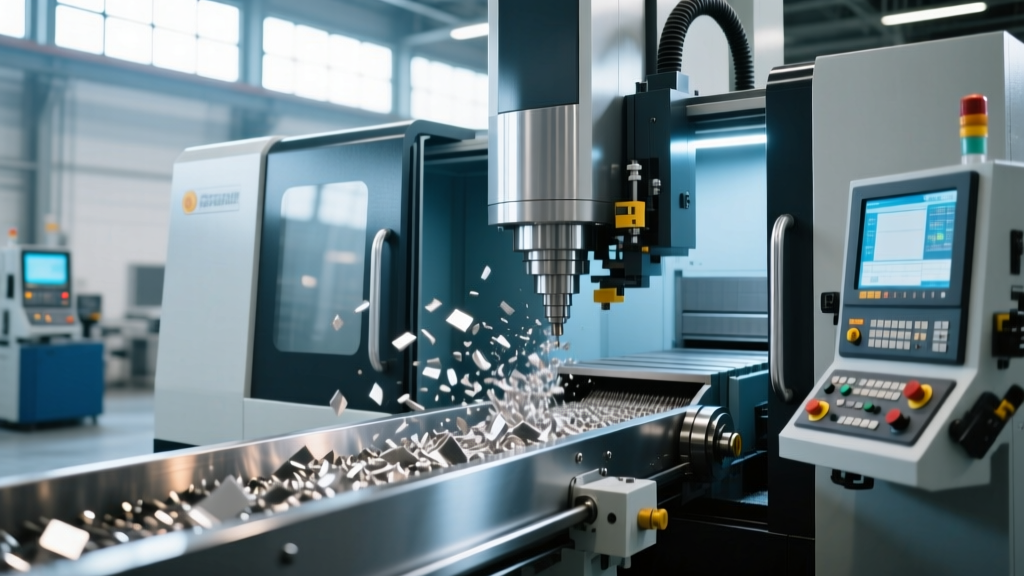
When roughing 304 stainless steel, the material work-hardens and produces long, stringy, bird-nest chips. A standard hinge-belt conveyor will pull these strings into the lower return pan, wrapping them around the tail shaft. Within 48 hours, the torque overload will trip the conveyor's breaker. By upgrading to a scraper-type conveyor (such as the LNS Turbo RF or Mayfran ConSep 2000), a cleated steel belt scrapes the bottom of the pan, physically pushing stringy chips up the incline without entanglement. The CapEx premium of roughly $6,000 is recovered in less than 8 months purely through reclaimed spindle time and reduced maintenance labor.
⚠️ Critical Warning: Motor Sizing and VFD IntegrationDo not accept OEM default conveyor motors for heavy roughing applications. A standard 1/2 HP conveyor motor on a 5-axis mill cutting Inconel 718 will fail under the sheer weight of dense, high-temperature chips. Specify a minimum 1.5 HP motor paired with a Variable Frequency Drive (VFD). The VFD allows the conveyor to sense torque spikes and automatically reverse the belt for 3 seconds to break up chip dams before tripping the overload relay. This single specification eliminates 80% of manual conveyor jams.
Alternative Swarf Solutions: Briquetters vs. Centrifuges
Chip evacuation is only half the battle; swarf processing and coolant recovery represent the second major ROI opportunity. Wet chips hauled away for recycling contain up to 15% trapped metalworking fluid. With synthetic coolant costs exceeding $45 per gallon in 2026, disposing of wet chips is literally pouring money into the scrap bin.
- Chip Briquetters (e.g., RUF, PRAB): These hydraulic presses compress loose swarf into dense, hockey-puck-sized briquettes, squeezing out up to 98% of the coolant. Best for: Aluminum and cast iron. The recovered coolant is filtered and returned to the machine sump. A single RUF briquetter processing 1,000 lbs of aluminum chips daily can recover over 12 gallons of coolant per shift, yielding an annual savings of $35,000+.
- Centrifugal Wringer Systems: These use high-speed rotational force to separate chips from coolant. Best for: Stringy steel and titanium chips that would jam a briquetter press. While centrifuges require more floor space and higher electrical draw (often 15+ HP), they handle the difficult, tangled swarf generated by heavy turning and 5-axis milling operations without requiring pre-crushing.
Managing these fluid recovery systems requires a higher tier of maintenance. Technicians must monitor hydraulic pressures, replace centrifugal liners, and balance fluid pH levels. According to the Occupational Safety and Health Administration (OSHA), proper management of metalworking fluids is also a critical health compliance issue, further elevating the need—and the corresponding machine tool technology salary—for skilled environmental and fluid systems technicians on the shop floor.
Strategic Decision Matrix: When to Upgrade Your Swarf System
Use the following framework to determine if your current chip management setup is actively eroding your profitability and wasting your technicians' time.
- Audit Spindle Interruptions: Pull the alarm logs from your CNC controllers for the last 90 days. Filter for 'Conveyor Overload', 'Chip Flush Fault', or 'Coolant Level Low'. If these alarms account for more than 3% of total scheduled runtime, an immediate conveyor upgrade is mathematically justified.
- Map Material to Conveyor: If your shop has transitioned from aluminum to aerospace alloys (titanium, Inconel) or ductile stainless steels, your existing hinge-belt conveyors are likely obsolete for the new chip morphology. Transition to scraper/slat conveyors immediately.
- Calculate Coolant Haul-Away Costs: Review your scrap vendor invoices. If you are paying to haul away wet chips, or if your coolant makeup rate exceeds 5 gallons per machine, per week, invest in a centralized briquetter or centrifuge system.
- Realign Labor Allocation: Track how many hours your highest-paid CNC programmers and setup technicians spend on chip removal. If a $90,000/year automation engineer is manually shoveling chips out of an HMC tombstone fixture, your swarf management infrastructure is bottlenecking your entire technological investment.
Ultimately, the rising machine tool technology salary is a reflection of the complex, highly automated nature of modern manufacturing. Protecting that labor investment requires viewing chip conveyors and swarf management not as auxiliary accessories, but as critical, data-driven production assets that guarantee continuous, unattended spindle operation.