CNC Retrofits to Build Custom Washing Machine Repairing Tools
Discover how a regional repair shop used CNC retrofit options on manual mills to manufacture high-precision custom washing machine repairing tools.
The Bottleneck in Appliance Maintenance: Tool Failure Under Load
Modern high-efficiency (HE) washing machines are engineered for water conservation and vibration dampening, but their internal mechanical assemblies—specifically sealed tub bearings, splined drive shafts, and stator mounts—require immense force to disassemble. The commercial market for washing machine repairing tools is saturated with stamped-steel spanner wrenches and cast-iron bearing pullers that routinely snap or deform when subjected to the 150+ ft-lbs of breakaway torque required for seized components.
Facing a 22% annual replacement rate for off-the-shelf hand tools, a Midwest-based appliance repair cooperative made an unconventional pivot in late 2025. Instead of continuing to import low-grade tooling, they leveraged CNC retrofit options for manual machine tools to manufacture proprietary, high-durability washing machine repairing tools in-house. This case study dissects the technical and financial realities of converting legacy manual iron into a precision toolmaking operation.
Case Study Snapshot
- Facility: Regional Appliance Repair Co-op (Midwest, USA)
- Legacy Equipment: 1998 Bridgeport Series I (2HP, R8 taper), 2005 Grizzly G0602 10x22 Lathe
- Project Budget: $6,800 (Retrofit hardware, ball screws, and cutting tooling)
- Target Output: 500+ custom washing machine repairing tools annually for internal network use
- Primary Materials: 4140 Pre-Hardened Alloy Steel (HRC 28-32), O1 Tool Steel
Evaluating CNC Retrofit Options for Manual Iron
According to the Association for Manufacturing Technology (AMT), the average age of machine tools in North American job shops frequently exceeds 10 years. Retrofitting these machines preserves massive cast-iron mass and damping characteristics that are absent in modern, lightweight entry-level CNC mills. The cooperative evaluated three primary CNC retrofit architectures based on rigidity, software compatibility, and budget.
| Controller System | Est. Cost (2026) | Drive Type | Best Application | Install Time |
|---|---|---|---|---|
| Centroid Acorn | $1,200 (Board) + $2,500 (Drives/Motors) | Closed-Loop DC Servos | Complex 3D surfacing (puller jaws) | 35-45 Hours |
| FlashCut Bridgeport Pro | $4,800 (Complete Kit) | NEMA 34 Closed-Loop Steppers | 2.5D milling (spanner wrenches) | 15-20 Hours |
| Mach4 + Leadshine DIY | $1,400 (Total Sourced) | Closed-Loop Steppers | High-volume simple parts | 50+ Hours |
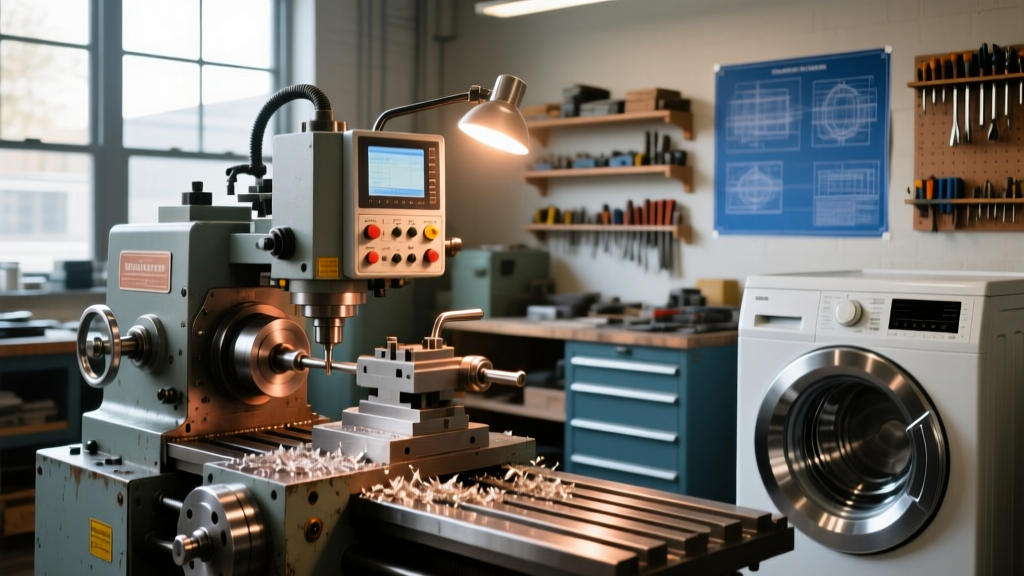
The cooperative ultimately selected the FlashCut CNC Bridgeport Pro kit for the mill and a 2-axis Centroid Acorn configuration for the Grizzly lathe. This hybrid approach balanced plug-and-play mechanical brackets with the advanced threading capabilities required for the lathe's forcing screws.
Mechanical Prerequisites: You Cannot Digitize Wear
The most common failure mode in manual-to-CNC conversions is attempting to mask mechanical slop with software backlash compensation. Before wiring a single stepper motor, the Bridgeport's mechanicals were completely overhauled to meet CNC tolerances:
- Way Inspection and Scraping: Using Prussian blue, the X and Y axis ways were checked for bell-mouth wear. The saddle was hand-scraped to achieve 16-20 points per square inch of contact, then coated with Turcite-B to reduce the stick-slip friction that causes limit-cycle oscillations during slow contouring.
- Ball Screw Conversion: The original Acme lead screws were replaced with 16mm C7-grade precision rolled ball screws featuring preloaded double-nut assemblies. This reduced axial backlash from 0.015 inches to a verified 0.0004 inches.
- Motor Mounting and Wind-up: NEMA 34 stepper motors were connected to the ball screws using zero-backlash helical beam couplers. Rigid set-screw couplers were avoided to prevent torsional wind-up during heavy roughing passes in alloy steel.
Machining the Washing Machine Repairing Tools
With the machines retrofitted, the shop transitioned to producing the specific washing machine repairing tools that previously failed in the field. The programming was handled in Autodesk Fusion 360, utilizing 2D Adaptive Clearing toolpaths to maintain constant tool engagement and extend cutter life.
Tool 1: Heavy-Duty Tub Spanner (Whirlpool/Samsung Equivalents)
OEM tub nuts on direct-drive washers often seize due to galvanic corrosion between the aluminum spider arm and the steel shaft. Standard stamped spanners round off under torque. The retrofit team machined custom spanners from 1/2-inch 4140 pre-hardened plate.
- Cutting Tool: 3/8-inch 4-flute AlTiN coated carbide endmill (Helical Solutions HEV-4).
- Speeds & Feeds: 850 RPM, 14 IPM (Inches Per Minute), 0.060-inch radial depth of cut (RDOC), 0.125-inch axial depth of cut (ADOC).
- Cycle Time: Reduced from 45 minutes (manual indexing) to 8 minutes (CNC continuous contouring).
- Performance: The CNC-machined 4140 spanners withstood 220 ft-lbs of torque via a 3/4-inch drive breaker bar without tooth deformation.
Tool 2: 3-Jaw Sealed Bearing Puller Assembly
Extracting the sealed bearing assembly (e.g., LG part 3091ER1001A) requires a specialized puller that grips the inner race without stressing the plastic outer tub. This tool required multi-axis coordination between the retrofitted mill and lathe.
- Lathe Operations (Centroid): Turned the central M16x2.0 forcing screw from O1 tool steel, utilizing the CNC's rigid tapping and threading cycles to ensure perfect pitch alignment.
- Mill Operations (FlashCut): Milled the three gripping jaws from 6061-T6 aluminum, pocketing the interior to reduce weight while maintaining a 0.001-inch tolerance on the pivot pin holes.
'The precision we gained from the CNC retrofits allowed us to design washing machine repairing tools with internal relief cuts that simply aren't possible on a manual mill without complex fixturing. Our technicians can now extract a seized Samsung spider arm in ten minutes, a job that used to result in a scrapped outer tub and a lost repair ticket.'
— Lead Fabricator, Midwest Appliance Co-op
ROI and Production Realities in 2026
The financial argument for CNC retrofit options over purchasing new equipment is stark when evaluated against current market pricing. A new entry-level CNC vertical machining center (such as a Haas CM-1 or comparable Tormach package) requires a capital expenditure between $18,000 and $35,000, plus the cost of 3-phase power installation and floor space reallocation.
By retrofitting their existing manual machines, the cooperative achieved the following financial milestones:
- Total Hardware Spend: $6,800 for both machines.
- Tooling Cost Avoidance: Saved $14,500 annually by eliminating the purchase and replacement of commercial-grade appliance tools.
- Scrap Reduction: Reduced outer-tub breakage during bearing replacements by 88%, saving an estimated $9,200 in warranty claims and replacement parts.
Limitations and Edge Cases to Consider
While retrofits offer massive ROI, they are not a universal panacea. The manual Bridgeport's R8 taper lacks the retention force of a CAT40 or BT30 spindle, limiting the shop's ability to run large-diameter face mills or aggressive high-speed machining (HSM) toolpaths. Furthermore, the lack of an automatic tool changer (ATC) means that complex washing machine repairing tools requiring multiple drill sizes and taps still necessitate manual intervention, capping true unattended production.
Final Verdict: When to Retrofit vs. Buy New
CNC retrofit options for manual machine tools are highly recommended for job shops, maintenance departments, and specialized repair cooperatives that already own high-quality, heavy cast-iron manual machines and possess the mechanical aptitude to install ball screws and align ways. If your application requires high-precision, low-volume custom tooling—like specialized washing machine repairing tools or proprietary aerospace fixtures—a retrofitted Bridgeport will outperform a lightweight, budget-tier CNC mill in surface finish and chatter resistance. However, if your operation demands unattended mass production, high-pressure through-spindle coolant, and rapid tool changes, capital must be allocated toward a modern production VMC.