Automating Machine Tools from Liquidation Auctions: A Retrofit Guide
Learn how to evaluate, bid on, and retrofit liquidated CNC machines for automated production. Includes cost analysis and controller integration strategies.
The 2026 Liquidation Landscape: Automation-Ready Arbitrage
Buying liquidated CNC equipment offers a 40% to 60% discount off OEM pricing, but mechanical integrity is only half the equation. For modern job shops and contract manufacturers, the true arbitrage in the secondary market lies in automating machine tools post-auction to achieve lights-out production at a fraction of the cost of a new, turnkey automated cell. As AI-driven valuation tools and predictive maintenance algorithms mature in 2026, buyers can now accurately assess the automation readiness of legacy iron before placing a single bid on platforms like Machinio, BidSpotter, or Liquidity Services.
The strategy requires shifting focus from purely mechanical condition to digital and spatial compatibility. A pristine 2018 Mazak VCN-530C with a closed-architecture controller might be a poor candidate for robotic tending, whereas a heavily used Haas VF-2SS with an NGC controller and available M-code macros could be a goldmine for cobot integration.
Assessing Automation Readiness on the Auction Block
When scanning liquidation catalogs, you must filter for specific hardware and software features that dictate how easily a machine can be integrated into an automated workflow. Retrofitting older machines requires overcoming both physical and digital bottlenecks.
The 5-Point Automation Readiness Checklist
- Macro B & Custom M-Codes: Verify the controller supports Macro B. You need custom M-codes (e.g., M85 for door open, M86 for vise clamp) to synchronize the robot arm with the spindle.
- Physical Footprint & Way Covers: Ensure a minimum 48-inch clearance on the operator side for a cobot base (like the FANUC CRX-10iA) without interfering with the X-axis way covers.
- I/O Port Availability: Check the electrical cabinet photos for unused digital I/O terminals on the operator panel or junction box for handshaking signals.
- Automatic Door Actuators: Machines with manual swing doors require expensive pneumatic retrofit kits ($3,500–$5,000). Prioritize liquidated assets with factory-installed auto-sliding doors.
- Chip Management: High-volume automated runs generate massive swarf. Look for machines equipped with high-pressure coolant pumps (1,000+ PSI) and hinge-belt conveyors, not just standard auger systems.
Overcoming Legacy Protocol Bottlenecks
The most significant hurdle in automating machine tools from liquidation is bridging the gap between legacy controllers and modern edge networks. Older Fanuc 0i or Siemens Sinumerik 828D controllers lack native MTConnect or OPC-UA support, making it difficult to feed real-time spindle load and cycle status data to your cobot or central ERP system.
Rather than replacing the controller—a $25,000+ endeavor—the standard 2026 approach is deploying a hardware edge gateway. Devices like the CIMCO MTConnect Adapter or Ignition Edge install directly into the machine's RS-232 or Ethernet port. These gateways translate proprietary Fanuc FOCAS or Siemens S7 protocols into standardized MQTT or MTConnect streams. This allows your Universal Robots UR10e to query the machine's status via a simple REST API, confirming the spindle has stopped and the door is open before the robot enters the work envelope.
According to the NIST Smart Manufacturing framework, interoperability via standardized data models like MTConnect is the foundational requirement for scalable automation. Retrofitting liquidated machines with edge gateways brings legacy iron into compliance with modern Industry 4.0 standards at less than 5% of the cost of a new machine.
Cost Breakdown: Liquidation Retrofit vs. New Turnkey Cell
To justify the liquidation strategy, you must model the total capital expenditure (CapEx) against the output capacity. Below is a comparative analysis of purchasing a liquidated machine and retrofitting it for automation versus buying a new, OEM-integrated automated cell.
| Component | Liquidation Retrofit (Haas VF-2SS + UR10e) | New OEM Cell (DMG Mori CMX 600V + Robo2Go) |
|---|---|---|
| Base Machine Cost | $38,000 (Auction avg.) | $185,000 |
| Automation Hardware (Cobot/Gripper) | $42,000 (UR10e + Robotiq Hand-E) | Included in OEM Package |
| Integration, Gateways & Software | $12,500 | $15,000 (CELOS setup) |
| Mechanical Retrofits (Doors/Vises) | $8,500 (Pneumatic Kurt DX6) | $0 |
| Installation & Floor Prep | $6,000 | $9,000 |
| Total Capital Expenditure | $107,000 | $209,000 |
| Estimated ROI Payback (2-shift lights-out) | 11 Months | 26 Months |
Cobot Deployment and End-of-Arm Tooling (EOAT)
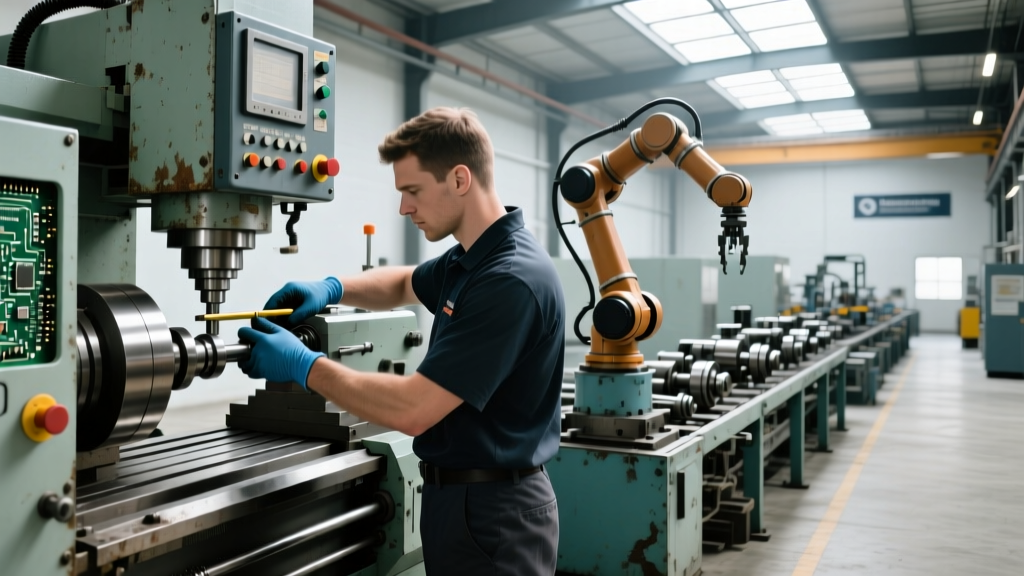
When automating machine tools sourced from liquidation, the physical interface between the robot and the CNC is where most integration failures occur. The industry has largely standardized around collaborative robots for retrofits due to their lack of required safety caging, which is critical when floor space around auctioned machines is constrained.
Sizing the Cobot and Gripper
For standard VMCs like the Haas VF series or Mazak VCN line, a 10kg payload cobot (such as the Universal Robots UR10e) is the baseline. However, payload calculations must account for the EOAT weight. If you are using a dual-gripper setup to swap parts in a single cycle, the Robotiq Hand-E gripper combined with custom aluminum endplates adds roughly 3.5kg. This leaves only 6.5kg for the actual workpiece. For heavier steel or titanium aerospace components, you must step up to a FANUC CRX-10iA or CRX-25iA, which offer higher payload margins and superior rigidity for machine tending.
Pneumatic vs. Manual Workholding
A common mistake in liquidation retrofits is attempting to use manual vises with a robot. You must replace manual vises with pneumatic or hydraulic equivalents. The Kurt DX6 vise equipped with a rear-mounted pneumatic actuator is the industry standard. You will need to route a 90 PSI air line through the machine's existing rotary union or via a flexible drag chain to the work envelope, triggering the vise clamp/unclamp via the CNC's auxiliary I/O relay.
Strategic Bidding Framework for Automation Projects
To execute this strategy profitably, follow this sequential bidding framework when evaluating liquidation catalogs:
- Filter by Controller Generation: Exclude machines pre-2012 unless they have been retrofitted. Target Fanuc 31i/32i, Siemens 840D sl, or Haas NGC. These controllers have the processing speed and memory required for complex macro execution and high-speed data polling.
- Request I/O and Macro Documentation: Before bidding, contact the auction house or liquidator to request photos of the machine's I/O schematic and parameter pages. If the liquidator cannot provide this, factor a $5,000 contingency into your bid for third-party electrical troubleshooting.
- Calculate the 'Automation Tax': Subtract the estimated cost of required retrofits (auto-doors, edge gateways, pneumatic vises) from your target CapEx to determine your absolute maximum bid on the base machine.
- Verify Way Cover and Spindle Condition: Automation means the machine will run 24/7. A worn spindle bearing or torn X-axis way cover will fail rapidly under continuous lights-out operation. Use vibration analysis tools during the preview day to check spindle health, or hire a local rigger to perform a laser ballbar test.
By treating liquidation auctions not just as a source for cheap iron, but as a procurement channel for automation-ready platforms, manufacturers can drastically compress their ROI timelines. For deeper insights into standardized integration, refer to the Universal Robots CNC Machine Tending guidelines and the Mazak Automation technical library, which provide excellent baseline architectures for retrofitting legacy VMCs and HMCs.