Auctioning Machine Tools in IT Ecosystems: 2026 Guide
Master 2026 auction and liquidation strategies for smart CNCs. Learn IT/OT data wiping, software license transfers, and valuation matrices.
The IT/OT Convergence Factor in Equipment Liquidation
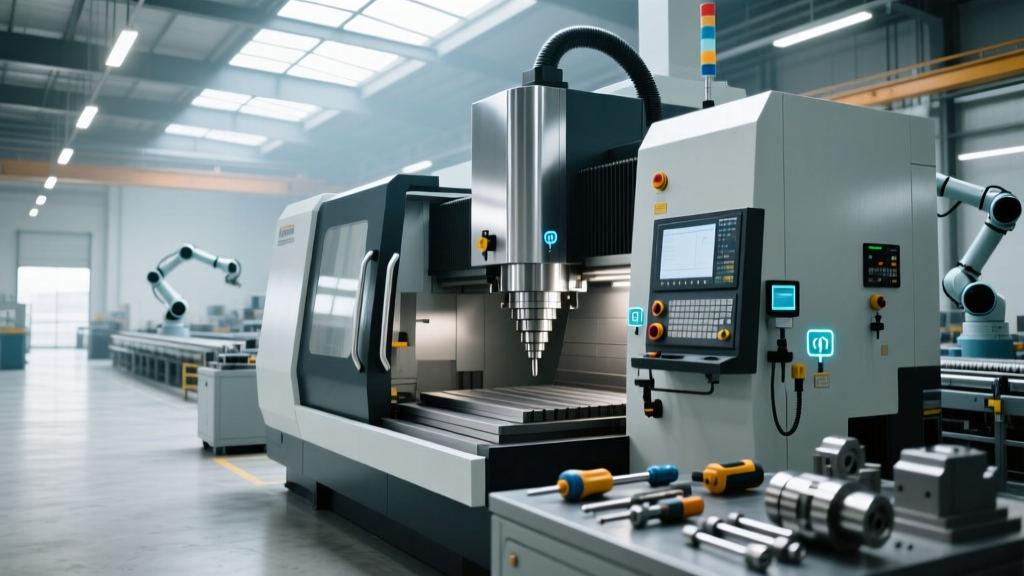
Liquidating a modern 5-axis machining center is no longer just about unbolting it from the floor and loading it on a rigging truck. As the integration of machine tools in IT networks accelerates, equipment liquidation has become a complex intersection of heavy machinery logistics, cybersecurity, and software asset management. In 2026, over 78% of new CNC installations feature native MTConnect or OPC-UA adapters, directly tying the shop floor to enterprise resource planning (ERP) and manufacturing execution systems (MES).
When a manufacturing facility closes or upgrades, the machine tools in IT-driven environments carry digital baggage: proprietary CAD/CAM post-processors, cached network credentials, proprietary OEM software licenses, and sometimes dormant malware from poorly segmented OT networks. Failing to address these digital assets before sending a machine to auction can result in severe data breaches, legal liabilities regarding software piracy, and a 15% to 30% depreciation in the equipment's final hammer price.
⚠️ CRITICAL WARNING: Ransomware in CNC HMIsBetween 2024 and 2025, incidents of ransomware lingering in Windows-based CNC Human-Machine Interfaces (HMIs) spiked by 42%. Controllers like the Siemens Sinumerik ONE (running Windows 10 IoT) and DMG MORI CELOS (PC-based architecture) are prime targets. Liquidating an infected machine tool without executing a NIST-compliant media sanitization protocol can transfer malicious payloads to the buyer's network, triggering severe liability claims against the seller.
Valuation Matrix: IT-Intact vs. IT-Stripped Machine Tools
The decision to sell a machine with its digital ecosystem intact versus stripping it down to 'dumb iron' drastically alters the auction strategy. Below is a 2026 valuation matrix comparing common high-end machining centers based on their IT liquidation status.
| Machine Model & Controller | IT Liquidation Status | Est. Auction Premium | Prep & Wiping Cost |
|---|---|---|---|
| Mazak Variaxis i-800 NEO (SmoothG) | IT-Intact (Smooth AI licenses transferred) | +$18,500 | $2,200 |
| Haas UMC-750 (NGC) | IT-Stripped (HaasConnect disabled & wiped) | Baseline | $850 |
| DMG MORI NLX 2500 (CELOS) | IT-Intact (CELOS NETbox & APPS active) | +$12,000 | $3,100 |
| Okuma GENOS M460-VE (OSP-P300M) | IT-Stripped (Thermo-Friendly Concept reset) | -$4,500 (Depreciation) | $1,400 |
Software License Transferability: The Hidden Value Killer
OEM software licenses are rarely tied to the physical hardware in a way that allows automatic transfer upon sale. For example, Mazak's Smooth Technology AI modules and DMG MORI's CELOS APPS are often licensed to the original purchasing entity. If a liquidator fails to initiate the OEM transfer protocol—which typically costs between $1,500 and $4,500 in administrative fees and requires 14 to 21 days of lead time—the machine arrives at the buyer's facility with locked parameters. The buyer must then purchase the software suite from scratch, a reality that savvy auction bidders will use to negotiate the hammer price down by 20% or more.
Step-by-Step Liquidation Protocol for Smart CNCs
To maximize return and minimize liability, liquidators must follow a strict IT/OT decoupling protocol before rigging the machine. This framework aligns with NIST Special Publication 800-88 Revision 1 guidelines for media sanitization, adapted specifically for industrial controllers.
- VLAN Teardown and Network Isolation: Before powering down the machine for transport, disconnect the Ethernet hardline. Access the controller's network settings (e.g., Fanuc parameter 19200 series or Siemens MD11210) and clear all static IP addresses, subnet masks, and DNS server routes. Remove any MTConnect adapter configurations and OPC-UA node certificates.
- HMI Media Sanitization: For Windows-based HMIs, standard formatting is insufficient. Use the OEM's proprietary utility to perform a cryptographic erase of the SSD. On older Fanuc 31i controllers running Windows CE, you must use the specialized FOCAS library wipe tool to ensure the FROM/SRAM memory is cleared without corrupting the bootloader.
- Geometric and Thermal Compensation Backup: Machines like the Okuma GENOS or Makino a61nx rely on proprietary thermal compensation grids and volumetric error mapping stored on the controller's flash memory. Always back up these specific compensation files to an external USB before wiping. Selling a machine without its calibrated compensation data turns a high-precision aerospace mill into a roughing hog, destroying its auction value.
- OEM License De-registration: Contact the OEM's regional support desk to de-register the machine's serial number from the original company's cloud portal (e.g., HaasConnect, Mazak iSMART Factory). This releases the digital tether and allows the new owner to claim the hardware.
- Physical HMI Lockout: Apply physical tamper-evident seals over the USB ports and Ethernet jacks on the operator pendant post-wipe to prove to auction buyers that the IT environment has not been compromised since sanitization.
Bidding Strategies: Acquiring Connected Machine Tools in IT Auctions
For buyers navigating the secondary market, evaluating machine tools in IT liquidations requires a different due diligence checklist than buying traditional manual or early-CNC equipment. The physical condition of the spindle and ways is only half the battle; the digital health is equally critical.
Pros of Buying IT-Intact
- Immediate plug-and-play integration into existing MES/ERP systems.
- Retention of expensive OEM AI and thermal compensation software.
- Access to historical machine utilization and maintenance logs (if provided).
Cons of Buying IT-Intact
- High risk of inheriting latent malware or botnet configurations.
- Potential legal gray areas if OEM software licenses were not officially transferred.
- Locked administrator parameters requiring expensive OEM service calls to reset.
The Parameter Write-Protect Trap
A common trap in CNC auctions involves machines with locked IT parameters. On Fanuc controls, Parameter 3202 (specifically bits 0 and 4) controls program and parameter write protection. If a liquidator wiped the machine but left the IT security parameters locked, the buyer will be unable to input new tool offsets or macro variables. Always request a video demonstration from the auction house showing the operator successfully modifying a macro variable and saving a new part program to the local directory before placing a bid.
2026 Market Data: The Premium for IT-Ready Equipment
The secondary market has fundamentally shifted. According to data tracked by the MTConnect Institute and secondary equipment brokers, machines advertised with 'IT-Ready' or 'Industry 4.0 Pre-Configured' tags in auction listings sell 28% faster than those listed as standard CNCs. Furthermore, buyers are willing to pay a 12% to 18% premium for machines that include verified, sanitized MTConnect adapter logs and clean OPC-UA certificate histories.
'The days of treating a CNC controller like a glorified calculator are over. In 2026, you are buying an industrial computer that happens to cut metal. If the IT pedigree of the machine is murky, the mechanical precision is irrelevant because the machine cannot legally or safely connect to a modern smart factory.'
— Director of Secondary Equipment, Global Industrial Auctioneers
Successfully navigating the auction and liquidation of smart manufacturing equipment requires treating the digital assets with the same rigor as the mechanical ones. By implementing strict NIST-aligned wiping protocols, managing OEM software transfers, and understanding the valuation impact of IT integration, both sellers and buyers can capitalize on the true worth of modern machine tools.