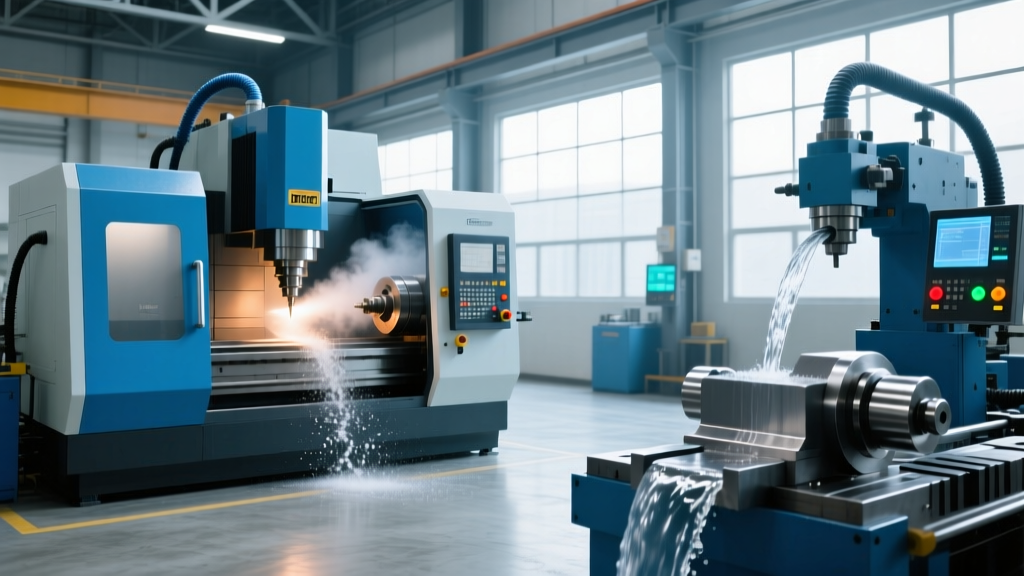
Allied Tool and Machine Coolant Tech: Flood vs Mist MQL in 2026
Explore 2026 coolant innovations for Allied Tool and Machine operations. Compare flood vs. mist MQL systems, retrofit costs, and aerospace machining specs.
For high-precision, high-mix job shops operating like the benchmark Allied Tool and Machine, thermal management dictates cycle times, surface finishes, and overall tool life. As spindle speeds push past 20,000 RPM and aerospace alloys become more abrasive, the traditional approach of drowning the cutting zone in flood coolant is being challenged by advanced Minimum Quantity Lubrication (MQL) and mist systems. In 2026, selecting the right fluid delivery architecture is no longer a binary choice; it requires a physics-based understanding of heat extraction and fluid chemistry.
2026 Industry Data Highlight: MQL Adoption
According to recent manufacturing surveys, 34% of Tier 2 aerospace suppliers have integrated dual-channel MQL systems into their 5-axis machining centers. Shops transitioning from flood to MQL report a 40-60% reduction in annual fluid disposal costs and a 15% increase in tool life when machining cast iron and aluminum alloys, primarily due to the elimination of thermal shock on carbide inserts.
The Thermal Dynamics: Flood vs. Minimum Quantity Lubrication
The fundamental difference between flood coolant and MQL lies in the mechanism of heat transfer. Flood coolant relies on sensible heat absorption—the high thermal mass of the liquid physically carries heat away from the cutting zone. Conversely, MQL relies on latent heat of vaporization. When the microscopic aerosolized ester oil droplets hit the 800°F+ cutting edge, they instantly vaporize, absorbing massive amounts of phase-change energy while leaving a micro-thin lubricating film that prevents built-up edge (BUE).
| Parameter | High-Pressure Flood Coolant | MQL / Mist Aerosol |
|---|---|---|
| Delivery Pressure | 200 – 1,000+ PSI (Through-Tool) | 4 – 8 Bar (Compressed Air) |
| Flow Rate | 5 – 15 Gallons Per Minute | 5 – 50 mL / Hour |
| Fluid Chemistry | Water-soluble semi-synthetic (5-8% conc.) | 100% Biodegradable Ester Oils |
| Chip Morphology | Wet, heavy, requires conveyor/flushing | Dry, easily vacuumed or blown away |
| Sump Footprint | 50 – 250 Gallons per machine | 1 – 2 Gallon reservoir |
| Retrofit Capital Cost | $12,000 - $25,000 (Chiller + Pump) | $3,500 - $8,000 (Nozzle + Generator) |
Application-Specific Deployments for Allied Tool and Machine Workflows
When evaluating workflows typical of an Allied Tool and Machine production floor, the choice between flood and mist must be matched to the specific material removal rate (MRR) and alloy thermal conductivity.
Aerospace Aluminum (7075-T6) and High-Speed Machining
Machining 7075-T6 aluminum at spindle speeds exceeding 15,000 RPM generates long, stringy chips that are prone to re-welding onto the cutter. Flood coolant at 700 PSI through-tool is mandatory here. The high-velocity fluid mechanically breaks the chip and clears the deep pockets. MQL struggles in this specific scenario; without the physical mass of water to evacuate chips, deep pocket milling with MQL often results in chip packing and catastrophic tool failure. If MQL must be used for aluminum, shops must integrate specialized external air-blast nozzles operating at 6 bar to simulate mechanical chip evacuation.
Heavy Interruption Milling and Cast Iron
For interrupted cuts on ductile iron or steel forgings, MQL is vastly superior. When a carbide insert enters and exits the cut, flood coolant causes rapid thermal cycling (micro-cracking) on the cutting edge. MQL maintains a stable thermal boundary. Utilizing a plant-based ester oil (such as those from ITW ROCOL or Unist) at a flow rate of 12 mL/hr extends insert life by up to 22% in heavy milling operations by preventing thermal shock.
⚠️ OSHA Compliance & Mist Inhalation Warning
Transitioning to mist/MQL requires strict adherence to air quality standards. According to OSHA guidelines on metalworking fluids, the Permissible Exposure Limit (PEL) for coolant mist is 5 mg/m³ over an 8-hour TWA. However, best practices dictate keeping respirable fractions below 0.5 mg/m³. Shops must install high-efficiency HEPA mist collectors (e.g., Losma or SmogHog) directly on the CNC enclosure to capture aerosolized ester droplets before the door opens. Failure to do so risks severe respiratory liabilities and OSHA citations.
Financial Modeling: Retrofitting Legacy CNCs
For shops looking to upgrade legacy Haas VF-series or Mazak VTC machines, the financial barrier to MQL is remarkably low compared to high-pressure flood systems. A complete dual-channel MQL retrofit kit—including the aerosol generator, precision metering pump, and internally routed spindle unions—typically costs between $4,200 and $6,800 per machine.
The Hidden Costs of Flood Coolant:
According to data referenced by the EPA's pollution prevention protocols, the lifecycle cost of flood coolant extends far beyond the initial purchase. Hazardous waste disposal for spent semi-synthetic fluids ranges from $1.50 to $3.00 per gallon. A 100-gallon sump that requires bi-annual dumping and cleaning costs a shop upwards of $800 annually in disposal fees alone, excluding the labor hours lost to sump maintenance, tramp oil skimming, and concentration checks. MQL eliminates sump maintenance entirely; the chips leave the machine virtually dry, and the ester oil is consumed during the cut.
2026 Fluid Chemistry and Smart Sump Monitoring
For operations where flood coolant remains non-negotiable (such as deep-hole drilling or grinding), 2026 has seen a massive shift toward IoT-enabled sump management. Maintaining the exact chemical balance is critical to prevent bacterial growth and dermatitis among operators.
- pH Monitoring: Semi-synthetic fluids must be maintained at a pH between 8.8 and 9.2. A drop below 8.5 indicates bacterial proliferation, which degrades the fluid's rust inhibitors and causes foul odors.
- Concentration (Brix): Refractometer readings must be kept strictly between 5% and 8%. Running lean (below 4%) causes flash-rusting on machine ways, while running rich (above 10%) leaves sticky residues that clog way-covers and increase foam generation.
- Tramp Oil Control: Hydraulic way-lube inevitably leaks into the sump. If tramp oil exceeds 2% of the total volume, it forms a barrier that starves the coolant of oxygen, accelerating anaerobic bacteria growth. Automated belt skimmers and coalescers are now standard requirements for Tier 1 compliance.
The Titanium Exception: Cryogenic Cooling
When Allied Tool and Machine workflows involve Ti-6Al-4V titanium, both standard flood and MQL face severe limitations due to the alloy's exceptionally low thermal conductivity. The heat stays in the tool, not the chip. In 2026, the cutting-edge solution for titanium is cryogenic cooling. By delivering liquid nitrogen (LN2) at -320°F directly through the tool spindle, shops can increase cutting speeds by up to 40% while virtually eliminating flank wear. While the capital cost for a cryogenic delivery system exceeds $35,000, the ROI is realized in high-value aerospace contracts where cycle time reduction is paramount.
Quick Decision Framework: Flood vs. MQL
- Choose High-Pressure Flood if: You are machining deep pockets in sticky alloys (Aluminum, Stainless), performing deep-hole drilling (BTA/Gundrilling), or require high-volume chip flushing.
- Choose MQL/Mist if: You are milling cast iron, performing interrupted cuts on steel, running high-volume production of simple turned parts, or want to eliminate sump maintenance and fluid disposal costs.
Ultimately, the modern machine shop cannot rely on a single fluid delivery method. The most competitive facilities deploy a hybrid approach: utilizing high-pressure flood for aggressive roughing and deep-cavity milling, while leveraging MQL for finishing operations, cast iron milling, and near-dry tapping. By aligning the physics of the coolant with the specific metallurgy of the workpiece, shops can unlock double-digit percentage gains in both tool life and spindle utilization.