Reviewing Machine Tool Industry News Today October 2025: Safety Interlock and E-Stop Upgrades
Analyze October 2025 machine tool industry news regarding safety interlocks and E-stops, featuring operator training, ISO 13849-1 standards, and retrofit costs.
The Shift in Safety Protocols: Context from Recent Industry Updates
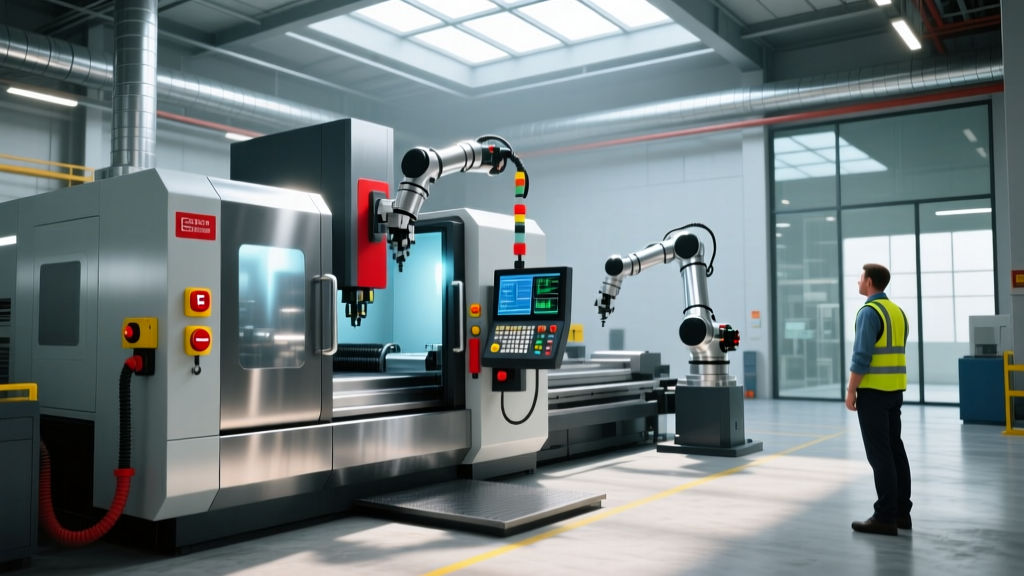
When evaluating machine tool industry news today October 2025, a recurring theme among safety auditors and manufacturing compliance officers is the heightened scrutiny of legacy machine tool safeguarding. Recent OSHA enforcement sweeps across midwestern manufacturing hubs have specifically targeted defeated door interlocks and improperly wired emergency stop (E-stop) circuits on 5-axis CNC machining centers and manual lathes. For shop floor managers and CNC operators, understanding the exact architecture of these safety systems is no longer optional; it is a critical operational competency.
The modern machine shop relies on complex electromechanical and solid-state safety relays to prevent catastrophic kinetic and electrical hazards. However, a persistent gap exists between the installation of ISO-compliant safety hardware and the operator's ability to diagnose, respect, and maintain these systems. This guide bridges that gap, translating recent regulatory focus into actionable operator training and precise hardware specifications.
WARNING: The True Cost of Bypassing InterlocksAccording to OSHA's Machine Guarding guidelines, willful bypassing of safety interlocks using zip-ties, taped limit switches, or 'cheater keys' can result in citations exceeding $161,323 per violation in 2026. Beyond financial penalties, defeating a Category 3 or 4 safety circuit removes the redundant fault-detection layer, directly exposing operators to spindle entanglement and axis-crush hazards.
Decoding E-Stop Architectures: Stop Categories and Performance Levels
Operator training often fails to distinguish between the types of stops a machine executes when an E-stop button is depressed. Under IEC 60204-1 and NFPA 79 standards, machine stops are classified into distinct categories, which dictate how the drive and spindle motors react.
- Stop Category 0 (Uncontrolled Stop): Power is immediately removed from the machine actuators. The spindle coasts to a halt, and axes drop if mechanical brakes are not engaged. Common on older manual machines and basic hydraulic presses.
- Stop Category 1 (Controlled Stop): Power is maintained to achieve a controlled, rapid deceleration (often via dynamic braking or regenerative drives), and then power is removed once the machine reaches a standstill. This is the standard for modern CNC mills and lathes (e.g., Haas VF-series, Mazak Integrex) to prevent heavy tooling from crashing into the workpiece or chuck upon E-stop activation.
- Stop Category 2 (Controlled Stop with Power Maintained): The machine stops in a controlled manner, but power remains available (e.g., for servo holding torque or spindle orientation). This is rarely used for E-stops but common for 'Feed Hold' or cycle-stop functions.
Furthermore, the reliability of the circuit executing these stops is governed by ISO 13849-1 Performance Levels (PL). Most CNC door interlocks and E-stop circuits must meet at least PL d (Category 3) or PL e (Category 4). Category 3 ensures that a single fault in the safety circuit does not lead to the loss of the safety function, but undetected faults can accumulate. Category 4 requires that faults are detected and annunciated before the next demand upon the safety system, typically achieved via dual-channel monitoring with cross-fault detection.
Hardware Deep Dive: Safety Relay Modules and Interlock Switches
Selecting and maintaining the right hardware is paramount. Below is a comparison of industry-standard safety components frequently specified in 2025/2026 machine tool retrofits.
| Component Type | Brand / Model | Key Specifications | Approx. Unit Cost (2026) |
|---|---|---|---|
| Safety Relay Module | Pilz PNOZ X3 | 3 N/O, 1 N/C contacts; 24V AC/DC; Category 4 / PL e capable; cross-fault detection. | $450 - $520 |
| Safety Relay Module | Allen-Bradley Guardmaster 440R | Expandable I/O; Ethernet/IP diagnostic integration; dual-channel monitoring. | $600 - $750 |
| Solenoid Interlock Switch | Schmersal AZM161 | Guard locking with 2,000N holding force; RFID actuator option to prevent defeat. | $320 - $380 |
| Non-Contact RFID Switch | Sick STR1 | Transponder-based; immune to dust/coolant; no mechanical wear; PL e capable. | $210 - $260 |
The Shift to RFID and Coded Actuators
A major takeaway from recent safety audits is the phase-out of traditional tongue-and-groove mechanical interlocks on CNC enclosure doors. Mechanical switches are easily defeated by inserting a spare tongue or bending the actuator. Modern best practices mandate the use of RFID-coded non-contact switches (like the Sick STR1 or Omron D40A). These switches require a specific cryptographic handshake with the actuator; holding a generic magnet or a duplicate piece of metal against the sensor will not close the safety circuit.
Operator Training: Recognizing and Responding to Interlock Faults
Operators are the first line of defense in identifying degrading safety hardware. Training must move beyond 'push the red button' to understanding fault diagnostics. When a machine's safety circuit drops out, the PLC or safety relay will lock the system until the fault is cleared and the circuit is manually reset.
Expert Insight:'The most dangerous moment on a shop floor is not when the machine is running, but when an operator is troubleshooting an interlock fault under time pressure. If an operator uses a multimeter to jumper out a safety relay channel to 'get the part out,' they have fundamentally compromised the machine's Category 4 architecture.' — Lead Safety Engineer, Advanced Manufacturing Institute
Step-by-Step E-Stop Reset and Fault Diagnosis Protocol
Operators must follow a strict sequence when recovering from an E-stop or interlock trip. Bypassing steps can lead to immediate re-tripping or, worse, unexpected machine motion.
- Verify the Hazard Zone: Before touching the E-stop twist-release, visually confirm the spindle is at 0 RPM, the tool changer is parked, and no personnel are inside the machining envelope.
- Release the E-Stop: Twist the mushroom head clockwise to release the mechanical latch. Do not pull it straight out, as this will break the internal switch mechanism.
- Check the Safety Relay LEDs: Look at the main safety relay (e.g., Pilz PNOZ). If the 'CH1' or 'CH2' LED is unlit or flashing red, a hard fault exists in the wiring (e.g., a severed wire in the door hinge loop or a welded contactor). Do not attempt to reset. Call maintenance.
- Execute the Reset Command: If both channel LEDs are solid green, press the dedicated 'Safety Reset' button on the operator panel. This button sends a momentary pulse to the safety relay's reset terminals (typically Y1/Y2), confirming to the relay that the operator is intentionally clearing the fault.
- Clear CNC Alarms: Once the safety relay drops power back to the servo drives, press 'RESET' on the CNC control (Fanuc, Siemens, Haas) to clear the drive-level 'Safe Torque Off' (STO) alarms.
Retrofitting Legacy CNCs: Costs and Hardware Selection
For job shops operating 1990s or early 2000s VMCs (such as older Fadal, Bridgeport, or early Mori Seiki models), the original E-stop circuits often rely on single-channel, direct-wired contactors. These do not meet current ANSI B11 or ISO 13849-1 standards. Upgrading these machines requires a structured retrofit.
A standard retrofit involves removing the mainline contactor, installing a dual-channel safety relay, wiring the E-stops in series across both channels, and adding Safe Torque Off (STO) modules to the servo drives if supported. If the drives lack STO, the safety relay's output contacts must physically break the 24V DC control power to the drive enable circuits, alongside breaking the main 3-phase contactor.
Estimated Retrofit Costs (Per Machine):
- Hardware (Safety Relay, RFID Door Switches, E-Stop Buttons): $1,200 - $1,800
- Wiring Materials (Shielded cable, DIN rail, terminals): $300 - $450
- Labor (Electrician/Integrator at $125-$175/hr): $1,600 - $2,500 (approx. 12-16 hours)
- Total Average Investment: $3,100 - $4,750 per machine.
While this capital expenditure is significant, it is vastly outweighed by the mitigation of OSHA fines and the reduction in catastrophic spindle crashes caused by uncontrolled Category 0 stops.
Mandatory Monthly Maintenance Checks for Safety Circuits
Safety circuits degrade due to the harsh environment of the machine shop. Coolant ingress, tramp oil, and continuous vibration cause specific failure modes. Maintenance teams must implement a documented monthly checklist, as recommended by NIOSH machine safety guidelines.
- Actuator Alignment Check: Verify that door interlock actuators are not rubbing against the switch housing. Misalignment by more than 2mm can cause the internal reed switches to chatter, leading to micro-welding of the safety relay contacts.
- E-Stop Mechanical Test: Depress every E-stop button on the machine. Measure the physical travel distance. If the button feels 'mushy' or fails to click audibly, the internal NC (Normally Closed) contacts may be fouled with graphite dust or oil. Replace immediately.
- Contactor Drop-Out Test: With the machine in a safe, idle state, trigger the E-stop and use a multimeter to verify that voltage at the servo drive enable pins drops to 0V within 20 milliseconds. Any delay indicates a failing mainline contactor that may be sticking due to arc welding.
- Wiring Flex-Loop Inspection: Inspect the multi-conductor cables routing through the machine's axis cable carriers (e.g., igus e-chains) and door hinges. Look for cracked insulation or exposed copper, which can cause cross-channel short circuits that the safety relay will interpret as a critical fault.
By aligning operator training with rigorous hardware maintenance and staying informed on compliance trends, machine shops can ensure their safeguarding systems remain robust, legal, and, most importantly, life-saving.