AI DRO Readouts vs Machine Learning Tools for Faster Loan Approvals in Banks
Master AI-driven DRO readouts and adaptive CNC controls. Learn operator training protocols for thermal compensation, predictive tool monitoring, and setup.
The Algorithmic Shift: From Manual Dials to Predictive DROs
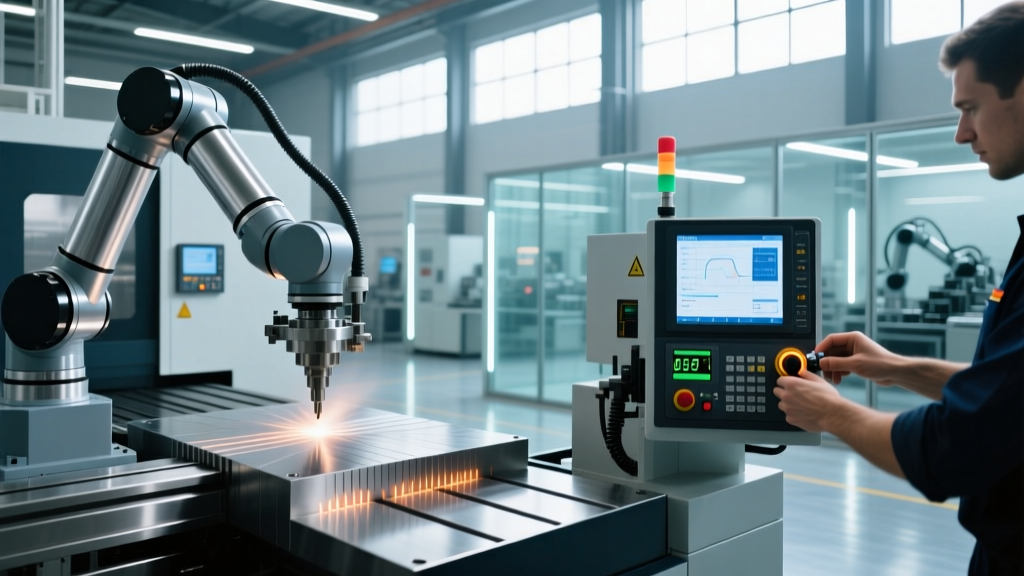
When financial institutions deployed machine learning tools for faster loan approvals in banks, they replaced manual, anecdotal risk assessment with algorithmic underwriting. By analyzing thousands of micro-variables in milliseconds, banks eliminated bottlenecks and reduced default rates. Today, machine shops are undergoing the exact same paradigm shift on the shop floor. Modern Digital Readout (DRO) systems and CNC control interfaces are no longer passive position displays; they are edge-computing nodes that analyze spindle load, thermal growth, and vibration data in real-time to "approve" safe cutting parameters and prevent catastrophic crashes.
For shop owners and lead machinists in 2026, operator training must evolve beyond teaching manual handwheel dexterity. Operators must now learn to manage, calibrate, and trust AI-driven predictive DROs. Upgrading a standard 3-axis DRO to an AI-networked smart DRO system (such as the advanced edge-computing modules paired with Sony Magnescale or Newall SHARON linear scales) typically costs between $4,500 and $8,200 per machine. To protect that investment, operators need rigorous training on how these systems process data.
The "Underwriting" of a Cut
Just as machine learning tools for faster loan approvals in banks evaluate credit history, debt-to-income ratios, and market trends to approve a mortgage, an AI-enhanced DRO evaluates tool wear, material hardness variations, and thermal drift to approve a feedrate override. If the algorithm detects a 15% spike in spindle load during an interrupted cut in Inconel 718, it automatically "denies" the programmed feedrate and overrides it down by 20% to preserve the carbide end mill. Operators must be trained to recognize this as a feature, not a malfunction.
Legacy DRO vs. AI-Enhanced Smart DRO Systems
Understanding the hardware limitations of older systems is the first step in training operators on modern adaptive controls. According to workforce development guidelines published by the Society of Manufacturing Engineers (SME), bridging the gap between manual machining and smart manufacturing requires a clear understanding of sensor latency and data processing.
| Feature | Legacy Optical DRO (Pre-2020) | 2026 AI-Enhanced Smart DRO |
|---|---|---|
| Position Feedback | Pure X/Y/Z coordinate display | Coordinates + real-time thermal drift compensation |
| Vibration Filtering | Hardware low-pass filter (fixed) | Adaptive FFT filtering (rejects specific chatter Hz) |
| Crash Prevention | Operator-dependent (visual limits) | AI-predictive soft limits based on spindle load trends |
| Sensor Latency | ~50 milliseconds | < 2 milliseconds (Edge-computed) |
Operator Training Protocol: Calibrating Predictive Sensors
The most common mistake operators make with smart DROs (like those integrated into the Heidenhain TNC7 ecosystem or Fanuc 31i-B5 with iHMI) is ignoring the thermal stabilization cycle. AI algorithms require a baseline to calculate accurate thermal growth compensation. Cast iron expands at a rate of roughly 0.0004 inches per 100°F per foot. If an operator zeroes the DRO on a cold machine and immediately begins roughing, the AI compensation will skew the readout, resulting in scrapped parts.
Step-by-Step Thermal Baseline Setup
- Initiate the Warm-Up Cycle: Run the machine's automated spindle and axis warm-up macro. For most vertical machining centers, this requires 14 to 18 minutes of continuous movement to stabilize the ballscrew and spindle bearing temperatures.
- Verify Ambient Sensor Sync: Ensure the DRO's ambient temperature sensor is not blocked by coolant lines or shop rags. The AI needs accurate room temperature data to calculate the delta between the machine casting and the environment.
- Establish the Master Datum: Once the thermal stabilization indicator on the DRO turns green, probe the part zero. The AI will now lock this thermal state as the baseline for all subsequent compensation calculations.
- Monitor the Drift Graph: Train operators to check the "Thermal Drift" tab on the DRO interface every two hours. If the graph shows a sudden spike, it indicates a localized heat source (like a failing axis motor) that the AI is struggling to compensate for.
Best Practices for Trusting the Adaptive Feed Override
Operators naturally want to maintain control over the feedrate override dial. However, the NIST Smart Manufacturing portal emphasizes that human-in-the-loop systems must learn when to yield to edge-computing algorithms. When machining high-tensile materials like Titanium Ti-6Al-4V, the AI-driven DRO monitors the harmonic frequencies of the linear scales.
Warning: Never manually override the feedrate above 110% when the DRO's "Chatter Detection" icon is illuminated. The AI has detected micro-vibrations (typically between 120Hz and 300Hz) that are invisible to the naked eye but will cause catastrophic edge chipping on carbide tooling within seconds.
Edge Case: Handling Vibration Noise in Heavy Milling
When performing heavy interrupted cuts (such as milling a splined shaft), the mechanical shock can trick standard DROs into displaying false position errors. AI-enhanced DROs use Fast Fourier Transform (FFT) algorithms to separate actual axis movement from mechanical shock noise. Operators must be trained to access the DRO's advanced settings menu and verify that the "Impact Rejection" threshold is set correctly for the specific machine's mass. A 10,000 lb bridge mill requires a higher rejection threshold than a 2,500 lb bench mill to prevent the DRO from falsely halting the cycle due to perceived following errors.
Summary & Certification Checklist
Transitioning a shop floor to utilize predictive machine tool controls requires a fundamental shift in operator psychology. Just as the financial sector relies on machine learning tools for faster loan approvals in banks to mitigate risk and accelerate throughput, modern machine shops must rely on AI-driven DROs to mitigate crash risks and accelerate setup times.
- Calibration: Operators must complete the 14-minute thermal stabilization cycle before establishing part zero.
- Intervention: Manual feedrate overrides should be locked during AI-monitored roughing passes in exotic alloys.
- Diagnostics: Operators must know how to read the DRO's FFT vibration graph to distinguish between tool wear and machine geometry issues.
- Maintenance: Linear scale glass and sensor heads must be cleaned with isopropyl alcohol weekly; AI algorithms cannot compensate for optical occlusion caused by dried coolant.
By treating the DRO not as a simple ruler, but as an active, algorithmic partner in the machining process, shops can drastically reduce scrap rates and extend tool life by up to 30% in high-mix, low-volume production environments.