Troubleshooting Advanced Machine Tool Coolant Systems: Flood vs Mist
Diagnose and fix advanced machine tool coolant issues. Compare flood vs mist cooling systems, troubleshoot flow drops, and optimize MQL setups.
Flood Coolant Failures: Diagnosing Pressure and Flow Drops
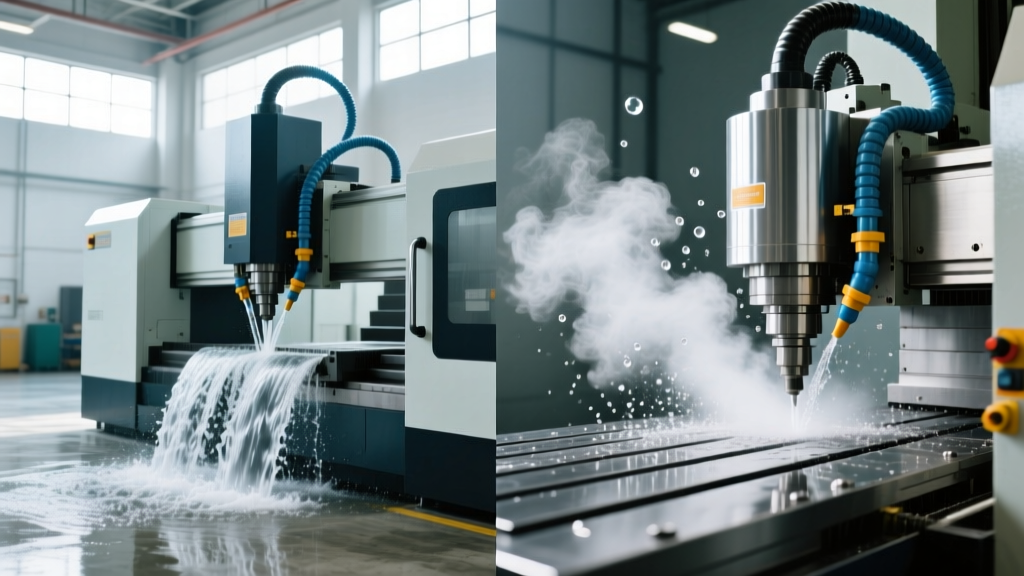
Advanced machine tool operations, particularly 5-axis simultaneous milling and high-speed titanium machining, generate localized heat exceeding 800°C at the shear zone. When flood coolant systems fail to penetrate this thermal boundary, tool life plummets and workpiece metallurgy degrades. The most common failure mode in high-pressure flood systems is not an outright pump failure, but a gradual loss of volumetric efficiency and pressure.
CRITICAL FAULT: If your Haas or Mazak VMC alarms out on 'Low Coolant Pressure' despite a full sump, do not immediately replace the pump impeller. Check the suction line for micro-fractures drawing air, which causes centrifugal pump cavitation and a 40-60% drop in effective flow rate.Symptom-Cause-Fix Decision Tree for Flood Systems
| Symptom | Root Cause | Corrective Action |
|---|---|---|
| Pressure drops below 200 PSI at the nozzle (Target: 300+ PSI) | Swaf bypass in 100-micron bag filters or clogged machine-way wipers | Install a duplex filter housing to allow filter changes without halting production; verify way-cover seals. |
| Coolant stream pulsates or 'spits' at high RPM | Centrifugal pump cavitation due to restricted suction or high fluid viscosity | Clean the foot valve strainer; ensure fluid temperature is maintained between 68°F and 72°F to stabilize viscosity. |
| Workpiece shows thermal burn despite adequate flow | Nozzle misalignment or incorrect orifice sizing for the tool diameter | Use adjustable Loc-Line nozzles; match orifice size to tool diameter (e.g., 1/8' orifice for 1/2' end mills) to maximize jet velocity. |
Minimum Quantity Lubrication (MQL) and Mist Cooling Diagnostics
Minimum Quantity Lubrication (MQL) represents a paradigm shift for advanced machine tools, replacing gallons-per-minute flood cooling with 10 to 15 mL/hour of precisely atomized ester-based lubricants (such as Unist Coolube 2210 or Accu-Lube LB-2000). Troubleshooting MQL systems requires shifting focus from fluid dynamics to aerosol physics and pneumatic stability.
Atomization and Delivery Failures
When an MQL system fails, the result is often 'dry cutting,' which instantly destroys carbide substrates when machining abrasive materials like Inconel 718 or compacted graphite iron (CGI). The primary culprit is usually a disruption in the air-to-fluid ratio at the mixing chamber or the nozzle tip.
- Droplet Size Deviation: Effective MQL requires droplet sizes between 5 and 15 microns. If droplets exceed 50 microns, they coalesce on the tool holder and fail to reach the cutting edge. Verify that the atomizing air pressure is strictly maintained above 80 PSI. Pressures dropping to 60 PSI will cause fluid pooling.
- Capillary Tube Crimps: The internal PTFE capillary tubes (often 1.5mm outer diameter) that deliver fluid inside the air hose are highly susceptible to kinking during machine-axis articulation. Inspect the umbilical tracks for sharp bend radii. Replace standard tubing with reinforced braided PTFE lines in high-flex zones.
- Nozzle Distance and Angle: External MQL nozzles must be positioned 20mm to 40mm from the cutting zone. Distances greater than 50mm allow the high-velocity air envelope to dissipate, causing the heavier ester droplets to fall out of suspension before reaching the shear zone.
Sump Chemistry and Biological Troubleshooting (Flood Systems)
Even the most advanced machine tool will suffer from poor surface finishes if the coolant chemistry is compromised. Biological growth and tramp oil infiltration alter the fluid's pH and reduce its lubricity.
Refractometer Calibration and Concentration Recovery
Machinists frequently misread coolant concentration by ignoring the specific refractometer correction factor (Brix multiplier) required by modern synthetic and semi-synthetic fluids. For example, a high-lubricity semi-synthetic like Master Chemical TRIM E709 requires a multiplier of 1.2. If the refractometer reads 5.0 Brix, the actual concentration is 6.0%. Running the sump at an uncorrected 5% concentration will lead to catastrophic corrosion on cast iron machine beds within 72 hours.
- Test pH Levels: Healthy coolant maintains a pH between 8.8 and 9.4. A drop below 8.5 indicates anaerobic bacterial bloom, which produces hydrogen sulfide (rotten egg odor) and rapidly degrades the fluid's rust inhibitors.
- Tramp Oil Skimming: Hydraulic way-oil leakage is inevitable. If tramp oil exceeds 2% of the sump volume, it creates a barrier that starves aerobic bacteria of oxygen, forcing them into anaerobic metabolism. Deploy a coalescing oil skimmer rated for at least 5 gallons per hour to continuously remove surface oils.
- Hard Water Buildup: If your facility's water exceeds 15 grains of hardness (approx. 250 ppm calcium carbonate), the minerals will react with the coolant's emulsifiers, forming insoluble soap scum that clogs 100-micron filters and leaves abrasive deposits on workpieces. Switch to reverse osmosis (RO) water for all sump top-offs.
Flood vs. MQL: Application and Retrofit Decision Matrix
Deciding whether to maintain a flood system or retrofit an advanced machine tool for MQL requires analyzing the specific material removal rates (MRR) and chip evacuation requirements of your production mix. MQL retrofits for a standard vertical machining center typically range from $4,500 to $8,500, including external nozzle arrays and pneumatic integration.
| Parameter | High-Pressure Flood Coolant | MQL / Mist Cooling |
|---|---|---|
| Initial Setup Cost | $12,000 - $25,000 (Chiller, HP Pump, Skimmer) | $4,500 - $8,500 (Retrofit Kit, Pneumatic lines) |
| Fluid Consumption | 500 - 2,000 Gallons/Year (with drag-out and evaporation) | 2 - 5 Gallons/Year |
| Chip Evacuation | Excellent (Flushes deep cavities and blind holes) | Poor (Requires compressed air blasts or specialized chip conveyors) |
| Tool Life (Aluminum 6061) | Good (Prevents built-up edge) | Excellent (Ester lubricity reduces friction) |
| Tool Life (Inconel/Titanium) | Excellent (High thermal mass absorbs shear heat) | Poor (Fails to manage extreme thermal loads without through-tool delivery) |
Advanced Sensor Integration and Predictive Maintenance
Modern troubleshooting relies on data, not guesswork. Integrating IO-Link enabled sensors into your coolant architecture allows the machine's PLC to predict failures before they scrap a $10,000 aerospace casting.
- Micro-Leak Detection in MQL: Install a thermal mass flow meter (such as the IFM Electronic SM series) on the MQL fluid line. These sensors detect flow rates as low as 0.01 liters per minute. If the PLC registers fluid flow while the solenoid valve is commanded closed, it triggers an alarm for a leaking internal diaphragm before the tool is starved of lubrication.
- Pressure Transients in Flood Systems: Mount a piezoelectric pressure transducer directly downstream of the main pump. Sudden pressure spikes (exceeding 15% of baseline) indicate a downstream blockage, often caused by a collapsed filter element or a jammed check valve. Gradual pressure decay over a 48-hour cycle indicates impeller wear or internal pump bypass leakage.
Environmental and Safety Compliance in Mist Systems
While MQL drastically reduces fluid consumption, the aerosolized mist presents distinct occupational health challenges that require rigorous engineering controls. The Occupational Safety and Health Administration (OSHA) strictly monitors airborne metalworking fluid (MWF) concentrations, as inhalation of aerosolized esters and microscopic metallic particulates can lead to severe respiratory conditions, including occupational asthma and hypersensitivity pneumonitis.
Furthermore, the National Institute for Occupational Safety and Health (NIOSH) recommends maintaining airborne MWF exposure limits below 0.4 mg/m³ as a time-weighted average. To achieve this in an advanced machine tool environment utilizing MQL, the enclosure must be maintained under a slight negative pressure, and the mist collector must utilize a multi-stage filtration process: a centrifugal pre-separator to remove heavy droplets, followed by a HEPA-grade secondary filter capable of capturing sub-micron aerosol particles. Neglecting filter maintenance not only violates environmental regulations outlined by the EPA regarding volatile organic compound (VOC) and particulate emissions, but also allows oil mist to settle on the machine's linear scales and optical encoders, causing catastrophic positioning errors in high-precision 5-axis contouring.