Medical Equipment Manufacturing Industry Growth Projections: Green Tech
Analyze medical equipment manufacturing industry growth projections through the lens of sustainable green tech alternatives for cleanroom production lines.
Global market data indicates that medical equipment manufacturing industry growth projections are tracking toward a $750 billion valuation by 2028, driven by aging demographics and the proliferation of single-use diagnostic devices. However, this aggressive scaling is colliding with strict environmental, social, and governance (ESG) mandates. For medical device original equipment manufacturers (OEMs), expanding capacity using legacy, energy-intensive machinery is no longer viable under tightening Scope 3 emissions reporting requirements outlined by the EPA's climate leadership guidelines.
Transitioning a medical production line to sustainable manufacturing equipment requires navigating complex FDA Quality System Regulations, where process validation cannot be compromised for energy savings. This analysis compares legacy manufacturing equipment with modern green technology alternatives, providing exact specifications, pricing, and ROI frameworks for facility upgrades in 2026.
2026 ESG Compliance Checkpoint for MedTech OEMs
- Scope 3 Mandates: Medical device companies with over $50M in revenue must now report indirect emissions, including energy consumed by contract manufacturers and equipment lifecycle footprints.
- Cleanroom Energy Baseline: Standard ISO Class 7 cleanrooms consume 40-60 kWh per square foot annually. Green HVAC alternatives reduce this by up to 35%.
- Material Shift: Transition from petroleum-based PVC tubing to bio-based TPU (Thermoplastic Polyurethane) requires specialized extruder screw geometries.
Equipment Comparison Matrix: Legacy vs. Sustainable Alternatives
The following matrix evaluates the core production technologies used in manufacturing surgical instruments, diagnostic housings, and fluid management systems. The shift from hydraulic and solvent-based processes to electric and ultrasonic alternatives represents the highest-impact decarbonization strategy for medical factories.
| Process Category | Legacy Equipment | Sustainable Alternative | Energy / Emission Impact |
|---|---|---|---|
| Plastic Injection Molding | Hydraulic Toggle (e.g., standard 400-ton) | All-Electric Servo (e.g., Engel e-mac 460) | 60% reduction in kWh/kg; zero hydraulic fluid disposal. |
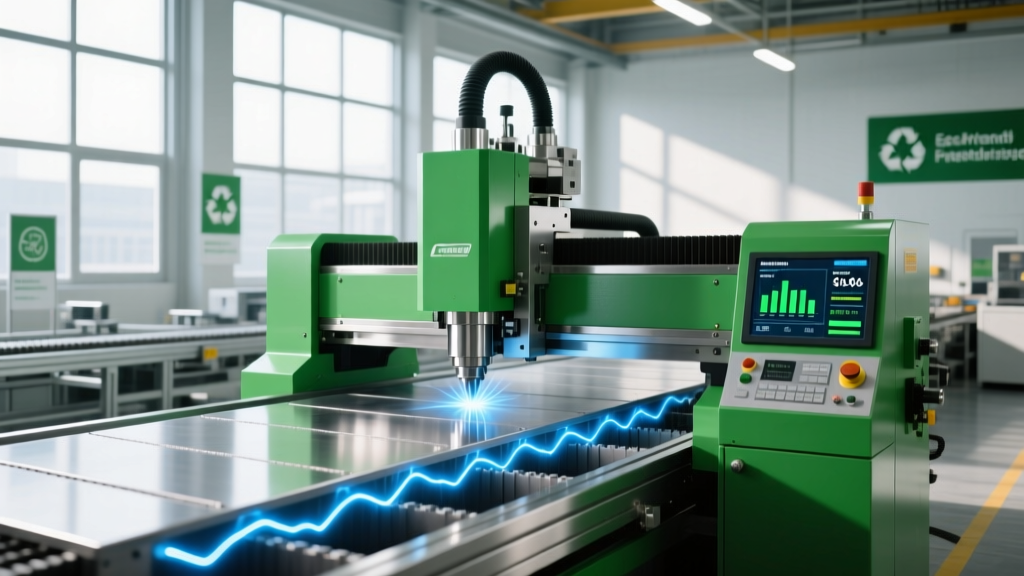
| Metal Cutting (Surgical Tools) | CO2 Laser Systems (4kW) | Fiber Laser with GreenTru (TRUMPF 3030) | 30% lower electrical draw; no laser gas consumables. |
| Device Assembly / Sealing | Chemical Solvent Bonding | Ultrasonic Welding (Herrmann Ultraschall) | 100% elimination of VOCs; no curing time required. |
| Cleanroom Climate Control | Constant Volume AHU Systems | AI-Driven Variable Air Volume (VAV) with EC Motors | 40% reduction in HVAC energy load during non-peak shifts. |
Deep Dive: All-Electric vs. Hydraulic Injection Molding
Manufacturing plastic components for diagnostics (like microfluidic chips and syringe barrels) requires extreme precision and cleanroom compatibility. Legacy hydraulic injection molding machines pose two major sustainability issues: high baseline energy draw to maintain hydraulic pressure, and the risk of hydraulic oil leaks contaminating ISO Class 8 or cleaner environments.
Technical and Financial Breakdown
Comparing a standard 400-ton hydraulic press (priced around $190,000) to an all-electric alternative like the Engel e-mac 460 (priced at approximately $285,000) reveals a clear operational advantage for green manufacturing.
- Energy Consumption: The Engel e-mac operates at roughly 0.35 kWh per kilogram of processed medical-grade polycarbonate, compared to 0.85 kWh/kg for hydraulic equivalents. For a facility running 24/7 producing 5 million parts annually, this translates to an electrical savings of roughly $42,000 per year per machine.
- Cycle Time Reduction: Servo-electric drives offer simultaneous axis movements (ejector, mold, and injection). This reduces dry cycle times by up to 1.2 seconds, increasing throughput by 8-12% without additional energy draw.
- ROI Timeline: Despite the $95,000 capital expenditure premium, the combination of energy savings, eliminated hydraulic oil maintenance (saving ~$4,500 annually in fluid and filter disposal), and increased yield typically results in a break-even period of 2.8 years.
Ultrasonic Welding vs. Chemical Solvent Bonding
Assembling fluid management systems, IV bags, and respiratory masks historically relied on chemical solvents (like cyclohexanone or THF) to melt and fuse PVC or polycarbonate joints. This process generates volatile organic compounds (VOCs), requiring massive, energy-intensive exhaust scrubbers to maintain cleanroom air quality and protect operators.
The sustainable alternative is high-frequency ultrasonic welding. Systems like the Herrmann Ultraschall MicroTouch or Dukane 40kHz iQ Series use localized acoustic friction to melt polymers at the joint interface.
"Transitioning from solvent bonding to 40kHz ultrasonic welding not only eliminates the facility's VOC footprint, but it also removes the 24-hour off-gassing curing period. Parts can be packaged and sterilized immediately, reducing work-in-progress (WIP) inventory footprint by 30%."
While a Dukane 40kHz actuator and generator setup requires an upfront investment of $35,000 to $55,000 per station, the elimination of solvent purchasing, hazardous waste disposal manifests, and localized exhaust ventilation yields a sub-18-month payback period for high-volume respiratory device lines.
Capital Allocation Framework: Retrofit vs. Replace
Facility managers analyzing medical equipment manufacturing industry growth projections must decide whether to retrofit existing legacy equipment with green technology or purchase entirely new sustainable platforms. Use the following decision framework to guide capital expenditure:
- Evaluate the Drive System (Molding & CNC): If your hydraulic presses are under 10 years old, investigate variable frequency drive (VFD) retrofits for the main pump motors. This costs roughly $12,000 per machine and yields a 20-30% energy reduction. If the machines are older than 12 years, bypass retrofits and replace with all-electric models to capture the full 60% efficiency gain and eliminate oil contamination risks.
- Analyze the Thermal Process (Sterilization & Extrusion): For medical tubing extrusion lines, retrofit the heating barrels with nanotechnology insulating jackets (e.g., Firwin Corp coatings). This traps radiant heat, reducing barrel heater energy draw by 25% for under $3,000 per extruder, avoiding the need to replace the entire screw and barrel assembly.
- Assess Cleanroom Airflow Dynamics: Do not replace entire Air Handling Units (AHUs) if the ducting and HEPA filter banks are intact. Instead, retrofit constant-volume fan motors with Electronically Commutated (EC) motors and integrate AI-driven particle counters that modulate air changes per hour (ACH) based on real-time particulate loads rather than static maximums.
Bio-Polymer Extrusion Challenges and Equipment Needs
As the WHO continues to highlight the environmental burden of single-use medical plastics, OEMs are exploring bio-based alternatives like PHA (Polyhydroxyalkanoates) and medical-grade PLA blends for non-implantable housings and packaging.
Processing these sustainable polymers requires specific equipment modifications. Bio-polymers are highly sensitive to shear heat and moisture. Standard single-screw extruders often degrade the material, causing brittleness in diagnostic casings. Sustainable manufacturing lines must utilize:
- Low-Shear Barrier Screws: Specifically designed with a 24:1 L/D ratio to gently melt bio-resins without thermal degradation.
- Desiccant Dryers with Dew Point Monitoring: Bio-polymers must be dried to <50 ppm moisture. Energy-efficient vacuum dryers (like those from Piovan) use 40% less compressed air and electricity than traditional twin-bed desiccant dryers.
Actionable Next Steps for Plant Managers
1. Conduct a baseline energy audit mapping kWh consumption per specific SKU produced.
2. Cross-reference your top 5 energy-consuming assets against the all-electric and ultrasonic alternatives detailed above.
3. Request validation protocols (IQ/OQ/PQ) from equipment vendors to ensure green alternatives meet FDA 21 CFR Part 820 requirements before finalizing purchase orders.