Startup Safety for Sporting Goods Equipment Manufacturers
Navigate OSHA and CPSC compliance for small-scale sporting goods equipment manufacturers. Learn startup safety protocols, machine guarding, and testing.
The Dual-Compliance Burden: Worker vs. Consumer Safety
Launching a sporting goods brand requires more than a viral prototype and a Shopify store. For sporting goods equipment manufacturers operating out of micro-factories and small-scale workshops, navigating the intersection of worker safety and consumer product safety is a severe operational hurdle. Startups in this space face a unique dual-compliance burden: protecting the operators running the manufacturing equipment (governed by OSHA) and ensuring the final athletic gear does not cause catastrophic injury to the end-user (governed by the CPSC and ASTM).
Failing on either front is fatal to a young company. A single missing machine guard can result in crippling fines, while a consumer injury linked to a defective bicycle helmet or weightlifting collar can trigger a mandatory recall and immediate bankruptcy. Understanding how to configure small-scale manufacturing equipment for both operator safety and product integrity is the foundational step for any sporting goods startup.
⚠️ 2026 Penalty Warning: OSHA's maximum penalty for willful machine guarding violations (under 29 CFR 1910.212) now exceeds $161,000 per instance. Startups cannot rely on "small business leniency" when operator amputations or crush injuries occur on unguarded CNC lathes or presses.Small-Scale Equipment Matrix: Guarding and Costs
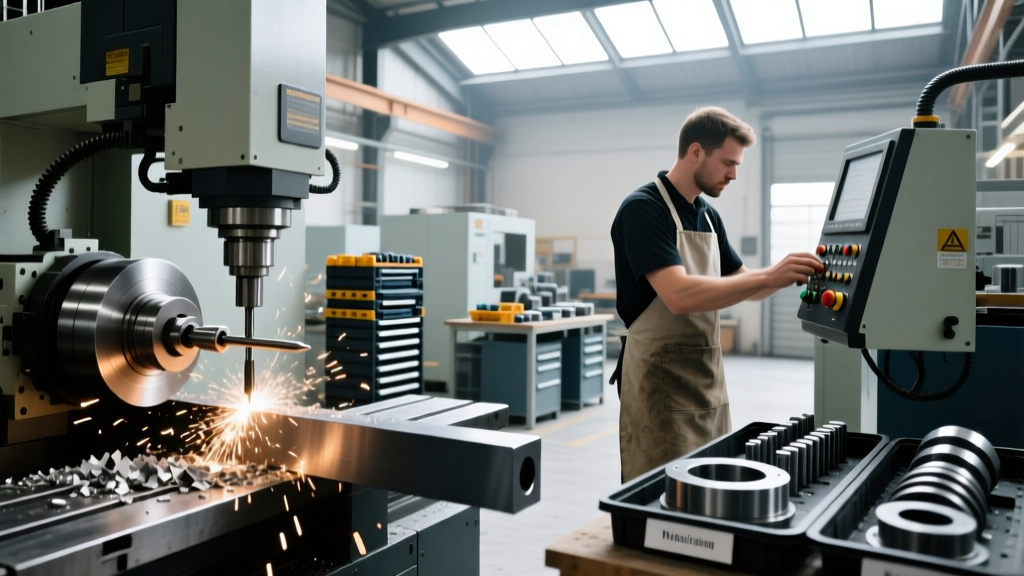
Startups rarely have the capital for fully automated, enclosed production lines. Instead, sporting goods equipment manufacturers rely on compact, semi-manual machinery to produce runs of 500 to 5,000 units. However, smaller machines do not mean smaller hazards. Below is a breakdown of common small-scale equipment used in sporting goods manufacturing, paired with their specific safety guarding requirements and current market costs.
| Equipment Type & Model | Sporting Goods Application | Required Safety Guarding | Est. 2026 Cost |
|---|---|---|---|
| Pocket NC V2-10 (5-Axis CNC) | Titanium golf club heads, custom cleat spikes | Full polycarbonate enclosure with magnetic safety interlock; mist collector. | $5,400 |
| Tormach 15L (CNC Lathe) | Aluminum baseball bat cores, javelin tips | Chuck guard with electrical interlock; heavy-duty splash shielding; emergency stop foot pedal. | $11,800 |
| Formlabs Fuse 1+ 30W (SLS 3D) | Nylon cleat midsoles, custom shin guard shells | Integrated HEPA filtration, thermal shielding, nitrogen inerting system for powder handling. | $28,500 |
| Baileigh DP-1250VS (Drill Press) | Drilling mounting holes for snowboard bindings | Self-adjusting point-of-operation shield; spindle guard; workpiece clamping vise. | $2,100 |
Combustible Dust and Air Quality in Micro-Factories
One of the most overlooked hazards for sporting goods equipment manufacturers is combustible dust. Manufacturing aluminum baseball bats, magnesium bicycle frames, or carbon-fiber hockey sticks generates fine particulate matter that is highly explosive when suspended in air. Startups operating in leased 2,000-square-foot warehouse spaces often make the fatal mistake of relying on standard shop vacuums or basic HVAC filters.
Compliance with OSHA's General Requirements for All Machines and NFPA 484 (Standard for Combustible Metals) dictates strict engineering controls. If your startup machines aluminum or titanium alloys, you must implement the following:
- Wet Dust Collectors: Dry collectors are a severe explosion risk for aluminum dust. Startups must invest in wet scrubber systems (e.g., Torit WSO or equivalent wet downdraft tables) costing between $8,000 and $14,000 to safely trap and neutralize metallic particulates.
- Conductive Tooling and Grounding: All workbenches, CNC enclosures, and dust collection ducts must be bonded and grounded to prevent static discharge, which can ignite accumulated dust.
- Respiratory Protection: When machining carbon fiber composites for tennis rackets or bicycle frames, operators must use NIOSH-approved P100 respirators, as standard N95 masks do not filter microscopic carbon fibers that cause severe respiratory scarring.
Consumer Product Safety Commission (CPSC) Testing Protocols
While OSHA protects your employees, the CPSC protects your customers. Sporting goods equipment manufacturers must validate that their products will not fail under dynamic athletic loads. Startups cannot afford a $150,000 Instron universal testing machine or a high-speed impact drop tower. Instead, the standard industry practice is to design to specific ASTM tolerances and outsource validation to certified third-party laboratories like Intertek or SGS.
💡 Prototyping Tip: Use photoelastic stress analysis films (like Vishay Micro-Measurements PS-1) during the prototyping phase. Applying this $300 coating to a 3D-printed or CNC-machined cleat prototype allows you to visually identify stress concentrations under load using a simple polariscope, saving thousands in failed third-party lab tests.Key consumer safety standards your products must meet before hitting the market include:
- ASTM F1446 / CPSC 16 CFR 1203 (Helmets): If manufacturing cycling or skate helmets, the EPS foam liner and polycarbonate shell must pass impact attenuation tests (peak acceleration cannot exceed 300g) and strap retention tests.
- ASTM F2216 (Selectorized Fitness Equipment): Startups making home-gym cable machines must ensure weight stack guards prevent finger entrapment (no gaps between 0.25 and 0.75 inches) and that cables possess a 6:1 safety factor against breaking under maximum load.
- ASTM F2049 (Fences/Barriers for Sports): Manufacturers of chain-link or netting for baseball cages must validate structural integrity against 100-mph wind loads and baseball impact deflection limits.
"The biggest mistake I see in sporting goods startups is treating material traceability as an afterthought. If a batch of injection-molded polycarbonate fails an impact test, you need the exact resin lot number from the supplier to isolate the failure. Without ISO 9001-style lot tracking from day one, a single defective batch of shin guards will force you to recall your entire year's production."
— Marcus Thorne, Lead Materials Engineer, SportsTech Compliance Group
The 90-Day Startup Compliance Implementation Plan
Integrating safety and compliance into a micro-factory requires a phased approach. Below is a structured 90-day timeline for sporting goods equipment manufacturers to achieve operational readiness before the first production run.
Days 1–30: Facility Layout and Machine Guarding
- Space Planning: Map the facility floor plan ensuring all aisles meet the OSHA 1910.22 minimum width of 3 feet for pedestrian traffic and 4 feet for forklift/pallet jack traffic.
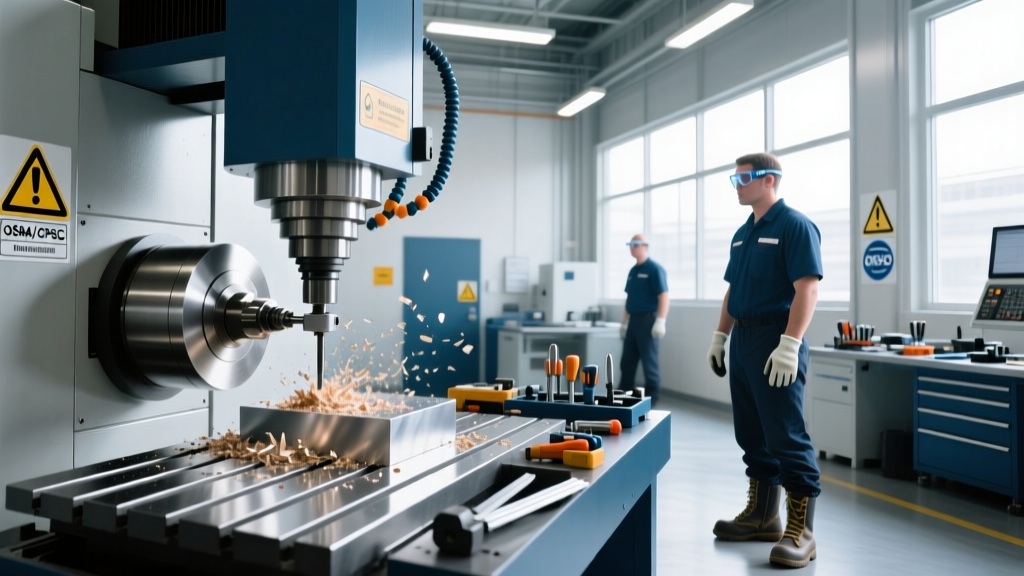
- Interlock Wiring: Hire a certified industrial electrician to wire magnetic safety interlocks to all CNC doors and lathe chucks. The machine spindle must halt within 1.5 seconds of a door opening.
- Lockout/Tagout (LOTO): Draft specific LOTO procedures for every piece of equipment. Generic LOTO policies are a frequent target for OSHA citations. Document the exact valve and breaker locations for the Tormach lathe, the air compressor, and the injection molder.
Days 31–60: Environmental Controls and PPE Matrix
- Air Quality Baseline: Hire an industrial hygienist ($1,500–$2,500) to conduct baseline Personal Breathing Zone (PBZ) air sampling for aluminum dust and VOCs from composite resins.
- PPE Procurement: Issue task-specific PPE. Do not use generic leather gloves near rotating CNC lathes (snag hazard); use cut-resistant nitrile-coated gloves for handling machined edges, and heavy Kevlar sleeves for composite layup.
- Noise Mapping: If ambient noise exceeds 85 dBA (common near vibratory tumblers used for deburring golf clubs), implement a mandatory hearing conservation program and provide 32 NRR ear muffs.
Days 61–90: Product Validation and Certification
- Third-Party Testing: Submit 50 production-intent samples to a CPSC-accepted lab. Budget $3,000 to $8,000 per SKU for full ASTM impact and fatigue testing. Reference the CPSC Testing and Certification guidelines to ensure your lab is properly accredited.
- Children's Product Certificate (CPC): If your sporting goods are sized for children under 12 (e.g., youth baseball bats, junior ski bindings), you must issue a CPC based on third-party testing for lead content and phthalates, in addition to structural testing.
- Insurance Audit: Invite your product liability insurance underwriter to tour the facility. Present your OSHA compliance logs, machine guarding schematics, and ASTM test reports. A well-documented safety program can reduce your product liability premiums by 15% to 25%.
Compliance is not a bureaucratic hurdle; it is a competitive advantage. Sporting goods equipment manufacturers who embed OSHA and CPSC standards into their micro-factory DNA from day one avoid the catastrophic recalls and workplace accidents that routinely destroy undercapitalized startups. Invest in the guarding, validate the materials, and document every step.