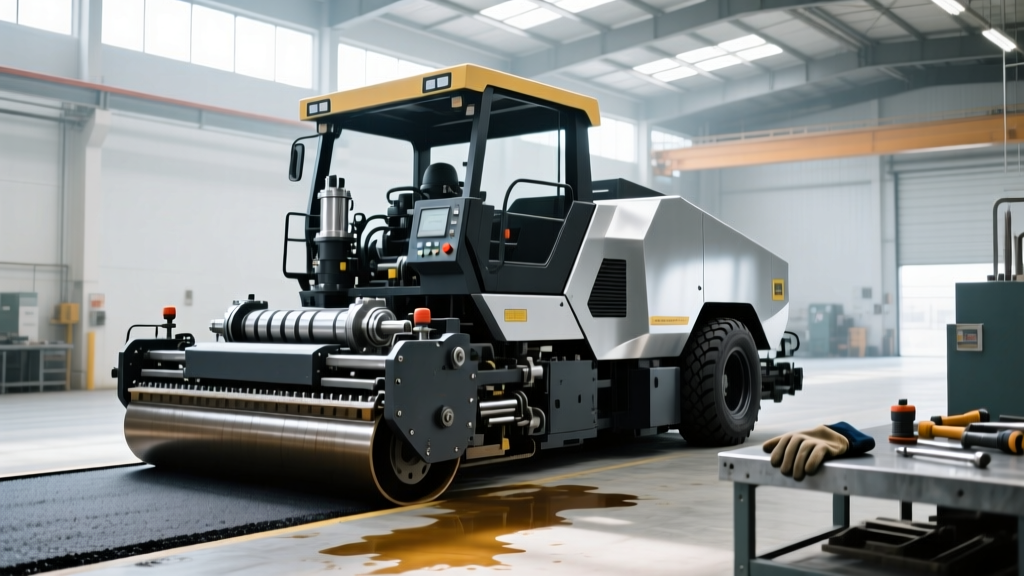
Asphalt Paving Equipment Manufacturers: Lifecycle Management Specs
Explore lifecycle management specs from top asphalt paving equipment manufacturers, covering telematics, wear-part degradation, and overhaul intervals.
The Engineering Behind Paver Lifecycle Management
Modern asphalt pavers are engineered for a baseline operational lifecycle of 10,000 to 12,000 hours before requiring a major powertrain or structural overhaul. Leading asphalt paving equipment manufacturers design these machines around a modular degradation model, separating high-wear consumable components from long-life structural and hydraulic systems. Understanding the technical specifications of this lifecycle is critical for fleet managers aiming to optimize total cost of ownership (TCO) and minimize unplanned downtime during critical paving seasons.
Core Lifecycle Phases Defined by OEMs
- Phase 1: Commissioning & Baseline (0–2,000 Hours): System break-in, telematics calibration, and initial settling of hydraulic hoses and electrical connections.
- Phase 2: Mid-Life Wear Management (2,000–8,000 Hours): Cyclical replacement of ground-engaging tools, screed plates, and conveyor chains based on abrasive wear metrics.
- Phase 3: Major Overhaul & Refurbishment (8,000–12,000+ Hours): Top-end engine rebuilds, hydrostatic pump replacement, and structural NDT (Non-Destructive Testing) of the mainframe and screed extensions.
Telematics Architecture and Predictive Degradation
The foundation of modern lifecycle management relies on the machine's internal Controller Area Network (CAN bus). Current-generation pavers utilize SAE J1939 standard CAN bus architectures, polling over 500 distinct parameters in real-time. While engine RPM and fuel consumption are sampled at 1Hz (once per second), critical hydraulic pressures—such as the screed extension cylinders and hydrostatic drive loops—are sampled at 10Hz to capture micro-fluctuations that indicate internal pump bypass or valve spool wear.
Telematics gateways (such as Cat Product Link or Wirtgen WITOS FleetView) utilize edge computing to process this data locally. Instead of transmitting raw 10Hz data over cellular networks, the gateway calculates rolling averages and flags deviations exceeding 15% from the baseline. According to industry data tracked by the Association of Equipment Manufacturers (AEM), fleets utilizing predictive telematics reduce mid-life hydraulic failures by up to 34% by catching volumetric efficiency drops before catastrophic cavitation occurs.
Metallurgical Specs for High-Wear Components
The material handling system (MHS) and the screed are subject to extreme abrasive and thermal fatigue. Asphalt paving equipment manufacturers specify distinct metallurgical grades for these components to ensure predictable wear patterns rather than sudden brittle fractures.
| Component | Material Specification | MTBR (Hours) | Est. Replacement Cost |
|---|---|---|---|
| Screed Bottom Plates | Hardox 450 / AR450 Steel | 1,200 – 1,500 | $3,200 – $4,800 |
| Auger Flighting | Ni-Hard Cast Iron Overlay | 1,800 – 2,200 | $4,500 – $6,200 |
| Conveyor Chain & Slats | AR400 Steel w/ Induction Pins | 2,500 – 3,000 | $7,500 – $9,800 |
| Tow Point Cylinders | Nitrocarburized Rods | 4,000 – 5,000 | $2,800 per pair |
Screed Heating and Thermal Fatigue
Electric screed heating elements operate at continuous surface temperatures of 250°F to 300°F (121°C to 149°C). Over a 3,000-hour lifecycle, the internal resistance wire undergoes thermal expansion and contraction, leading to micro-fractures in the magnesium oxide insulation. When the resistance variance between the left and right screed extensions exceeds 8%, the temperature differential will cause uneven asphalt mat compaction. Technicians must perform annual megohmmeter (megger) testing to detect insulation breakdown before the element shorts to the screed casing.
Hydrostatic Drive and Powertrain Overhaul Protocols
The transition from mid-life maintenance to major overhaul is typically triggered by the hydrostatic drive system. Pavers utilize variable-displacement axial piston pumps (commonly Rexroth or Danfoss units) for the traction drive. By the 8,000-hour mark, internal slip within the pump's swashplate and piston shoes reduces volumetric efficiency.
Diagnostic Protocol: To measure volumetric efficiency, technicians install an inline flow meter on the pump's case drain line. If case drain flow exceeds 12% of the pump's maximum rated displacement at 2,500 PSI system pressure, the pump requires a complete rotating group replacement. Ignoring this spec leads to traction loss on inclines and erratic paving speeds, directly violating the smoothness tolerances mandated by the National Asphalt Pavement Association (NAPA) for highway-grade projects.Similarly, the primary diesel engines (such as the Cummins QSB 6.7 or Deutz TCD 4.1) require a top-end overhaul between 8,000 and 10,000 hours. This involves replacing cylinder liners, piston rings, and the turbocharger cartridge. Unlike highway trucks, paver engines operate under high-ambient-temperature conditions due to proximity to the asphalt hopper and exhaust routing, accelerating oil coking and valve guide wear.
Decision Framework: Rebuild vs. Replace
When a paver approaches the 10,000-hour threshold, fleet managers must execute a strict financial and technical analysis to determine whether to refurbish the existing chassis or procure a new unit. Use the following framework to guide the capital expenditure decision:
- Mainframe NDT Assessment: Perform magnetic particle inspection (MPI) on the mainframe welds, specifically at the hopper pivot points and screed arm mounting brackets. If stress fractures exceed 2mm in depth, the chassis is condemned. Cost: $1,200 for NDT.
- Calculate the 50% Rule: Tally the cost of the engine overhaul ($8,500), hydrostatic pump rebuilds ($12,000), and complete MHS replacement ($18,000). If this total exceeds 50% of the current market replacement value of a new equivalent model, replacement is the mathematically sound choice.
- Emissions & Software Compatibility: Evaluate the existing engine's Tier level. If the machine utilizes a Tier 3 engine, retrofitting it to meet 2026 local municipal emissions mandates for urban paving contracts may require a $25,000+ DPF (Diesel Particulate Filter) integration, heavily skewing the ROI toward purchasing a new Tier 4 Final or electric-battery hybrid paver.
Summary of OEM Lifecycle Support
Effective lifecycle management requires moving beyond reactive maintenance. By leveraging high-frequency CAN bus telematics, adhering strictly to metallurgical replacement intervals for wear parts, and executing precise volumetric testing on hydrostatic systems, operators can safely extend the profitable life of their paving fleet. Asphalt paving equipment manufacturers design these systems with specific failure thresholds in mind; respecting those engineering boundaries is the only way to guarantee mat quality and protect the machine's residual value.