Operator Training for IoT Sensors on Pizza Manufacturing Equipment
Master operator training for IIoT sensors on pizza manufacturing equipment. Learn calibration, data interpretation, and predictive maintenance best practices.
Bridging the Gap Between IIoT Data and Line Operators
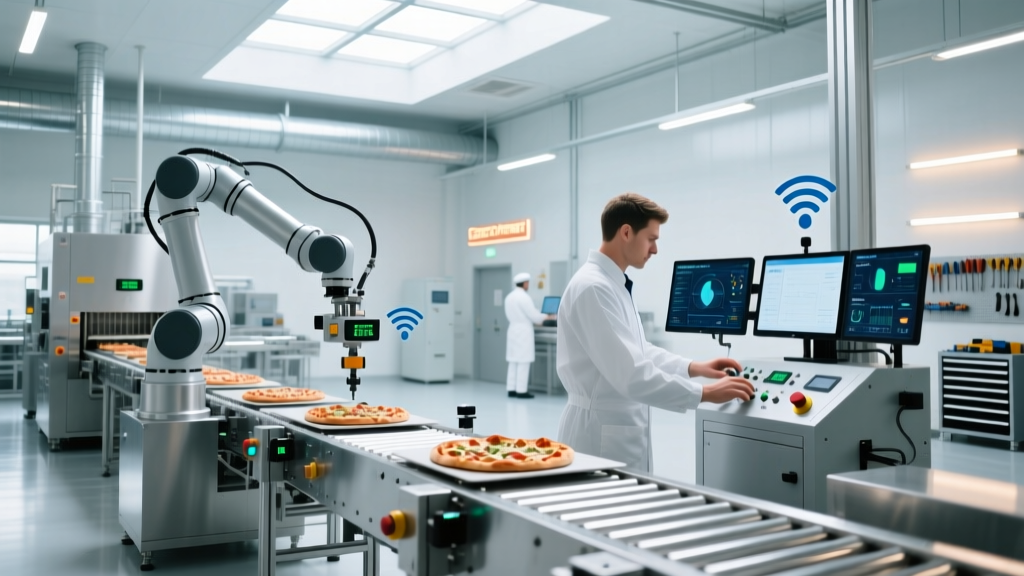
Modern automated pizza manufacturing equipment—from Reading Bakery Systems (RBS) continuous mixers to Fritsch tunnel ovens—relies heavily on Industrial IoT (IIoT) sensors to maintain throughput, ensure crust consistency, and guarantee food safety. However, a $500,000 sensor network is functionally useless if line operators treat the Human-Machine Interface (HMI) as a passive display rather than an active diagnostic tool.
The most common failure mode in high-volume frozen pizza plants is not sensor hardware failure, but operator misinterpretation of IIoT alerts. When an operator ignores a subtle vibration trend on a dough sheeting extruder, a minor bearing fault escalates into a catastrophic line stoppage, costing upwards of $14,000 per hour in lost throughput. This guide outlines exact, actionable training protocols for IIoT sensor management, specifically tailored for pizza manufacturing equipment operators.
The Core IIoT Sensor Suite on Pizza Lines
Before operators can interpret data, they must understand the physical realities of the sensors deployed across the line. Training must move beyond generic 'sensor basics' and focus on the specific models and metrics used in pizza production.
| Equipment Zone | Sensor Type & Example Model | Primary Metric Monitored | Critical Threshold (Action Required) |
|---|---|---|---|
| Continuous Dough Mixer | Acoustic/Vibration (e.g., Banner QM42VT2) | Gearbox bearing wear & dough cavitation | Velocity >0.4 in/s RMS |
| Tunnel Oven (Par-Bake) | Infrared Thermal Array (e.g., Fluke RSE300) | Belt surface temp & crust blistering | Deviation >±5°F from setpoint |
| Automated Topping Dispenser | Photoelectric/Optical (e.g., SICK WTB4F) | Pepperoni/cheese drop volume & flow | Signal loss >200ms (blockage) |
| Spiral Freezer | Accelerometer (e.g., SKF Multilog IMx) | Belt tension & drive motor alignment | High-frequency spike >2g |
| Sauce Applicator | Coriolis Mass Flow Meter (e.g., Endress+Hauser) | Sauce density & volumetric flow rate | Density shift >±0.02 g/cm³ |
Operator Dashboard Triage: The 3-Tier Response System
Operators must be trained to differentiate between a 'Process Deviation' (requiring a recipe or feed tweak) and an 'Equipment Fault' (requiring maintenance intervention). Implement the following 3-tier triage framework on the SCADA dashboard:
Tier 1: Process Drift (Yellow Alerts)
These alerts indicate the equipment is functioning correctly, but the product parameters are shifting. For example, if the microwave resonance sensor (e.g., Tews Elektronik) on the dough sheeter reports a moisture drop of 1.2%, the operator must adjust the water dosing valve at the mixer, not call maintenance.
Tier 2: Sensor Degradation (Orange Alerts)
The equipment and product are fine, but the sensor's confidence score is dropping. This usually indicates lens fouling or calibration drift. Operators must execute Tier-1 cleaning protocols (detailed below) and acknowledge the alert in the HMI.
Tier 3: Imminent Equipment Failure (Red Alerts)
These alerts indicate mechanical degradation. If the spiral freezer accelerometer detects a 2g high-frequency spike, it indicates belt mistracking or a failing sprocket bearing. Operators must initiate a controlled ramp-down of the freezer and immediately dispatch the predictive maintenance team. Replacing a freezer drive chain during a planned 2-hour changeover costs roughly $3,500; an unplanned failure mid-shift can result in $40,000 of scrapped product as the freezer thaws.
⚠️ The Flour Dust Problem: A Critical Training Focus
Flour dust (particle size ~10-100 microns) is highly abrasive, hygroscopic, and the number one enemy of optical sensors on pizza manufacturing equipment. It coats photoelectric lenses on topping dispensers and capacitive sensors on dough hoppers.
Best Practice: Operators must never use standard compressed air to clean SICK or Keyence optical sensors. Compressed air drives fine flour dust into the sensor's IP67 seals, causing internal condensation and short-circuiting the emitter. Train operators to use ionized air guns every 4 hours to safely neutralize and blow dust off optical lenses without damaging the housing.
Step-by-Step Calibration for Dough Hydration Sensors
Maintaining exact dough hydration (typically 38-42% for frozen pizza crusts) is critical for par-bake oven performance. Inline microwave moisture sensors require regular operator verification. Train operators on this exact 4-step calibration offset procedure:
- Extract a Physical Grab Sample: Pull 500g of dough directly from the sheeter belt immediately after the sensor reading is logged.
- Rapid Moisture Analysis: Run the sample through the lab halogen moisture analyzer (e.g., Mettler Toledo HE73). Target time: 4 minutes.
- Compare and Calculate Delta: Compare the lab result against the HMI's 5-minute rolling average. If the HMI reads 40.1% and the lab reads 39.6%, the delta is -0.5%.
- Input the Offset: Access the 'Sensor Calibration' tab on the HMI (requires operator-level passcode). Input the -0.5% offset. The PLC will automatically adjust the baseline algorithm for the next 8-hour shift.
Troubleshooting Decision Matrix: Mixer Vibration Alarms
When a continuous mixer triggers a high-vibration IIoT alarm, operators often default to shutting down the line. Train them to use this decision matrix to identify false positives caused by process conditions rather than mechanical faults.
- Alarm: Mixer Vibration >0.4 in/s RMS.
Check 1: Is the dough batch size correct? Underloading the mixer causes the dough to slosh and cavitate against the agitator blades, creating a false vibration signature. Action: Verify batch weight. If underloaded, adjust feeder. - Alarm: Mixer Vibration >0.4 in/s RMS.
Check 2: Check the gearbox oil temperature via the secondary IIoT tag on the HMI. Action: If oil temp is >180°F alongside high vibration, this confirms mechanical bearing failure. Halt the line immediately. - Alarm: Mixer Vibration >0.4 in/s RMS.
Check 3: Check the ambient temperature sensor in the mixer jacket. Action: If glycol cooling temp is >45°F, the dough is overheating, increasing viscosity and motor load. Increase glycol flow rate before assuming mechanical failure.
Hygiene, Washdown, and FSMA Compliance
IIoT sensors on food contact surfaces or splash zones must endure harsh CIP (Clean-in-Place) washdowns. Operators must be trained to inspect sensor physical integrity as part of their food safety mandate. According to the FDA's FSMA Preventive Controls rule, facilities must implement measures to prevent allergen cross-contact and microbial harborage.
Sensors with frayed M12 connector cables or cracked polycarbonate lenses create microscopic crevices where Listeria monocytogenes can thrive. Operators must perform a visual 'tug and inspect' test on all IP69K-rated sensor cables during the pre-shift sanitation verification. Furthermore, as facilities integrate more edge-computing gateways to process this sensor data locally, operators and IT staff must adhere to baseline network security protocols to prevent unauthorized access to the plant's operational technology (OT) network, aligning with guidelines established by the NIST Cybersecurity Framework for IoT.
Continuous Training and the ISO Standard
Sensor technology evolves rapidly. The deployment of edge-AI for acoustic anomaly detection on pizza line gearboxes is becoming standard. To maintain operational excellence, training cannot be a one-time onboarding event. Implement monthly 'IIoT Scenario Drills' where shift supervisors inject simulated sensor faults into the training SCADA environment. Operators must correctly diagnose and triage the simulated faults within 5 minutes.
By aligning your operator training with the ISO/IEC 30141 IoT Reference Architecture principles, you ensure that your workforce treats data as a critical manufacturing input, just like flour, yeast, and water. When operators understand the 'why' behind the data, pizza manufacturing equipment uptime increases, scrap rates plummet, and the ROI on your IIoT investment is fully realized.