Pool Equipment Manufacturer Guide: Lifecycle Management Alternatives
Compare OEM, TPM, and in-house lifecycle management strategies for injection molding and CNC assets used by a pool equipment manufacturer.
The Unique Production Demands of a Pool Equipment Manufacturer
Operating a facility that produces swimming pool pumps, large-format sand filters, and automated chlorinators requires a highly specialized mix of heavy-tonnage injection molding and precision CNC machining. For a pool equipment manufacturer, production seasonality is a brutal reality: downtime in March directly translates to missed summer revenue. Consequently, manufacturing equipment lifecycle management cannot be treated as a reactive afterthought. It requires a proactive, data-driven strategy that weighs Original Equipment Manufacturer (OEM) support against Third-Party Maintenance (TPM) and in-house refurbishment alternatives.
In 2026, the integration of low-cost IoT vibration and thermal sensors (averaging $350 to $500 per node) has fundamentally shifted lifecycle management from schedule-based to condition-based. However, the core decision matrix regarding who services the equipment and when to replace capital assets remains complex. This analysis breaks down the lifecycle alternatives for the two most critical asset classes in pool equipment production: high-tonnage injection molders and vertical machining centers.
Core Asset Classes and Their Specific Failure Modes
Before comparing maintenance strategies, it is critical to understand the specific wear profiles of the machinery used to manufacture pool components.
1. High-Tonnage Injection Molders (Filter Housings & Pump Volumes)
Manufacturing large sand filter tanks and pump strainer baskets typically requires 250-ton to 400-ton clamping force machines, such as the Haitian Mars 3300 III. The primary lifecycle adversary here is material abrasion. Pool filter housings are frequently molded from 30% glass-filled Polypropylene (PP) to withstand high PSI and UV degradation. This glass-filled resin acts like sandpaper on the plasticizing screw and barrel.
- Standard Nitrided Barrel: Yields a lifecycle of 12 to 18 months under continuous glass-filled PP production. Replacement cost: $1,200 to $1,800.
- Tungsten Carbide Bimetallic Barrel (Alternative): Extends lifecycle to 5 to 7 years. Upfront replacement cost: $5,500 to $6,800. Despite the 4x initial cost, the reduction in unplanned downtime and scrap rates makes this the superior lifecycle choice for high-volume pool equipment runs.
2. Vertical Machining Centers (Impellers & Heat Exchangers)
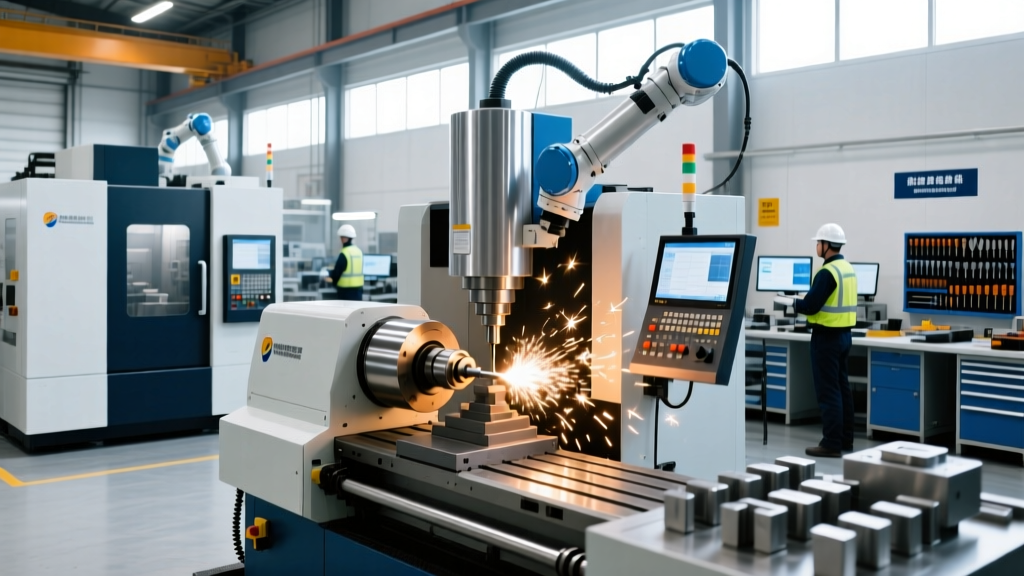
Machining bronze (C83600) pump impellers and brass multiport valve bodies requires rigid VMCs like the Haas VF-3SS. Bronze is a 'gummy' material prone to Built-Up Edge (BUE) on cutting tools, which increases cutting forces and accelerates spindle bearing degradation. Furthermore, fine bronze particulate can bypass standard way-cover seals, contaminating the spindle lubrication system.
Comparing Lifecycle Maintenance Strategies
When managing these assets, a pool equipment manufacturer must choose between three primary maintenance frameworks. The following matrix compares the operational realities of each approach for a mid-sized facility running a 10-machine injection molding cell and a 6-machine CNC department.
| Strategy | Estimated Annual Cost (Per Cell) | Mean Time to Repair (MTTR) | Pros | Cons & Risks |
|---|---|---|---|---|
| OEM Service Contracts | $18,000 - $24,000 | 48 - 72 hours | Guaranteed genuine parts; proprietary software updates included; maintains warranty compliance. | Highest cost; OEM technicians often prioritize newer models, leaving legacy pool equipment tooling at the bottom of the queue. |
| Third-Party Maintenance (TPM) | $9,500 - $13,000 | 12 - 24 hours | Faster local response times; highly flexible SLA terms; technicians often have cross-brand expertise. | May void proprietary software warranties; TPMs may source aftermarket parts that alter machine tolerances. |
| In-House Mechatronics Team | $110,000+ (Salary + Benefits + Tooling) | 2 - 8 hours | Immediate response; deep institutional knowledge of specific pool part molds and fixtures. | High fixed overhead; difficult to recruit specialized talent for niche PLC and servo-drive troubleshooting. |
According to the ISO 55001 Asset Management Standards, effective lifecycle management requires aligning maintenance expenditures directly with the criticality of the asset to the organization's strategic objectives. For a seasonal pool equipment manufacturer, a 48-hour MTTR during peak Q1 production is unacceptable, making TPM or In-House strategies vastly superior to OEM contracts for critical path machinery.
End-of-Life Alternatives: Refurbishment vs. Replacement
Every manufacturing asset eventually reaches a point where maintenance costs exceed the economic value of the machine's output. For a pool equipment manufacturer, deciding whether to rebuild an aging injection molder or purchase new capital equipment requires a strict financial framework.
The 50% CapEx Rule for Equipment Lifecycle
If the cost of a major lifecycle refurbishment (e.g., replacing the toggle mechanism, tie bars, and hydraulic pump on an injection molder) exceeds 50% of the cost of a new, equivalent machine, the alternative of purchasing new equipment must be triggered. New machines in 2026 feature 20-30% better energy efficiency via servo-hydraulic drives, which drastically alters the Total Cost of Ownership (TCO) calculation over a 10-year horizon.
Alternative: The Secondary Equipment Market
When capital expenditure budgets are constrained, purchasing refurbished equipment from the secondary market is a highly viable lifecycle alternative. A 5-year-old Milacron Roboshot** or **Engel e-mac can often be acquired for 40% to 50% of its original MSRP. However, the buyer must factor in the cost of re-commissioning:
- Ball Screw and Linear Guide Inspection: Bronze dust from previous machining operations or degraded grease in molding robots can cause micro-pitting. Budget $2,500 for laser interferometry calibration.
- Control System Upgrades: Older PLCs may not support modern OPC-UA protocols required for integration into the factory's centralized SCADA system. Retrofitting an IoT gateway (e.g., Ignition Edge) costs approximately $3,000 to $5,000 per machine.
Integrating Predictive Analytics into Lifecycle Planning
The most advanced pool equipment manufacturers are no longer relying on calendar-based oil changes or scheduled spindle rebuilds. By leveraging NIST-backed advanced manufacturing research on predictive maintenance, facilities are deploying acoustic emission sensors on CNC spindles and hydraulic pressure transducers on injection molders.
For example, monitoring the acoustic signature of a Haas VF-3SS spindle during the roughing pass of a bronze impeller can detect bearing race defects up to 60 days before catastrophic failure. This allows the maintenance team to schedule a spindle cartridge swap ($14,000) during a planned weekend mold changeover, rather than suffering an unplanned Tuesday morning crash that ruins a $4,000 custom mold base and halts the pump assembly line.
Strategic Recommendations for 2026
To optimize manufacturing equipment lifecycle management, a pool equipment manufacturer should adopt a hybrid approach based on asset criticality:
- Tier 1 Assets (Critical Path / High Volume): Utilize an In-House technician for daily triage, backed by a TPM contract for complex servo and PLC failures. Invest heavily in bimetallic barrels and IoT condition monitoring.
- Tier 2 Assets (Secondary Operations / Low Volume): Rely on run-to-failure or basic preventive maintenance. When these machines reach end-of-life, replace them with certified refurbished alternatives from the secondary market to preserve CapEx for Tier 1 upgrades.
- Tier 3 Assets (Ancillary / Support): Outsource entirely to OEM or local generalist repair shops, accepting longer MTTR in exchange for zero fixed overhead.
By segmenting assets and applying the correct maintenance and replacement alternatives, manufacturers can insulate their production schedules from the severe penalties of seasonal downtime, ensuring a steady supply of pool equipment to distributors when demand peaks. For further insights on maximizing Overall Equipment Effectiveness (OEE) through reliability engineering, consult the SME Maintenance and Reliability resources.