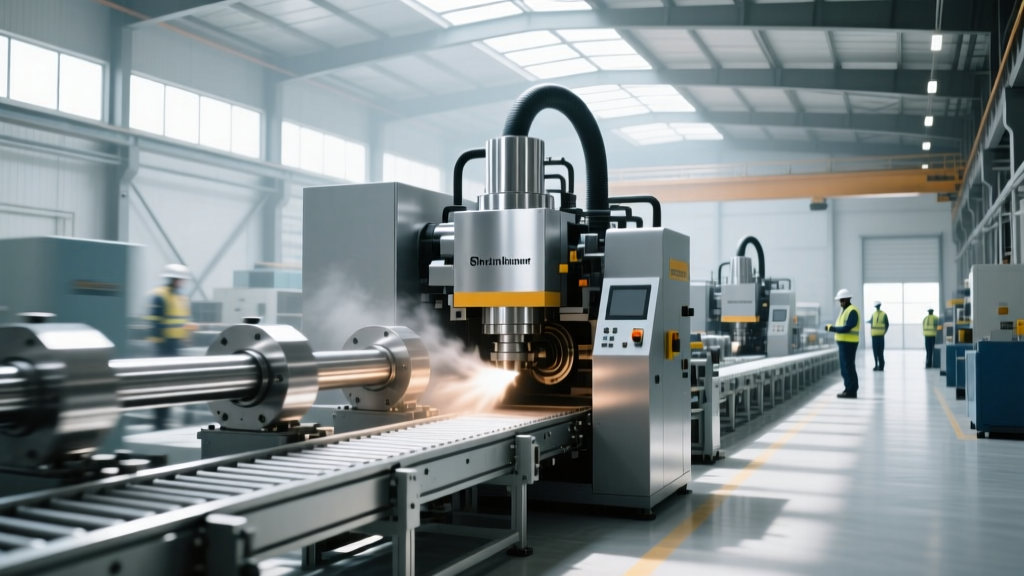
Shot Blasting Equipment Manufacturers: Navigating CE, UL & CSA Marks
Discover how leading shot blasting equipment manufacturers achieve CE, UL, and CSA compliance. Real-world case studies, costs, and certification timelines.
When a Tier 1 aerospace supplier installs a 12-wheel continuous pass-through shot blast machine, the kinetic energy of the media and the electrical load of 75HP blast motors are only half the engineering challenge. The other half is regulatory compliance. For plant managers and procurement engineers, sourcing from global shot blasting equipment manufacturers requires a rigorous understanding of how CE, UL, and CSA marks translate from factory-floor engineering to local Authority Having Jurisdiction (AHJ) approvals.
Non-compliance is not a paperwork error; it is a physical hazard and a financial liability. A control panel lacking the correct Short Circuit Current Rating (SCCR) can result in an arc flash event, while improper dust mitigation in aluminum blasting can trigger catastrophic deflagration. This guide dissects the exact compliance frameworks, real-world retrofit costs, and procurement checklists required when evaluating heavy surface preparation machinery.
The Regulatory Matrix: CE, UL, and CSA Decoded
Global shot blasting equipment manufacturers must design machines that satisfy regional safety directives. However, a CE mark affixed in Germany does not automatically satisfy an electrical inspector in Ohio. The divergence lies primarily in electrical enclosure standards and combustible dust protocols.
| Mark | Primary Machinery Standard | Electrical Panel Standard | Dust/Explosion Focus |
|---|---|---|---|
| CE (Europe) | Machinery Directive 2006/42/EC (ISO 12100) | EN 60204-1 | ATEX Directive 2014/34/EU |
| UL (USA) | OSHA 29 CFR 1910 / ANSI B11 | UL 508A / NFPA 79 | NFPA 484 / NFPA 652 |
| CSA (Canada) | CSA Z432 / Provincial OH&S | CSA C22.2 No. 14 / C22.2 No. 286 | CSA Z7396.1 (Combustible Dust) |
According to the European Commission's CE marking guidelines, the manufacturer bears full responsibility for risk assessment under ISO 12100. Conversely, in North America, the local AHJ (usually a city or state electrical inspector) holds the final authority to red-tag a machine if the control panel lacks a recognized UL or CSA field label.
The Electrical Bottleneck: SCCR and Wire Color Codes
The most frequent point of failure when importing shot blasting equipment from European or Asian manufacturers into North America is the electrical control panel.
Short Circuit Current Rating (SCCR)
Modern automotive foundries and structural steel fabricators often have high available fault currents (AFC) on their busbars—frequently 65kA or higher. Under UL 508A, every industrial control panel must have a calculated SCCR that meets or exceeds the AFC of the facility. Many international shot blasting equipment manufacturers build panels rated for only 10kA or 22kA (standard IEC baselines). If a plant with 65kA AFC installs a 22kA panel, the AHJ will halt the installation. Retrofitting a 480V/3-phase blast machine panel with current-limiting fuses and higher-rated contactors to achieve a 65kA SCCR typically costs between $12,000 and $18,000 and delays commissioning by up to four weeks.
Wiring Color Code Conflicts
IEC 60204-1 (CE) and NFPA 79 (UL) utilize different wire color standards. For example, IEC mandates blue for 24V DC control circuits, while NFPA 79 historically favors blue for DC but has specific exceptions for grounded conductors. More critically, IEC uses black for 480V AC power, whereas UL 508A strongly prefers black for ungrounded AC, but requires orange for interlock circuits that remain live when the main disconnect is off. International manufacturers must build dual-standard panels or rewire upon arrival to pass North American inspections.
⚠️ WARNING: The Combustible Dust TrapShot blasting aluminum, magnesium, or titanium components generates highly reactive, explosive dust. The OSHA National Emphasis Program on Combustible Dust strictly enforces NFPA 484 standards. Dry cartridge dust collectors on aluminum blast machines must feature explosion venting, chemical suppression, or be located outdoors with specific deflagration venting ducts. Never accept a standard steel-plate dust collector for non-ferrous blasting without verified Kst value testing and Pred calculations.
Case Study 1: The $28,000 AHJ Red-Tag Incident
Scenario: An Ohio-based aerospace Tier 1 manufacturer purchased a continuous pass-through spinner hanger blast machine from a prominent European manufacturer. The machine was CE-marked and featured state-of-the-art abrasive recycling.
The Failure: Upon installation, the local electrical inspector reviewed the main 600A disconnect panel. The panel was built to EN 60204-1 but lacked a UL 508A label. Furthermore, the grounding busbar did not meet the specific sizing requirements for the facility's 480Y/277V system, and the SCCR documentation was missing.
The Resolution: The machine was red-tagged. The buyer had to hire a local UL-certified panel shop to audit, rewire the control circuits, replace the main disconnect with a UL-listed rotary switch, and perform a formal SCCR calculation. Financial Impact: $28,500 in panel retrofitting, plus $14,000 in delayed production penalties. Takeaway: Procurement must explicitly mandate 'UL 508A Listed Panel with SCCR matching site AFC' in the RFQ, rather than accepting 'CE compliant electricals' as a substitute.
Case Study 2: ATEX Zone 20 Integration for Titanium Implants
Scenario: A medical device manufacturer in Switzerland required a robotic shot peening cabinet for titanium hip stems. Titanium dust is notoriously pyrophoric.
Engineering Solution: The chosen shot blasting equipment manufacturer designed the interior of the cabinet as an ATEX Zone 20 environment (where explosive dust is present continuously). To achieve this, the manufacturer implemented several specific engineering controls:
- Inert Gas Purging: Integration of an automated nitrogen purge system to reduce oxygen levels below the Limiting Oxygen Concentration (LOC) before blasting commenced.
- Grounding Verification: Installation of continuous resistance-monitoring grounding straps on all robotic blast nozzles to prevent static discharge.
- ATEX-Certified Airlocks: Use of specialized rotary airlocks with non-sparking rotor tips to discharge media without allowing oxygen ingress.
This integration added roughly 22% to the base capital cost of the equipment but ensured full compliance with EU Directive 2014/34/EU, preventing potential facility destruction.
Procurement Checklist: What to Demand in Your RFQ
To avoid post-delivery compliance failures, plant engineers must move beyond asking 'Is it CE/UL certified?' and demand specific technical documentation during the bidding phase. Include these exact requirements in your next RFQ to shot blasting equipment manufacturers:
- SCCR Calculation Document: Require a preliminary SCCR calculation based on your facility's provided Available Fault Current (AFC) and voltage.
- Dust Kst & Pred Data: If blasting non-ferrous metals or composite coatings, require the manufacturer to specify the Kst (deflagration index) and Pred (reduced explosion pressure) ratings of the integrated dust collector.
- Safety PLC Architecture: Specify that safety interlocks (e.g., blast cabinet door switches, maintenance access hatches) must be wired to a dedicated Safety PLC (e.g., Allen-Bradley GuardLogix or Siemens F-DI/F-DO) achieving at least ISO 13849-1 Performance Level 'd' (PLd).
- Third-Party Panel Listing: For North American deliveries, explicitly state: 'Control panels must bear a serialized UL 508A or CSA C22.2 label from an Nationally Recognized Testing Laboratory (NRTL), not just a manufacturer self-declaration.'
'The cheapest shot blast machine on the market is often the most expensive one to commission. Manufacturers who cut corners on UL 508A panel building and NFPA 484 dust mitigation shift the compliance risk—and the cost—directly onto the end user.' — Senior Industrial Safety Engineer, Heavy Manufacturing Sector
The Financial Reality of Certification Upgrades
Understanding the cost breakdown of compliance helps procurement teams evaluate bids accurately. Below is the estimated compliance premium for a standard $350,000 automated monorail blast system destined for a North American facility processing mixed steel and aluminum castings.
| Compliance Upgrade | Standard Base Machine | Fully Compliant (UL/NFPA) | Cost Delta |
|---|---|---|---|
| Control Panel (UL 508A & 65kA SCCR) | $18,000 (IEC Base) | $32,000 | +$14,000 |
| Dust Collection (NFPA 484 Compliant) | $25,000 (Standard Cartridge) | $58,000 (Wet Scrubber / Vented) | +$33,000 |
| Safety Interlock Wiring (PLd / Cat 3) | $4,500 (Standard Relays) | $11,500 (Safety PLC / Trapped Key) | +$7,000 |
| Total Capital Equipment Cost | $347,500 | $401,500 | +$54,000 (15.5%) |
While the 15.5% premium for verified compliance may seem steep during initial CAPEX approval, it is a fraction of the cost of a post-installation AHJ rejection, a forced dust collector replacement, or an OSHA citation following a near-miss deflagration event. By understanding the distinct requirements of CE, UL, and CSA marks, manufacturing leaders can partner with shot blasting equipment manufacturers to engineer safety directly into the production line.