Startup Equipment: Honda Power Equipment Manufacturing Swepsonville NC Case Study
Learn how hardware startups can scale production using small-scale manufacturing equipment, inspired by the Honda Power Equipment Swepsonville NC plant.
The Swepsonville Blueprint: Phased Scaling for Hardware Startups
Hardware startups building power equipment, small engines, or electromechanical assemblies frequently fail in the 'valley of death' between prototype and mass production. The primary culprit is premature capital expenditure on oversized factory equipment. When analyzing the operational trajectory of Honda Power Equipment Manufacturing Swepsonville NC, founders uncover a masterclass in phased capital deployment. The Swepsonville facility did not launch as a fully automated mega-factory; it began with targeted, scalable assembly cells and localized its supply chain incrementally over two decades.
For a startup manufacturing next-generation generators, battery-powered outdoor equipment, or specialized pumps, mimicking this localized, phased approach requires a highly specific selection of small-scale manufacturing equipment. According to the NIST Manufacturing Extension Partnership, startups that adopt modular, scalable micro-factory layouts reduce their initial CapEx by up to 65% while maintaining the flexibility to pivot designs based on early market feedback.
Phase 1 Micro-Factory: Essential Small-Scale Equipment
To replicate the early agility of major OEMs without the multi-million-dollar overhead, startups must equip a 'Phase 1' micro-factory (typically 2,000 to 5,000 square feet) with machinery that balances precision with low footprint. Here is the exact equipment stack required for low-volume power equipment production.
1. Precision CNC Machining for Prototypes and Jigs
Before committing to $80,000 cast-iron tooling for engine blocks or pump housings, startups must iterate designs using in-house CNC machining. The Tormach 1100MX CNC Mill (base price ~$22,500) is the industry standard for hardware startups. It handles 6061-T6 aluminum and Delrin plastics with enough rigidity to machine functional prototype crankcases and custom assembly jigs. For tighter tolerances on small steel shafts, a Haas Desktop Mill ($15,000) provides the necessary spindle speed (up to 20,000 RPM) for micro-endmills.
2. Modular Assembly Infrastructure
Welded steel workbenches are a liability for scaling startups. Instead, utilize 80/20 Inc. 1515 or 4040 series aluminum extrusions. These allow you to reconfigure assembly cells in hours rather than days. Pair these with ergonomically adjustable pneumatic lift tables (e.g., Southworth P4000, ~$4,500) to prevent operator fatigue during heavy small-engine assembly.
3. Torque-Controlled Fastening Systems
Power equipment vibration will loosen improperly torqued fasteners, leading to catastrophic field failures. Do not rely on manual click-wrenches for production. Invest in DC-electric torque drivers like the Cleco CellCore or Atlas Copco Tensor. While the initial tool and controller cost roughly $4,500 per station, they provide digital torque-angle logging for every single crankcase bolt, ensuring ISO-level quality control from unit number one.
⚠️ The Swepsonville Rule of Automation: Never purchase Phase 3 automated machinery for Phase 1 volumes. If your daily run rate is under 50 units, human operators using modular jigs will always outperform a $150,000 robotic palletizing cell in both ROI and adaptability.Building the Power Equipment Assembly Cell: A Step-by-Step Flow
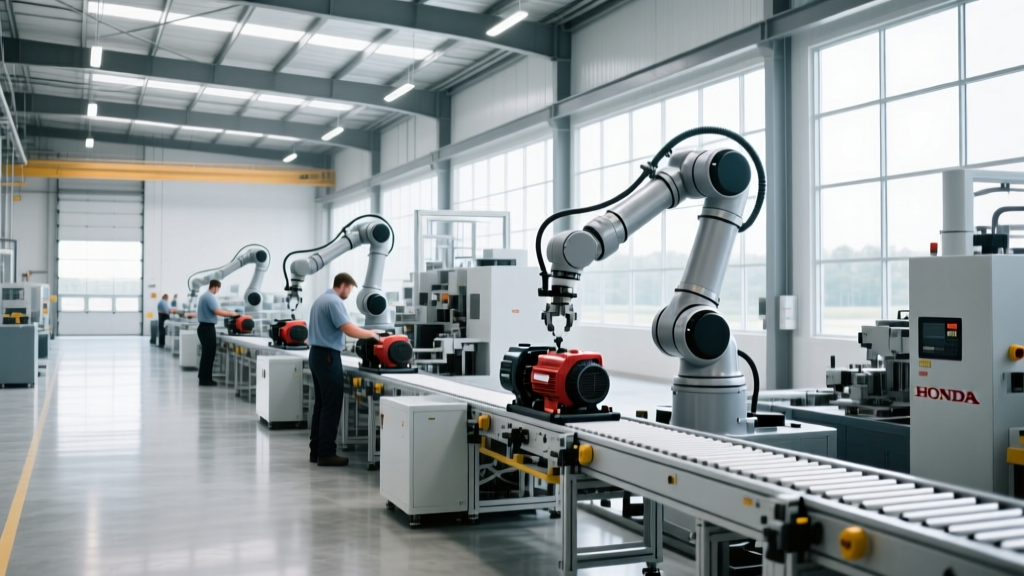
Translating the Honda corporate manufacturing philosophy of 'flow and pull' into a startup environment requires a disciplined layout. Follow this sequence to establish your first high-yield assembly cell:
- Define the Takt Time: Calculate your required daily output divided by available shift minutes. If you need 40 generators a day in an 8-hour shift, your takt time is exactly 12 minutes per unit.
- Segment Sub-Assemblies: Break the build into 12-minute chunks. Station 1: Short-block and crankshaft mating. Station 2: Stator and flywheel installation. Station 3: Fuel system and carburetor/injection routing.
- Implement Gravity Feed Bins: Use angled, flow-rack bins for fasteners and gaskets. Operators should never reach further than 18 inches for a part, minimizing motion waste.
- Install End-of-Line (EOL) Testing: For small combustion engines, integrate a water-brake dynamometer (e.g., Land & Sea DY-22, ~$9,500). This allows you to apply a physical load to the engine, verifying peak horsepower and checking for exhaust leaks under real-world thermal expansion conditions.
Equipment Scaling Matrix: Prototype to Full Production
Hardware founders must map their equipment purchases to verified sales volume, not projected volume. The matrix below outlines the financial and operational thresholds for scaling a power equipment manufacturing line.
| Production Phase | Assembly Infrastructure | Machining & Fabrication | Testing & QA | Estimated CapEx |
|---|---|---|---|---|
| Phase 1 (1-500 units/yr) |
80/20 Modular Benches, Manual Flow Racks | Tormach 1100MX CNC, Formlabs SLS 3D Printer | Manual Load Cells, Basic Water-Brake Dyno | $65,000 - $95,000 |
| Phase 2 (500-5,000 units/yr) |
Bosch Rexroth Lean Cells, Pneumatic Presses | Haas VF-2SS CNC, Trumpf Fiber Laser Cutter | Automated EOL Test Rigs, Leak-Down Testers | $220,000 - $350,000 |
| Phase 3 (5,000+ units/yr) |
Automated Conveyor Pallets, Cobot Integration | 5-Axis Mazak VARIAXIS, Swiss-Type Lathes | Vision Inspection Systems, Acoustic Vibration Analysis | $1.2M - $3.5M+ |
Supply Chain Localization: The True Swepsonville Advantage
The most critical lesson from the Swepsonville expansion was the aggressive localization of the supply chain. Rather than importing every plastic cowl and die-cast component from overseas, Honda integrated localized plastic injection molding and die-casting into the regional ecosystem. Startups must adopt this mindset early.
Instead of paying $40,000 for steel injection molds in Shenzhen with 12-week lead times, utilize small-scale in-house manufacturing equipment for bridge tooling. A Buster CNC or high-temp SLA resin printer can produce aluminum-filled epoxy molds capable of running 500 to 1,000 shots of glass-filled nylon (PA6-GF30) for equipment housings. This allows you to validate the thermal properties of your power equipment enclosures in the field before committing to hardened P20 steel tooling.
"The goal of a startup micro-factory is not to achieve the lowest per-unit cost on day one. The goal is to achieve the lowest cost of design iteration. Equipment that allows you to change a part geometry on Tuesday and assemble it on Wednesday is infinitely more valuable than equipment that produces a static design for three cents less."
— Lean Manufacturing Principles for Hardware Scaling
Avoiding the Premature Automation Trap
Walk into any well-funded hardware startup, and you will inevitably find a Universal Robots UR5 or FANUC CRX cobot sitting idle in the corner. Automation in small-scale power equipment manufacturing is highly complex due to the flexible nature of wiring harnesses, fuel lines, and rubber gaskets. Robotic end-effectors struggle with deformable parts, leading to endless downtime for re-gripping and vision-system recalibration.
The 10,000-Unit Threshold: Do not introduce robotic assembly arms until your product design is entirely frozen, and your annual volume exceeds 10,000 units. Until that threshold is crossed, invest in gravity-assisted tooling and zero-point clamping systems (like System 3R or Schunk) that allow human operators to swap fixtures in seconds. This reduces human changeover time to near-zero without the brittleness of robotic programming.
Strategic Takeaway for Founders
Building a hardware startup requires resisting the urge to buy 'factory-scale' equipment with 'startup-scale' budgets. By studying the phased, localized growth of facilities like the Swepsonville plant, founders can build resilient, adaptable micro-factories. Prioritize torque-controlled data logging, modular extrusions, and in-house bridge tooling. Let your sales volume, not your venture capital projections, dictate the transition from Phase 1 manual cells to Phase 3 automated lines.