Parking Control Equipment Manufacturers: Batch vs Continuous Safety
Compare batch vs continuous manufacturing safety standards for parking control equipment manufacturers. Ensure OSHA and ISO 13849 compliance.
Parking control systems—ranging from automated boom barriers and ALPR (Automated License Plate Recognition) cameras to payment kiosks and heavy-duty security bollards—require a highly hybridized manufacturing approach. For parking control equipment manufacturers, the production floor is split between two fundamentally different paradigms: batch manufacturing equipment (for PCB assembly, sheet metal kiosk enclosures, and logic controllers) and continuous manufacturing equipment (for aluminum extrusion of barrier arms and injection molding of polycarbonate housings).
Managing safety standards across these distinct processes is a complex compliance challenge. A safety protocol designed for a batch CNC routing cell is entirely inadequate for a continuous aluminum extrusion press. In 2026, with OSHA increasing penalties for machine guarding violations and global markets demanding strict adherence to the EU Machinery Regulation (2023/1230), facility safety managers must implement process-specific safeguarding architectures.
⚠️ Compliance Warning: Applying a blanket Lockout/Tagout (LOTO) and machine guarding policy across both batch and continuous lines is a primary driver of OSHA citations. Continuous lines with high thermal inertia (like extrusion presses) require specialized safe-torque-off (STO) and controlled deceleration protocols that standard batch LOTO procedures fail to address.The Compliance Matrix: Batch vs. Continuous Production Lines
Understanding the regulatory divergence between batch and continuous equipment is the first step in achieving facility-wide compliance. The table below outlines the core safety parameters and governing standards for both manufacturing types.
| Parameter | Batch Equipment (CNC, SMT, Assembly) | Continuous Equipment (Extrusion, Molding) |
|---|---|---|
| Primary Hazard | Crushing, shearing, entanglement, localized particulate exposure | Thermal burns, continuous nip points, runaway kinetic energy |
| Guarding Standard | OSHA 1910.212, ISO 14120 (Fixed/Interlocked Guards) | OSHA 1910.212, IEC 61496 (Type 4 Light Curtains, AOPD) |
| Control System Reliability | ISO 13849-1 Performance Level (PL) c or d | ISO 13849-1 PL e / IEC 62061 SIL 3 |
| Energy Isolation | Standard electrical/pneumatic LOTO (OSHA 1910.147) | Complex LOTO including thermal dissipation and hydraulic stored energy |
Batch Manufacturing Safety: Electronics and Kiosk Assembly
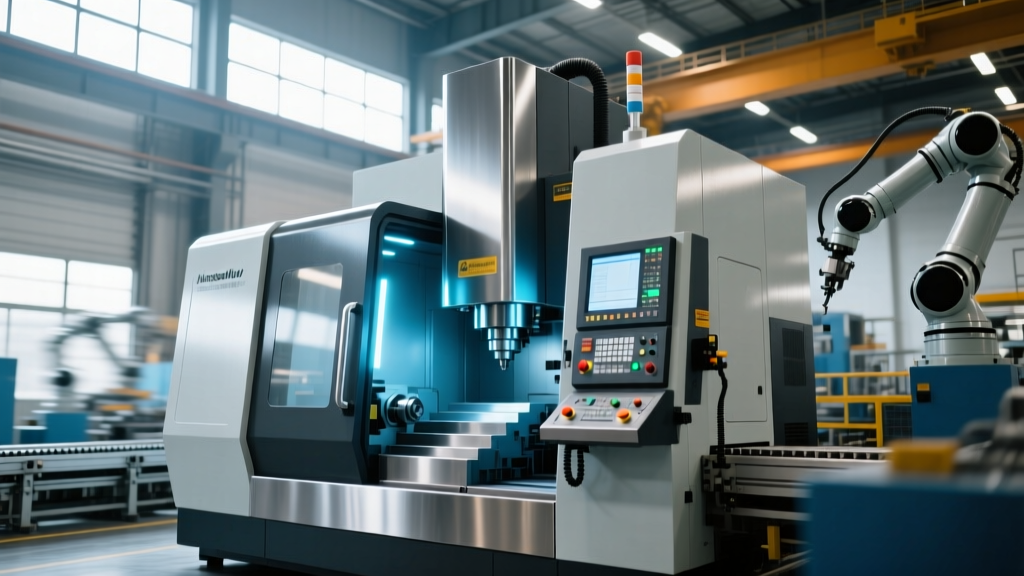
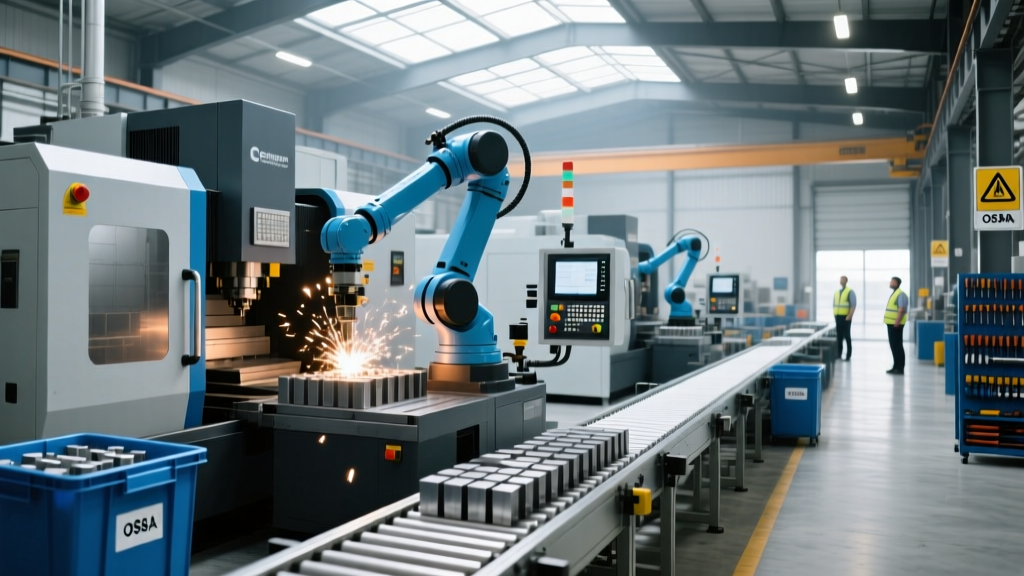
Batch processing in the parking control sector primarily involves the fabrication of payment terminal enclosures (using batch CNC press brakes and laser cutters) and the assembly of ALPR logic boards (using Surface Mount Technology pick-and-place machines). The defining characteristic of batch equipment is frequent changeovers, tooling adjustments, and manual material loading.
LOTO Complexities in High-Mix Batch Cells
Because batch machines require operators to enter the point of operation for setup and tool changes, OSHA's 1910.147 LOTO standard is heavily tested here. A common compliance failure occurs when technicians perform 'minor tool changes' without full energy isolation. To maintain compliance while preserving OEE (Overall Equipment Effectiveness), manufacturers must implement Alternative Protective Measures (APMs).
- Enabling Devices: Use two-hand, hold-to-run control stations with anti-tie-down circuitry for manual press brake setups.
- Interlocked Barrier Guards: Install RFID-coded safety switches (e.g., Pilz PSENcode) on CNC enclosure doors. Unlike mechanical limit switches, RFID switches prevent operators from defeating the interlock with a taped-down magnet, a frequent OSHA citation trigger.
- Local Exhaust Ventilation (LEV): Batch soldering and laser-cutting of coated steel for kiosk housings generate hazardous fumes. LEV systems must be interlocked with the batch machine's start circuit, preventing operation if airflow drops below 150 FPM.
Continuous Manufacturing Safety: Extrusion and Molding
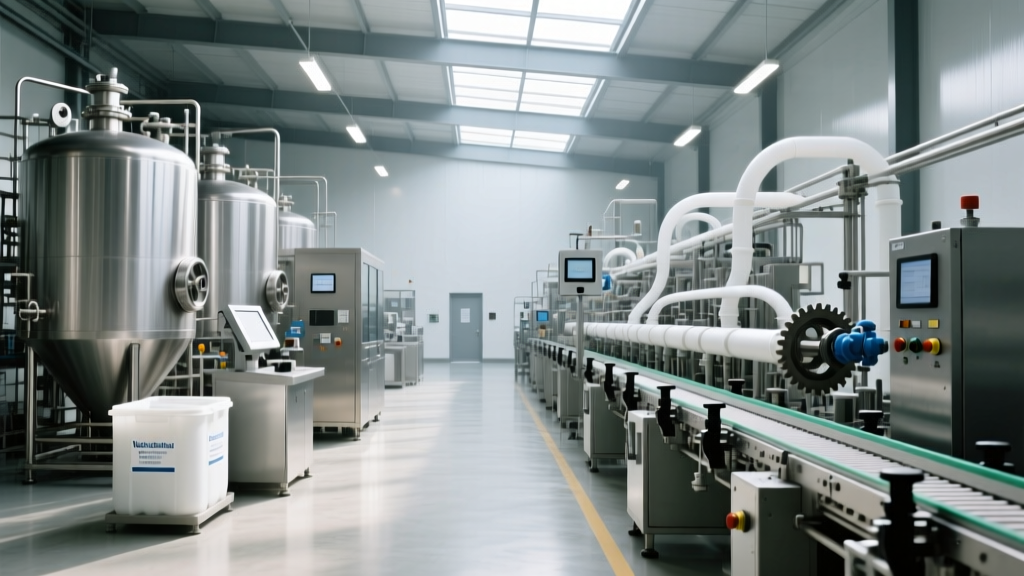
Continuous lines produce the high-volume structural components of parking systems. The most prominent example is the continuous aluminum extrusion press used to manufacture 6063-T5 boom barrier arms, and continuous injection molding lines for ticket dispenser housings. These systems run 24/7, possess massive kinetic and thermal energy, and feature long, unguarded material run-out zones.
Managing Nip Points and Thermal Inertia
Continuous extrusion lines utilize pullers and cooling tables that create extensive nip points. According to OSHA 1910.212 General Requirements for All Machines, these areas must be guarded. However, physical barriers impede the continuous flow of long extruded profiles. Therefore, manufacturers must rely on Active Opto-electronic Protective Devices (AOPDs).
💡 Technical Specification: For continuous aluminum extrusion run-out tables, deploy Type 4 light curtains (IEC 61496) with a minimum resolution of 30mm. The safety controller must calculate the exact stopping distance based on the press brake's deceleration curve. As of 2026, expect to pay between $4,500 and $8,200 per zone for integrated Type 4 light curtain arrays with built-in muting functions for material passage.Thermal Hazards and Safe-Torque-Off (STO)
Injection molding machines for polycarbonate camera housings operate at barrel temperatures exceeding 280°C (536°F). Standard electrical LOTO is insufficient because the barrel retains lethal thermal energy long after power is severed. Safety protocols must mandate a 'cool-down interlock'—a software-enforced delay in the safety PLC that physically prevents the mold from being opened or the barrel from being purged until thermocouples verify the temperature has dropped below 45°C.
Real-World Failure Mode Analysis: In a 2024 incident at a mid-tier barrier gate manufacturer, an operator bypassed a light curtain on a continuous extrusion puller using a piece of reflective tape to clear a jammed aluminum profile. Because the safety relay lacked cross-fault detection (a requirement for PL d and above), the machine failed to register the defeated sensor. The puller engaged, resulting in a severe crushing injury. Modern safety PLCs (like the Siemens SIMATIC S7-1500F) now enforce strict cross-monitoring, immediately faulting the system if sensor wiring is shorted or tampered with.
Decision Framework: Selecting the Right Performance Level (PL)
Under ISO 13849-1, safety functions must be validated to a specific Performance Level (PL r) based on the severity of injury (S), frequency of exposure (F), and possibility of avoidance (P). Parking control equipment manufacturers should apply this framework differently across their facility:
- Step 1: Severity Assessment (S1 vs S2). Batch assembly of lightweight payment kiosks usually presents S1 (reversible injury) risks. Continuous extrusion presses present S2 (irreversible/fatal) risks due to massive crushing forces.
- Step 2: Exposure Frequency (F1 vs F2). Batch CNC operators load/unload every 3 minutes (F2 - frequent). Continuous line operators only interact with the point of operation during threading or jam clearance (F1 - rare, but highly dangerous).
- Step 3: Avoidance (P1 vs P2). Can the operator see the hazard and move away? High-speed continuous pullers offer no avoidance time (P2).
- Step 4: Determine PL r. Using the ISO 13849-1 risk graph, an S2 + F1 + P2 scenario (continuous extrusion jam clearance) mandates a PL e (the highest level), requiring redundant, diverse safety architectures with diagnostic coverage >99%. An S1 + F2 + P1 scenario (batch kiosk assembly) typically requires PL c.
Navigating Global Certifications for Export Markets
When parking control equipment manufacturers export their final products, the safety compliance of the manufacturing equipment itself becomes a liability factor. If a manufacturer uses non-compliant, uncertified continuous molding equipment that introduces structural weaknesses into a bollard housing, the final product may fail impact testing (e.g., IWA 14-1 crash ratings).
Furthermore, the control panels governing both batch and continuous lines must meet regional standards. For North American markets, all manufacturing equipment control panels must be UL 508A certified, ensuring proper component sizing, short-circuit current ratings (SCCR), and thermal management. For European exports, the transition to the new EU Machinery Regulation (2023/1230) places heavy emphasis on cybersecurity for safety-related control systems. If your continuous extrusion line utilizes networked safety PLCs, those networks must be segmented and secured against unauthorized remote modifications that could alter safety parameters like light curtain muting times or press deceleration curves.
Summary of Actionable Safeguards
To achieve total facility compliance, safety managers must bifurcate their approach. Treat batch equipment as a high-frequency, human-machine interaction zone requiring robust interlocked guarding and strict minor-service APMs. Treat continuous equipment as a high-energy, low-interaction hazard zone requiring advanced opto-electronic guarding, thermal dissipation interlocks, and PL e rated safety controllers. By aligning the specific physics of the manufacturing process with the precise requirements of ISO 13849 and OSHA standards, manufacturers can protect their workforce while maintaining the high throughput required in the modern parking control industry.