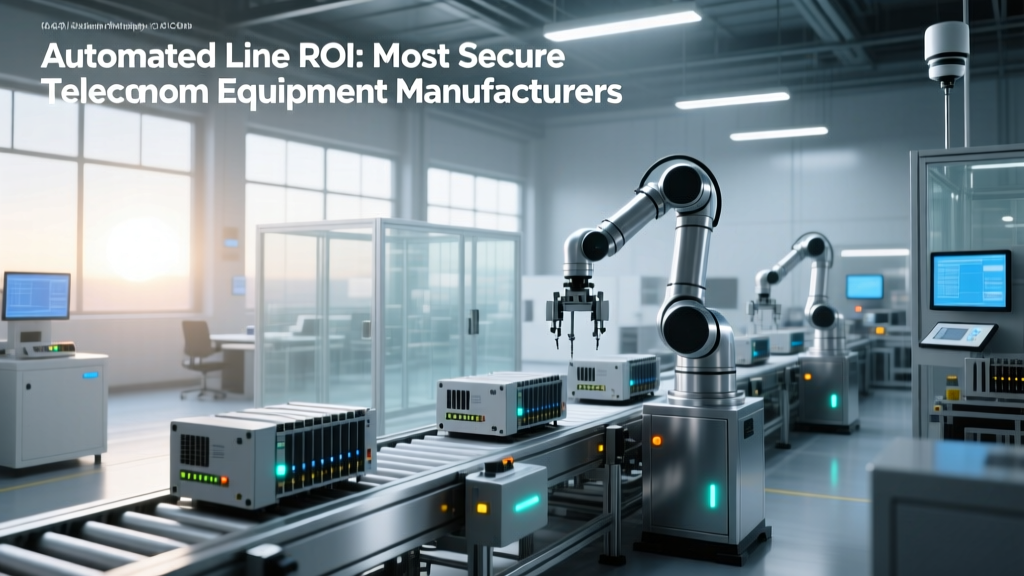
Automated Line ROI: Most Secure Telecom Equipment Manufacturers
Analyze the true costs of automated production line integration when sourcing from the most secure telecom equipment manufacturers in 2026.
The Hidden CapEx of Secure Telecom Integration in Automated Lines
Integrating automated production lines—encompassing 6-axis robotics, machine vision systems, and high-speed PLCs—requires a network backbone that guarantees sub-millisecond latency while repelling sophisticated cyber threats. When facility planners source from the most secure telecom equipment manufacturers, the initial Capital Expenditure (CapEx) inevitably spikes. However, evaluating this integration strictly on hardware unit cost is a critical budgeting error. The true financial analysis must weigh the premium of industrial-grade, IEC 62443-certified telecom hardware against the catastrophic Operational Expenditure (OpEx) of network-triggered line stoppages, ransomware lateral movement, and intellectual property theft.
In 2026, the concept of the 'air-gapped' factory floor is entirely obsolete. Modern automated lines rely on continuous telemetry streaming to on-premise edge servers and cloud-based digital twins. This IT/OT convergence means that a vulnerability in a cell-level managed switch can provide a direct vector into the enterprise ERP system. Consequently, selecting the most secure telecom equipment manufacturers is no longer an IT preference; it is a fundamental requirement for protecting the physical production output and maintaining Overall Equipment Effectiveness (OEE).
Executive Cost Summary: Integrating Tier-1 secure telecom hardware into a standard 12-cell automated assembly line typically increases network CapEx by 45% to 65% compared to commercial IT alternatives. However, this investment reduces unplanned network-related downtime by an estimated 82%, yielding a positive ROI within 14 to 18 months for high-margin manufacturing environments.Hardware Cost Matrix: Tier 1 Secure OT Telecom vs. Commercial Alternatives
To build an accurate budget, integration engineers must compare specific industrial switch and router models based on their security certifications, environmental tolerances, and protocol support. The table below outlines the 2026 pricing and specifications for leading OT telecom hardware versus a baseline commercial IT switch.
| Manufacturer / Model | IEC 62443 Security Level | Port Config & PoE Budget | 2026 Unit Cost (USD) | Industrial Protocol Support |
|---|---|---|---|---|
| Cisco Catalyst IE9300 Rugged | SL3 (Advanced) | 24x GE, 740W PoE+ | $6,800 - $8,400 | PROFINET, EtherNet/IP, Modbus TCP |
| Hirschmann BOBCAT | SL3 (Advanced) | 16x GE, 480W PoE+ | $5,200 - $6,500 | PROFINET (Conformance Class C) |
| Siemens SCALANCE XC400 | SL2/SL3 (Configurable) | 24x GE, 380W PoE+ | $4,100 - $5,300 | PROFINET, PRP/HSR Redundancy |
| Generic Enterprise IT Switch | None (IT-focused) | 24x GE, 370W PoE+ | $1,200 - $1,800 | Standard QoS, No OT Jitter Control |
The pricing disparity is stark. A 12-cell production line requiring two switches per cell will cost approximately $117,600 using the Cisco IE9300 series, compared to just $21,600 for generic IT hardware. This $96,000 CapEx gap is the primary friction point in budget approvals. However, the generic switches lack hardware-based packet prioritization for industrial protocols, MACsec encryption, and the ruggedized thermal tolerances required inside NEMA-rated control panels.
OpEx Realities: Firmware Lifecycle and Downtime Prevention
The financial justification for utilizing the most secure telecom equipment manufacturers becomes undeniable when analyzing Operational Expenditure (OpEx), specifically regarding firmware lifecycle management and vulnerability patching. Commercial IT switches typically receive security updates for 3 to 5 years. In contrast, Tier-1 OT telecom manufacturers guarantee 10 to 15 years of security patch support, aligned with the physical lifespan of the automated production machinery.
According to the NIST Special Publication 800-82 Revision 3, Industrial Control Systems (ICS) require stringent network segmentation and continuous monitoring to maintain operational safety. When a zero-day vulnerability targets an OT protocol stack, secure manufacturers issue validated, regression-tested patches that will not disrupt real-time PLC communication. Applying an untested IT firmware patch to a generic switch on a factory floor can induce a 200-millisecond latency spike, causing a robotic welding arm to miss its seam and scrap a $40,000 chassis component.
Calculating the Cost of a Network-Triggered Line Stoppage
To accurately budget for network security, planners must quantify the cost of failure. In high-volume automotive or semiconductor manufacturing, unplanned downtime averages $22,000 per minute. If a ransomware variant breaches a commercial-grade cell switch and encrypts the local HMI (Human-Machine Interface), the resulting line stoppage to re-image the network and restore PLC backups can easily exceed 45 minutes. This single event results in a $990,000 loss—effectively wiping out the CapEx savings of choosing cheaper telecom hardware ten times over.
Expert Insight on IT/OT Convergence: 'The most expensive component on an automated production line is not the 6-axis robot; it is the network switch that connects it to the enterprise. Budgeting for OT security must be treated as an insurance premium against physical production loss, not merely an IT compliance expense.'
Step-by-Step Budget Allocation for Secure OT Network Integration
When drafting the integration budget for a new automated line, facility engineers should allocate funds across the following five critical security and performance domains, adhering to the ISA/IEC 62443 Standards for industrial automation security.
- Industrial Demilitarized Zone (IDMZ) Architecture ($45,000 - $80,000): Budget for high-availability firewalls (e.g., Palo Alto Networks PA-400R series) and dedicated IDMZ switches. This perimeter prevents direct routing between the enterprise IT network and the production floor, forcing all traffic through inspected proxies.
- Cell-Level Rugged Switching ($80,000 - $120,000): Allocate funds for IEC 62443 SL3-certified DIN-rail switches. Ensure the budget includes SFP+ transceivers for fiber uplinks to eliminate electromagnetic interference (EMI) from nearby variable frequency drives (VFDs).
- Endpoint Authentication & 802.1X Deployment ($15,000 - $25,000): Secure telecom hardware supports 802.1X port-based authentication. Budget for the licensing and integration of a RADIUS/TACACS+ server tailored for OT devices, ensuring that unauthorized laptops plugged into a cell switch are immediately quarantined.
- Deep Packet Inspection (DPI) for OT Protocols ($30,000 - $50,000): Standard firewalls cannot read PROFINET or EtherNet/IP payloads. Budget for industrial DPI appliances that can detect anomalous write commands sent to a PLC, blocking them before they alter machine logic.
- Redundancy & Media Rings ($20,000 - $35,000): Allocate capital for hardware supporting PRP (Parallel Redundancy Protocol) or HSR (High-Availability Seamless Redundancy). This ensures zero-millisecond failover if a fiber cable is severed by a forklift, preventing line stoppages.
Edge Cases: When Premium Telecom Hardware Fails in Production
Even when budgeting for the most secure telecom equipment manufacturers, integration teams frequently encounter non-obvious edge cases that can derail production if not addressed during the design phase. Recognizing these failure modes is essential for contingency budgeting.
Thermal Derating in NEMA 4X Enclosures
A common budgeting oversight is ignoring the thermal derating curves of ruggedized switches. A switch rated for an ambient operating temperature of 70°C may be required to drop its Power over Ethernet (PoE) budget by 40% when internal temperatures exceed 55°C. If a machine vision camera requires 25W of PoE+, and the switch has thermally derated its ports to 15W, the camera will continuously reboot. Always budget for active cooling (e.g., Peltier cooling units or filtered fan trays) inside sealed control enclosures, adding approximately $1,200 to $2,500 per cell.
Warning: Protocol Jitter and QoS MismatchesDo not assume that an expensive, secure IT switch will seamlessly handle motion-control traffic. Protocols like PROFINET IRT (Isochronous Real-Time) require hardware-based clock synchronization and specific packet prioritization that standard IT Quality of Service (QoS) cannot replicate. If your automated line utilizes synchronized multi-axis servo drives, you must verify that the selected telecom hardware explicitly supports Conformance Class C (or higher) for PROFINET, otherwise, micro-jitter will cause mechanical vibration and premature bearing wear.
MACsec Encryption Overhead on Legacy PLCs
While MACsec (802.1AE) encryption is a staple of secure telecom hardware, enabling it on a network segment containing legacy PLCs (e.g., older Allen-Bradley ControlLogix or Siemens S7-300 models) can overwhelm their limited CPU resources. The encryption handshake and packet processing can introduce latency exceeding the 2-millisecond watchdog timeout of the safety controller, triggering an emergency stop. Budget for protocol-specific hardware encryption modules or segment legacy assets into a separate, physically isolated VLAN where MACsec is disabled but strict physical access controls are enforced.
Ultimately, the decision to integrate automated production lines using the most secure telecom equipment manufacturers is a calculation of risk tolerance versus capital availability. By accurately forecasting the CapEx premiums, accounting for thermal and protocol edge cases, and quantifying the true cost of network-induced downtime, manufacturing leaders can build a resilient, highly profitable production environment that withstands the cyber-physical threats of modern industry.
Related reading

Telecommunications Equipment Manufacturers Network Security & CE/UL

Maximizing Energy Efficiency Ratings Using Production Tracking Solutions in Industrial Equipment Manufacturing