Best Playground Equipment Manufacturers New York NY: IIoT
Discover how top NY playground equipment manufacturers use IIoT sensors to replace calendar-based maintenance with predictive service schedules.
The Shift from Calendar to Condition-Based Maintenance
In heavy fabrication and polymer processing, rigid preventive maintenance (PM) schedules are rapidly becoming obsolete. Replacing bearings, seals, and cutting tools based on arbitrary 30-, 60-, or 90-day intervals results in either premature part disposal or catastrophic mid-run failures. For facilities ranked among the best playground equipment manufacturers New York NY operates, the operational standard has shifted toward Industrial Internet of Things (IIoT) condition monitoring. By deploying localized sensor arrays on critical assets like 4-arm rotational molding carousels and 5-axis CNC routers, these manufacturers dynamically adjust service schedules based on real-time mechanical and thermal degradation data.
According to the NIST Manufacturing Extension Partnership (MEP), smart manufacturing technologies, including IIoT sensor integration, can reduce unplanned downtime by up to 45% in mid-sized fabrication plants. This guide details the exact sensor configurations, data protocols, and maintenance matrix adjustments required to transition a playground equipment production line from reactive to predictive servicing.
Critical IIoT Sensor Deployments for Playground Fabrication
Playground manufacturing relies on two primary heavy-duty processes: rotational molding for large plastic components (slides, decks, roofs) and multi-axis CNC machining for structural HDPE and aluminum parts. Each requires specific IIoT sensor topologies to monitor asset health.
Triaxial Vibration Sensors for 5-Axis CNC Routers
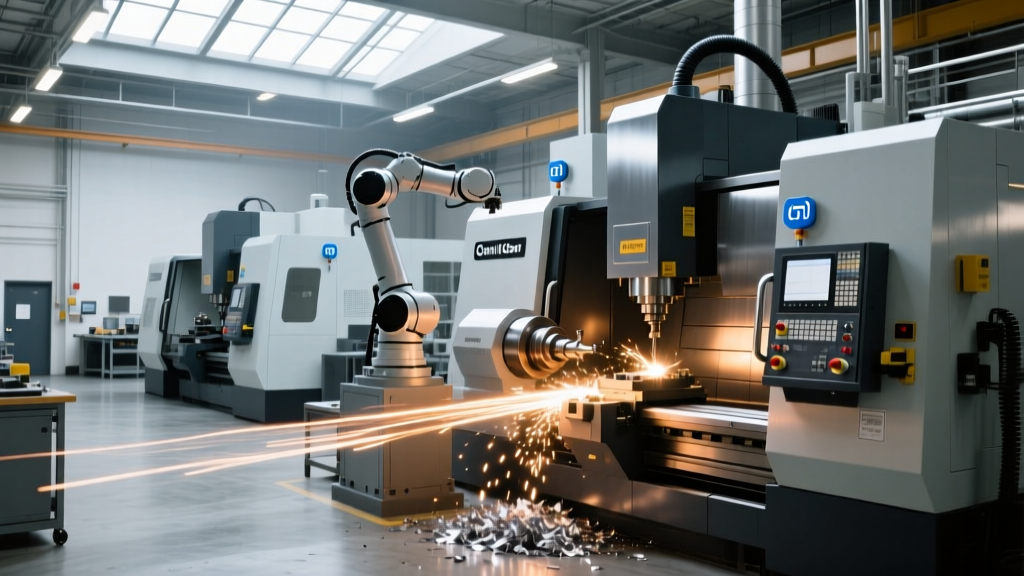
Machining high-density polyethylene (HDPE) and marine-grade plywood generates distinct harmonic vibrations that differ significantly from metal cutting. Standard piezoelectric accelerometers, such as the SKF CMSS 2200 or Banner Engineering QM42VT, are mounted directly onto the spindle housing and Z-axis ball screws. These sensors sample vibration frequencies between 10 Hz and 10 kHz. By establishing a baseline Fast Fourier Transform (FFT) signature for a sharp 12mm carbide end mill, the IIoT edge gateway can detect the exact micro-frequency shifts that indicate tool edge chipping or spindle bearing wear, triggering a tool-change work order in the CMMS before the HDPE sheet melts or delaminates.
Continuous Thermal Monitoring for Rotational Molding Ovens
Rotational molding ovens operate at sustained temperatures of 280°F to 350°F (138°C to 177°C) to sinter LLDPE powder. The electrical busbars, gas valve actuators, and main drive chain motors are subjected to severe thermal stress. Instead of manual weekly thermography sweeps, top-tier fabricators install continuous infrared thermal sensors like the FLIR AX8. These sensors monitor specific regions of interest (ROIs) on the electrical panels and drive motors, transmitting temperature data via Modbus TCP to the plant PLC. A sustained 5°C rise in a drive motor's casing temperature indicates lubrication breakdown, automatically advancing the bearing regreasing schedule from 90 days to 14 days.
WARNING: Wireless Signal Attenuation in Heavy Metal EnvironmentsRotational molding machines and large CNC gantries act as Faraday cages. Standard 2.4 GHz Wi-Fi IIoT sensors will experience severe packet loss in these environments. Always specify WirelessHART (IEC 62591) or ISA100.11a protocols for wireless sensor nodes, or utilize hardwired IO-Link connections routed through shielded conduit to local edge gateways.
Maintenance Schedule Matrix: Calendar vs. IIoT-Driven
The following matrix illustrates how IIoT data fundamentally restructures the service schedule for a standard 4-arm rotational molding machine producing playground decks.
| Asset / Component | Legacy PM Schedule | IIoT Condition-Based Trigger | Sensor Technology Used |
|---|---|---|---|
| Main Carousel Drive Gearbox | Oil change every 6 months | Dielectric breakdown or moisture ingress detected | Inline oil quality sensor (e.g., Tan Delta) |
| Oven Burner Ignition Electrodes | Replace every 12 months | Ignition cycle time exceeds 1.2 seconds | PLC cycle-time logic monitoring |
| Arm Pivot Thrust Bearings | Regrease every 30 days | Acoustic emission spike > 45 dB | Ultrasonic contact microphone |
| Cooling Station Water Nozzles | Descaling every 90 days | Flow rate drops below 45 GPM at 60 PSI | Electromagnetic flow meter |
Step-by-Step Legacy Retrofit Protocol
Integrating IIoT sensors into legacy playground manufacturing equipment requires a structured approach to data extraction and edge processing. The U.S. Department of Energy's Smart Manufacturing initiatives emphasize the importance of standardized data models to prevent vendor lock-in.
- Install MTConnect Adapters: For legacy CNC routers lacking native Ethernet capabilities, install an MTConnect adapter (such as those from System Insights) to translate proprietary G-code and spindle load data into standardized XML/JSON formats.
- Deploy Industrial Edge Gateways: Mount ruggedized edge gateways (e.g., Moxa UC-8100 series, priced between $1,200 and $2,500 per unit) inside NEMA 4X enclosures near the machine. These gateways aggregate serial, analog, and digital sensor inputs.
- Configure MQTT Brokerage: Program the edge gateway to publish sensor telemetry to an on-premise or cloud MQTT broker using a lightweight payload structure. Set the polling rate to 100ms for vibration data and 5 seconds for thermal data to optimize bandwidth.
- Integrate with CMMS via API: Connect the MQTT analytics engine to your Computerized Maintenance Management System (e.g., Fiix, UpKeep, or MaintainX). Configure webhooks so that when a sensor breaches a predefined threshold, the CMMS automatically generates a work order with the exact part number and required tooling.
Calculating the ROI of Sensor-Driven Service Intervals
The financial justification for IIoT deployment hinges on the cost of unplanned downtime versus the capital expenditure of the sensor network. According to IBM's comprehensive guide on predictive maintenance architectures, IIoT implementations typically yield a 10x return on investment within the first 18 months by eliminating catastrophic asset failures.
Consider a 5-axis CNC router cutting HDPE playground panels. An unexpected spindle failure costs approximately $14,500 in replacement parts and 16 hours of downtime, resulting in $38,000 in lost production and delayed shipments. A complete IIoT vibration and thermal monitoring kit for that single machine, including the edge gateway and installation, costs roughly $4,800. Preventing just one spindle seizure pays for the entire system's hardware and software licensing for three years.
Edge Cases and Non-Obvious Trade-offs
While IIoT sensors excel at detecting mechanical wear, they can generate false positives in environments with high ambient particulate matter. In rotational molding facilities, LLDPE dust frequently coats thermal sensor lenses, artificially inflating temperature readings. Maintenance teams must schedule automated air-purge systems for optical sensors or factor lens-cleaning into the weekly operator checklist to maintain data integrity. Furthermore, relying solely on vibration data for gearboxes can mask slow-speed bearing defects; combining low-frequency accelerometers with ultrasonic acoustic emission sensors provides a complete diagnostic picture.
Finalizing the Predictive Maintenance Strategy
Transitioning to an IIoT-driven maintenance schedule is not merely a hardware upgrade; it is a fundamental shift in operational philosophy. By instrumenting critical nodes on rotational molding carousels and CNC fabrication centers, manufacturers gain granular visibility into asset degradation. This eliminates the waste of premature part replacement and neutralizes the financial risk of catastrophic mid-cycle failures, establishing a highly competitive, resilient production environment.