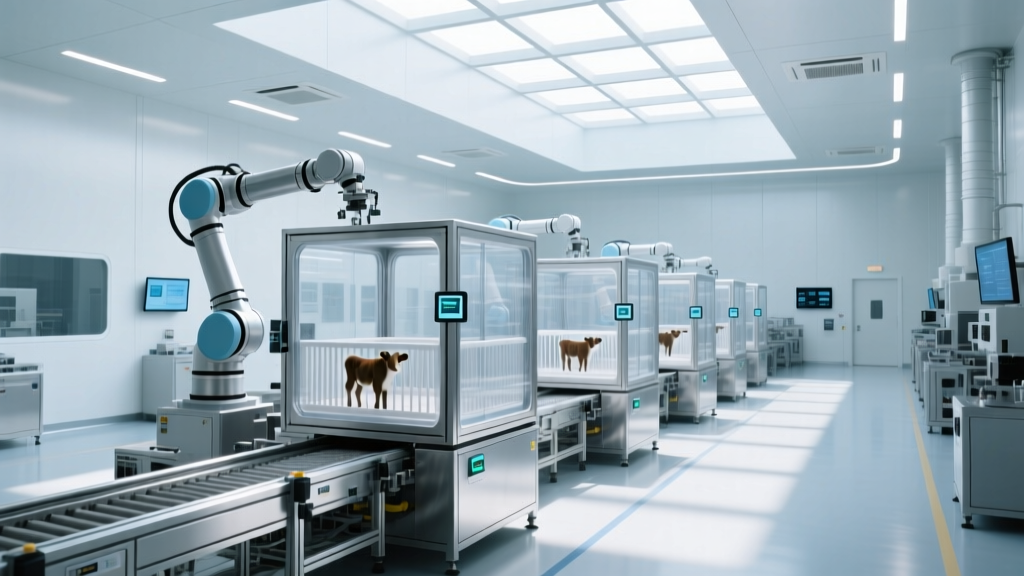
Cleanroom Specs for a Calf Nursery Equipment Manufacturer in 2026
How a modern calf nursery equipment manufacturer meets ISO cleanroom requirements to produce biosecure, pathogen-free neonatal bovine rearing systems.
The Biosecurity Mandate in Advanced Bovine Genetics
The intersection of advanced bovine genetics and precision manufacturing has created a highly specialized niche within the agricultural technology sector. As the demand for Specific Pathogen Free (SPF) livestock, high-value IVF embryos, and cloned neonatal calves accelerates, the rearing environment must be entirely devoid of nosocomial pathogens. Consequently, a modern calf nursery equipment manufacturer can no longer rely on standard agricultural fabrication floors. Producing positive-pressure isolation pens, sterile enteral feeding manifolds, and HEPA-filtered neonatal incubators requires strict adherence to cleanroom manufacturing equipment requirements to prevent microscopic contamination during the assembly process.
Immunocompromised newborn calves are highly susceptible to Mycoplasma bovis, Bovine Viral Diarrhea (BVD), and Johne's disease. If the manufacturing environment introduces ambient particulates, mold spores, or bacterial biofilms into the micro-crevices of automated milk replacer mixing valves, the neonatal immune system will fail before the calf even reaches the farm. To mitigate this, manufacturers are adopting ISO 14644-1 controlled environments, fundamentally shifting how agricultural biotech hardware is engineered and assembled.
2026 Industry Trend Alert: The global market for biosecure livestock rearing equipment has expanded by 14% year-over-year, driven primarily by the export demands of SPF genetics to regions with strict quarantine protocols. Manufacturers without ISO-certified clean assembly zones are increasingly disqualified from Tier-1 biotech and export supply chains.Core Cleanroom Manufacturing Equipment Requirements
Transitioning a standard fabrication facility into a controlled environment requires specialized capital equipment designed to manage airflow, particulate generation, and personnel contamination. For a facility assembling neonatal bovine isolation units, the cleanroom is typically segmented into ISO Class 8 (general assembly) and ISO Class 7 (final sterile packaging of fluid-handling components).
HVAC and HEPA Filtration Architecture
The backbone of cleanroom manufacturing is the air handling unit (AHU) paired with terminal High-Efficiency Particulate Air (HEPA) filters. According to the IEST RP-CC001 standard, HEPA filters must capture 99.99% of particles at 0.3 microns. In a facility manufacturing calf nursery equipment, the HVAC system must maintain positive pressure relative to the surrounding unclassified factory floor, ensuring that when doors open, air flows outward, preventing ingress of agricultural dust or dander.
- Air Changes Per Hour (ACH): ISO Class 8 requires 15-30 ACH, while ISO Class 7 demands 30-60 ACH to rapidly dilute and remove particulates generated during the mechanical assembly of pen latches and feeding tubes.
- Temperature and Humidity Control: Maintained strictly at 68°F (20°C) ± 2° and 45% ± 5% relative humidity to prevent static discharge (which attracts dust to plastic molded parts) and inhibit microbial growth on stainless steel surfaces.
Material Airlocks and Pass-Through Enclosures
Raw materials—such as 316L stainless steel tubing, medical-grade silicone hoses, and polycarbonate viewing panels—must enter the cleanroom without compromising the pressure cascade. Pass-through enclosures with interlocking doors and internal UV-C sterilization are mandatory. For large components like pre-welded calf igloo shells, specialized material airlocks with high-velocity air sweep-down systems are utilized to strip surface particulates before the items are moved into the Class 7 assembly zone.
ISO Classification Matrix for Ag-Tech Manufacturing
Understanding the precise environmental thresholds is critical for facility validation. The table below outlines the operational parameters required for manufacturing biosecure calf nursery hardware.
| Parameter | ISO Class 8 (Assembly Floor) | ISO Class 7 (Fluid Valve Packaging) |
|---|---|---|
| Max Particles ≥0.5µm (per m³) | 3,520,000 | 352,000 |
| Air Changes per Hour (ACH) | 15 - 30 | 30 - 60 |
| Filter Efficiency | HEPA (99.99% @ 0.3µm) | HEPA (99.99% @ 0.3µm) |
| Primary Equipment Assembled | Isolation Pen Frames, HEPA Housings | Automated Milk Replacer Mixing Valves |
Capital Equipment Checklist for the Factory Floor
Equipping the production line requires investments in specialized contamination-control hardware. A calf nursery equipment manufacturer upgrading to biosecure standards should budget for the following specific installations:
- Stainless Steel Air Showers ($12,000 - $18,000 per unit): Positioned at personnel entry points. These units utilize 20 m/s nozzle velocities to dislodge particulates from technician cleanroom garments. A 15-second interlocking cycle is standard to ensure compliance.
- Laminar Flow Workstations ($6,000 - $9,500 per bench): Required for the micro-assembly of enteral feeding check-valves. These workstations provide unidirectional, ISO Class 5 airflow directly over the components, ensuring that the internal pathways of the feeding tubes remain entirely sterile prior to capping.
- Ultrasonic Welding Stations with Localized Extraction ($15,000+): Used for joining polycarbonate viewing windows to the isolation pen frames. Standard welding generates micro-particulates; cleanroom-compatible units feature integrated localized HEPA vacuum shrouds to capture fumes at the source.
Material Science and Real-World Failure Modes
The UW-Madison Dairyland Initiative frequently highlights how environmental pathogens exploit microscopic surface defects in livestock housing. In cleanroom manufacturing, the choice of materials and surface finishes dictates the long-term biosecurity of the final product.
The 316L Stainless Steel Imperative
While 304 stainless steel is common in general agriculture, biosecure calf isolation units require 316L stainless steel for all fluid-contact surfaces (e.g., milk replacer lines, washing troughs). The addition of molybdenum in 316L provides critical resistance to chloride pitting.
Failure Mode: Manufacturers attempting to cut costs by using 304 SS in high-humidity, chlorine-based washdown zones frequently experience pitting corrosion within 14 months. These microscopic pits harbor Salmonella and E. coli biofilms that survive standard CIP (Clean-In-Place) sanitization cycles, leading to catastrophic neonatal mortality outbreaks.
Electropolishing and Surface Roughness (Ra)
All internal tubing of automated feeding systems must be electropolished to achieve a surface roughness (Ra) of less than 0.8 µm. Electropolishing removes the amorphous Beilby layer left by mechanical polishing, exposing a pure, passive chromium oxide layer. If a manufacturer skips this step, mechanical polishing leaves micro-grooves that trap milk proteins, providing a nutrient base for bacterial proliferation once the equipment is deployed in the calf nursery.
"Cross-contamination in neonatal livestock doesn't usually start on the farm; it starts in the microscopic crevices of poorly finished manufacturing components. If the cleanroom fabrication process fails to mandate Ra < 0.8 µm finishes on fluid pathways, the biosecurity of the entire nursery is compromised before the equipment is even uncrated."
— Industrial Biosecurity Audit Report, 2025
Validation, Testing, and Compliance
Meeting cleanroom manufacturing equipment requirements is not a one-time installation event; it requires continuous validation. The USDA APHIS biosecurity frameworks increasingly recognize facility-level contamination controls as a vector for disease prevention in high-value genetics export.
Particle Counting and Smoke Studies
Facilities must conduct bi-annual ISO 14644-1 particle counting using calibrated optical particle counters (OPCs) to verify that the ISO Class 7 and 8 thresholds are maintained during 'at-rest' and 'operational' states. Furthermore, airflow visualization studies (smoke studies) are critical around the laminar flow workstations.
Edge Case Gotcha: A common failure during smoke studies occurs when technicians place large calf pen components too close to the HEPA filter face of a laminar bench, creating turbulent eddies that pull unclassified room air back over the sterile feeding valves. Standard operating procedures must dictate exact placement zones to maintain unidirectional airflow.
UV-C Shadowing in Pass-Through Enclosures
While UV-C (254nm) lighting is standard in material pass-through boxes to sterilize incoming components, complex geometries—such as the multi-angled manifolds of automated milk mixing systems—create 'UV shadows.' Bacteria in these shadowed crevices survive the sterilization cycle. Advanced manufacturers are now supplementing UV-C with vaporized hydrogen peroxide (VHP) injection cycles in pass-through airlocks to ensure 360-degree surface decontamination of complex parts before they enter the ISO Class 7 assembly zone.
Strategic Takeaways for Manufacturers
The evolution of the agricultural biotech sector demands that equipment suppliers elevate their manufacturing standards to match medical-device protocols. By investing in ISO-classified HVAC systems, mandating 316L electropolished materials, and rigorously validating contamination control hardware, a forward-thinking calf nursery equipment manufacturer can dominate the high-margin, biosecure genetics market. The capital expenditure required for cleanroom integration is rapidly offset by the premium pricing commanded by certified, pathogen-free neonatal rearing systems in the global export economy.