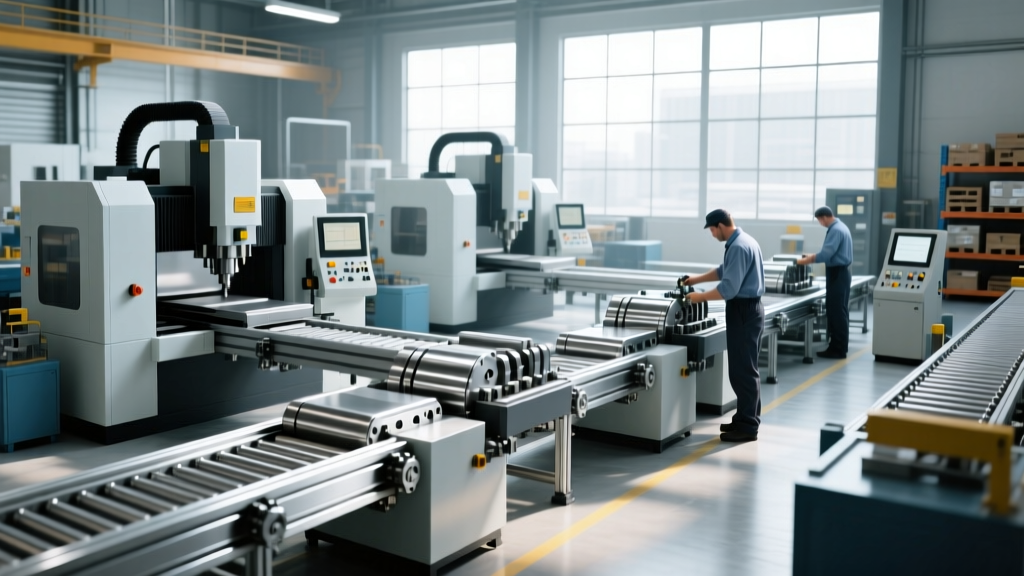
Fixing Modular Lines from Used Manufacturing Equipment Auctions
Expert troubleshooting guide for modular flexible production lines sourced from used manufacturing equipment auctions. Fix PLC, pneumatic, and drive faults.
The Liquidation Damage Profile of Modular Systems
Procuring modular manufacturing equipment for flexible production through used manufacturing equipment auctions yields significant capital expenditure reductions—often 40% to 60% below OEM pricing in 2026. However, systems designed for rapid reconfiguration, such as Bosch Rexroth TS2 plus conveyors or Festo Handling and Positioning Systems, present unique commissioning nightmares when dismantled by industrial liquidators. Liquidators prioritize speed over preservation, resulting in severed fieldbus cables, missing I/O nodes, and wiped PLC memory.
Unlike fixed, hard-automated lines, modular flexible systems rely heavily on distributed intelligence and rapid-disconnect mechanical interfaces. When you win a bid on a modular assembly cell, you are not just buying motors and aluminum extrusions; you are acquiring a complex network of IO-Link masters, distributed servo drives, and pneumatic quick-change tooling. This guide provides a deep-dive technical framework for troubleshooting, repairing, and recommissioning auction-sourced modular manufacturing lines.
Critical Safety Warning: Before probing any 480VAC distributed drive nodes or testing pneumatic manifolds, strictly adhere to OSHA's Lockout/Tagout standards. Auction gear frequently lacks functional E-stop wiring or has bypassed safety relays from previous owners.Phase 1: Reconstructing Severed PROFINet & IO-Link Topologies
The most common casualty in used manufacturing equipment auctions is the fieldbus network. Liquidators routinely use reciprocating saws to separate modular conveyor sections, severing PROFINet and EtherCAT daisy chains. Furthermore, modular IO-Link masters (such as the IFM AL1350 or Siemens ET 200SP) are often ripped from their mounting rails, leaving bent M12 connector pins.
Step-by-Step Topology Recovery
- Physical Continuity Check: Use a Fluke EtherScope or a basic wiremapper to verify the 4-pin M12 D-coded connections. Auction environments introduce severe oxidation; clean all male/female contacts with isopropyl alcohol and a fiberglass scratch pen before applying dielectric grease.
- LLDP Packet Sniffing: If the original TIA Portal or Studio 5000 project file is missing (a common auction reality), connect a managed switch (e.g., Cisco IE-4000) to the main trunk. Run Wireshark and filter for LLDP (Link Layer Discovery Protocol) packets. This will map the physical MAC addresses and port assignments of every distributed I/O node still powered on the line.
- IP Conflict Resolution: Modular cells often contain cloned MAC addresses or hardcoded IP conflicts from the original facility's DHCP server. Isolate the modular cell on a dedicated VLAN and use the NIST Smart Connected Manufacturing framework for network segmentation to prevent IP collisions with your plant's main SCADA network.
Phase 2: Pneumatic & Mechanical Quick-Connect Degradation
Flexible production relies on end-of-arm tooling (EOAT) and modular fixturing, such as Schunk VERO-S NSL plus clamping stations. These systems utilize pneumatic quick-disconnects to allow tooling changes in under 30 seconds. Equipment sitting in unclimate-controlled auction warehouses for 6 to 12 months suffers from severe elastomeric degradation.
| Modular Component | Auction Failure Mode | Diagnostic Method | Repair Protocol |
|---|---|---|---|
| Schunk VERO-S Clamps | Dried O-rings in quick-disconnects causing 15% pressure drop | Ultrasonic leak detector (e.g., UE Systems Ultraprobe) | Replace standard NBR seals with Viton (FKM) O-rings for longevity |
| Schmalz Vacuum Generators | Venturi nozzle clogging from warehouse dust and rust | Monitor vacuum decay time via IO-Link (Target: <400ms) | Disassemble and ultrasonically clean brass nozzles; replace PTFE filters |
| Festo Guided Cylinders | Scored guide rods from improper forklift rigging | Visual inspection and dial indicator runout test | Replace guide rod assembly; do not attempt to sand/polish scored rods |
Phase 3: Distributed Drive Fault Resolution
Modular conveyors and flexible indexing tables frequently use distributed servo drives like the Siemens Sinamics G120D or Rockwell ArmorStart. Because these drives are mounted directly on the machine frame rather than in a central MCC, they are highly susceptible to physical damage and coolant ingress during auction transport.
Troubleshooting Common Sinamics Fault Codes
- F07801 (Missing Motor Data): Liquidators often disconnect motor power cables and encoder feedback cables, mixing them up between modular stations. Verify the DRIVE-CLiQ topology in the Siemens Starter software. If the encoder type does not match the parameterized motor, the drive will inhibit.
- F30001 (Overcurrent): On modular belt conveyors, this is rarely an electrical fault. It is almost always a mechanical bind. Auction gear often has seized modular gearbox bearings due to lack of lubrication during storage. Disconnect the motor from the gearbox and test the motor uncoupled. If the fault clears, rebuild the gearbox.
- F30002 (Overvoltage): Check the braking resistor connections. In modular systems, braking resistors are often shared across multiple drive nodes via a DC bus link. If a liquidator severed the DC bus link but left the parameter enabled, the drive will fault on deceleration.
Repair vs. Replace Matrix for Modular Nodes
When evaluating damaged components from used manufacturing equipment auctions, maintenance managers must weigh the cost of OEM replacement against the labor hours required for repair. As of 2026, global supply chain stabilization has reduced lead times for modular automation components, making replacement more viable for low-cost nodes.
| Component Type | Est. OEM Cost (2026) | Repair Viability | Decision Framework |
|---|---|---|---|
| IO-Link Master (8-Port) | $350 - $550 | Low | Replace. Internal SMD damage from voltage spikes is unrepairable in-house. |
| Distributed Servo Drive (IP67) | $1,800 - $3,200 | Medium | Repair if fault is isolated to IGBT modules or connector pins. Replace if logic board is scorched. |
| Pneumatic Valve Terminal | $800 - $1,500 | High | Repair. Spool valves can be individually replaced; clean manifolds with compressed air. |
Overcoming the 'Missing License' Trap
A hidden cost in used manufacturing equipment auctions is proprietary software licensing. Flexible manufacturing lines heavily utilize HMI and SCADA systems like Rockwell FactoryTalk View or Siemens WinCC to manage recipe changes for different product variants. Liquidators frequently leave the physical USB activation dongles in the office of the bankrupt facility, or the licenses are tied to a MAC address on a dead industrial PC.
To resolve this, contact the OEM's technical support with the original equipment serial number and proof of auction purchase. Both Rockwell and Siemens have established 'Used Equipment Transfer' protocols in 2026 that allow you to pay a nominal re-hosting fee (typically $250 to $500 per seat) to migrate the activation keys to your new hardware. Attempting to use third-party license emulators violates the NIOSH hierarchy of controls regarding system integrity, as unverified software can introduce latency or drop critical safety interlocks during flexible changeovers.
Final Commissioning Checklist
Before running production on an auction-sourced modular line, execute a 72-hour dry-run cycle. Flexible systems are designed to handle asynchronous part arrivals; use the PLC to simulate random fault conditions at the modular infeed stations to verify that the distributed safety controllers correctly halt the specific zone without dropping the master control voltage to the entire line. Proper troubleshooting of auction equipment transforms a high-risk purchase into a highly profitable, flexible manufacturing asset.