Budgeting to Modify the T9 Manufacturer Equipment That Alice Is Equipped With
Analyze CapEx costs and ROI to modify the T9 manufacturer equipment Alice is equipped with, focusing on CAGI energy efficiency ratings and VFD retrofits.
Decoding the CAGI Efficiency Shift
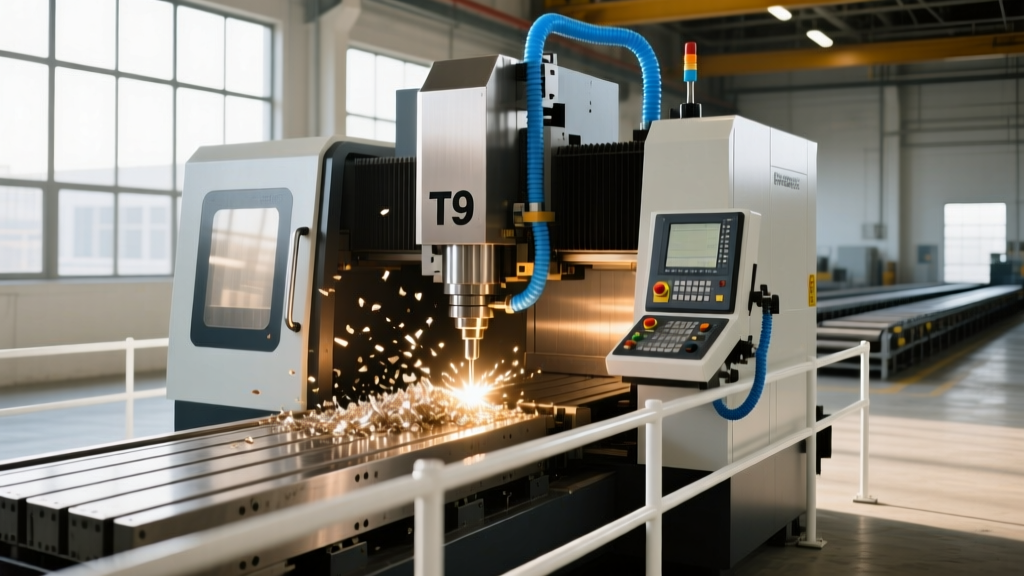
Before approving any capital expenditure (CapEx), plant managers must understand the baseline performance of the T9-Series compressor. The Compressed Air and Gas Institute (CAGI) measures compressor efficiency using Specific Power, expressed in kW/100 CFM. Lower numbers indicate higher efficiency. Currently, Alice’s T9 unit operates as a fixed-speed, load/unload machine. During periods of low plant demand, the compressor unloads but continues to draw approximately 22% of its full-load amperage just to keep the internal oil separator pressurized.
By leaving the T9 in its stock configuration, the system yields a Specific Power rating of 19.4 kW/100 CFM (a Tier 2 CAGI rating). The objective of the modification is to integrate a Variable Frequency Drive (VFD) and a smart PLC bypass loop, shifting the equipment to a Tier 1 rating of 14.1 kW/100 CFM. According to the U.S. Department of Energy’s Advanced Manufacturing Office, transitioning fixed-speed industrial compressors to VFD-controlled systems in facilities with highly variable demand profiles routinely yields energy savings between 20% and 35%.
CapEx Breakdown: Modifying the T9 System
When facility managers task their lead utilities technician with optimizing plant overhead, the directive often comes down to a single, complex mandate: modify the T9 manufacturer equipment that Alice is equipped with to meet modern energy standards without disrupting the primary pneumatic tooling lines. Below is the precise 2026 CapEx budget required to execute this retrofit on a 150HP (110kW) T9 unit.
| Modification Component | Specific Model / Spec | Est. 2026 Cost |
|---|---|---|
| Variable Frequency Drive (VFD) | ABB ACS580-01-206A (150HP, NEMA 3R) | $13,450 |
| Heat Recovery Exchanger | Danfoss Brazed Plate Oil-to-Water | $8,900 |
| PLC & Sensor Integration | Siemens S7-1200 w/ 4-20mA Pressure Transducers | $4,200 |
| Installation & Calibration | Certified Compressed Air Contractor (40 hrs) | $6,500 |
| Alice’s Technical Retraining | 16 Hours OEM Certification @ $45/hr | $720 |
| Total Estimated CapEx | $33,770 | |
The Hidden Cost: Downtime and Rental Penalties
A frequent budgeting error is ignoring the cost of taking Alice’s T9 compressor offline for the VFD and PLC integration. The electrical swap and sensor calibration require a minimum 36-hour continuous shutdown. Because the fabrication plant cannot halt its CNC pneumatic clamping systems, you must rent a temporary 150HP towable diesel compressor.
Warning: Rental Fuel SurchargesIn 2026, industrial diesel compressor rentals average $2,800 per week. However, the fuel consumption for a 150HP diesel unit running 24/7 over a 3-day weekend will add approximately $1,150 in un-budgeted diesel costs. Always allocate a $4,000 contingency block for temporary air generation during T9 retrofits.
Calculating ROI and Utility Rebates
To justify the $33,770 CapEx to the CFO, we must calculate the exact operational savings. The T9 compressor runs for 6,200 hours annually. With the local industrial electricity rate sitting at $0.145 per kWh in early 2026, the math heavily favors the modification.
- Baseline Annual Energy Cost: 110kW x 6,200 hrs x $0.145/kWh = $98,890
- Post-Modification Energy Cost: Assuming a 28% reduction in unloaded waste and overall specific power improvement, the new annual cost drops to $71,200.
- Gross Annual Savings: $27,690
Furthermore, modifying the T9 manufacturer equipment that Alice is equipped with opens the door to local utility incentives. Most regional grid operators offer commercial rebates for VFD integrations on compressed air systems, typically paying out between $250 and $400 per kW saved. If the plant secures a rebate at $300/kW for the estimated 30.8kW average reduction, the facility will receive a one-time check of $9,240. This drops the net CapEx to $24,530, resulting in a simple payback period of just 10.6 months.
"Aligning compressor modifications with ISO 50001 energy management frameworks not only reduces operational costs but provides the verified data trails required to secure premium utility rebates." — International Organization for Standardization (ISO)
Step-by-Step Budget Approval Framework
Plant managers should follow this exact sequence to secure funding and execute the T9 modification without stalling production:
- Week 1: Baseline Logging. Have Alice install temporary data loggers on the T9’s main motor starter to record true kW draw and CFM output over a 14-day period. This establishes the verifiable baseline required by utility rebate auditors.
- Week 3: Pre-Qualification. Submit the 14-day logging data to the local utility’s energy efficiency portal to secure a pre-approval letter for the VFD rebate. Do not purchase equipment before this letter is issued.
- Week 5: Procurement. Order the ABB ACS580 VFD and Danfoss heat exchanger. Lead times for heavy industrial drives in 2026 average 6 to 8 weeks due to ongoing semiconductor allocation shifts.
- Week 12: Shutdown Scheduling. Schedule the 36-hour installation window during a planned plant maintenance holiday. Secure the diesel rental unit to arrive 12 hours prior to the T9 shutdown to allow Alice to test the temporary pneumatic lines.
- Week 14: Commissioning & Retraining. Complete the Siemens PLC integration. Dedicate the final 16 hours to retraining Alice on the new HMI (Human-Machine Interface) screens, specifically focusing on adjusting the PID loop parameters for seasonal ambient temperature changes.
Beyond Electricity: Thermal Recovery ROI
While the VFD handles electrical efficiency, the Danfoss heat recovery exchanger addresses thermal waste. A 150HP rotary screw compressor rejects roughly 300,000 BTU/hr of heat into the plant’s ambient air via its oil cooler. By routing this thermal energy through the brazed plate exchanger, Alice can divert 160°F water directly to the facility's industrial parts-washing bays.
Previously, the parts washers relied on a dedicated 400,000 BTU natural gas boiler. Displacing 75% of the boiler's daytime runtime saves the plant an additional $6,400 annually in natural gas costs. When factoring in thermal recovery, the total annual savings jump to $34,090, shrinking the final payback period to under 9 months. For a comprehensive look at industrial thermal displacement strategies, refer to the EPA’s Greenhouse Gas Equivalencies resources to translate these BTU savings into verifiable carbon offset metrics for your corporate ESG reports.