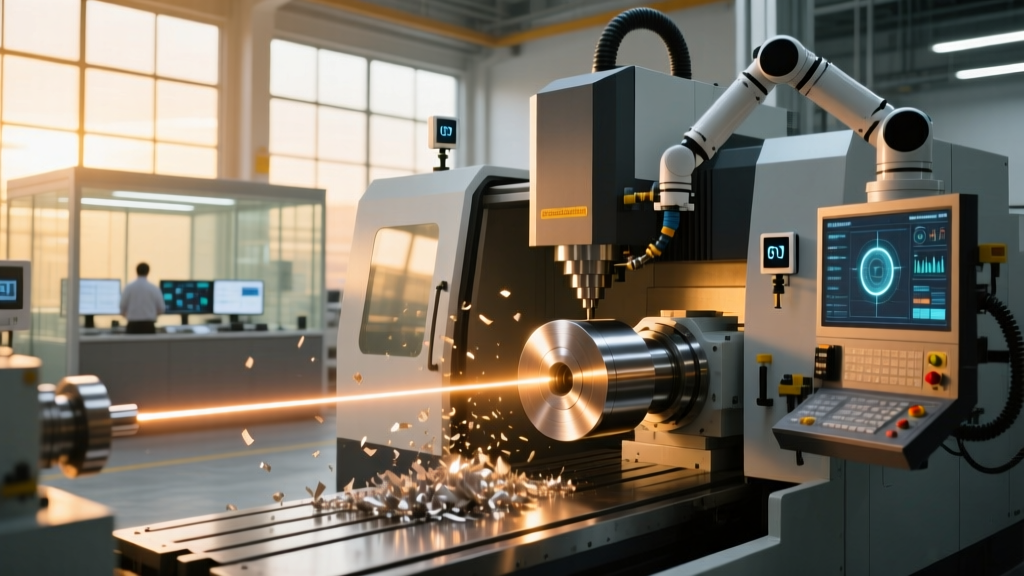
Medical Equipment Manufacturing Industry Trends 2025: Lifecycle Mgmt
Compare lifecycle management alternatives for medical device production. Analyze costs, FDA compliance impacts, and 2025 industry trends for OEMs.
The Shift from Capacity to Lifecycle Optimization
Entering 2026, the baseline established by the medical equipment manufacturing industry trends 2025 has fundamentally altered how Original Equipment Manufacturers (OEMs) manage capital assets. The era of purchasing a CNC micromachining center or a cleanroom injection molding press and running it to failure is over. With cleanroom operational costs exceeding $1,200 per square foot annually and FDA scrutiny intensifying around process validation, equipment lifecycle management (LCM) is now a primary lever for margin preservation.
Medical device manufacturing requires a unique approach to LCM. Unlike automotive or consumer electronics, a machine failure in MedTech does not just halt production; it risks invalidating the Device History Record (DHR), triggering a costly batch quarantine, or necessitating a partial re-validation of the manufacturing process. This analysis compares the four dominant LCM strategies currently deployed in tier-1 and tier-2 medical manufacturing facilities, evaluating their financial, operational, and regulatory trade-offs.
⚠️ Regulatory Warning: The Validation AnchorUnder 21 CFR Part 820.70 (Production and Process Controls), medical manufacturers must validate equipment that affects product quality. Any LCM strategy that involves replacing critical machine components (e.g., a spindle bearing on a Swiss-type lathe or a heating barrel on an extruder) requires documented evidence that the change does not adversely affect the validated state. Factor $25,000 to $40,000 in IQ/OQ/PQ (Installation, Operational, Performance Qualification) re-validation costs into your lifecycle planning for major asset overhauls.
Core LCM Alternatives: A Comparative Matrix
Medical OEMs typically deploy a hybrid LCM approach, assigning different strategies based on the asset's criticality to patient safety and production throughput. Below is a comparison of the four primary models.
| LCM Strategy | Financial Profile | FDA Validation Impact | Ideal MedTech Application |
|---|---|---|---|
| Reactive (Run-to-Failure) | Low upfront OPEX; catastrophic failure costs. | High risk of uncontrolled process drift; severe audit findings. | Non-critical packaging conveyors; secondary material handling. |
| Preventive (Calendar-Based) | Moderate, predictable OPEX; high spare parts inventory. | Standard compliance; requires strict SOP adherence for PM logs. | Cleanroom HVAC systems; standard assembly line robotics. |
| Predictive (IIoT / CBM) | High initial sensor CAPEX; lowest long-term cost per part. | Excellent; provides continuous data for process capability (Cpk). | Swiss-type CNC lathes; cleanroom injection molding presses. |
| Equipment-as-a-Service (EaaS) | Zero CAPEX; premium OPEX (15-20% higher over 5 years). | Vendor assumes validation burden; OEM must audit vendor QMS. | Laser cutting systems; automated optical inspection (AOI) cells. |
Deep Dive: Predictive Maintenance in Precision Machining
The most significant shift observed in recent industry data is the migration toward Condition-Based Maintenance (CBM) for high-precision subtractive manufacturing. Consider the production of orthopedic bone screws using a Tsugino B038-VI Swiss-type CNC lathe. A sudden spindle bearing degradation does not just stop the machine; it alters the cutting dynamics, causing micro-burring on titanium alloy parts that may bypass standard visual inspection but fail fatigue testing in vivo.
The Economics of Sensor Retrofitting
Retrofitting legacy or mid-life CNC equipment with predictive IIoT nodes is now standard practice. Installing acoustic emission and vibration sensors (such as the SKF Enlight IMx or Emerson AMS Machine Works packages) typically costs between $4,500 and $8,500 per machine axis.
- Cost of Unplanned Downtime: Scrapping a batch of 10,000 titanium spinal screws due to tool chatter caused by spindle runout costs approximately $45,000 in raw materials and lost cleanroom machine time.
- ROI Timeline: By detecting bearing wear 300 hours before catastrophic failure, the $6,800 sensor investment pays for itself on the first avoided batch quarantine.
Furthermore, continuous monitoring data feeds directly into the facility's Quality Management System (QMS), satisfying the continuous improvement mandates of ISO 13485:2016 by providing empirical evidence of process stability.
The Rise of Equipment-as-a-Service (EaaS) in Cleanrooms
For capital-intensive cleanroom processes, EaaS has emerged as a compelling alternative to traditional depreciation models. Under EaaS, the OEM (e.g., Arburg or Engel) retains ownership of the injection molding press and charges the medical manufacturer a fee per shot, per cycle, or per hour of verified uptime.
"EaaS shifts the validation and calibration risk back to the equipment provider. For a tier-2 medical molder producing diagnostic housings, this means the machine vendor is contractually obligated to maintain the equipment within the validated process window, drastically reducing the molder's internal metrology and maintenance headcount."
EaaS vs. Traditional Ownership: A 5-Year Financial Model
Assuming a $450,000 cleanroom-grade electric injection molding cell:
- Traditional Ownership: $450k CAPEX + $15k/year maintenance + $25k validation costs. 5-year total cost of ownership (TCO): ~$550,000. Risk of technological obsolescence rests on the manufacturer.
- EaaS Model: $0 CAPEX + $135,000/year usage fee (inclusive of PM, calibration, and remote monitoring). 5-year TCO: $675,000. While the absolute cost is 22% higher, the internal rate of return (IRR) on the freed-up capital, combined with zero downtime risk, makes EaaS superior for high-mix, low-volume diagnostic device lines.
Decision Framework: Selecting the Right LCM Strategy
Plant managers and quality directors should apply the following logic tree to determine the optimal lifecycle strategy for any new or existing asset on the production floor:
Asset Criticality Logic Tree
- Does the equipment directly contact the sterile field or alter the biocompatibility of the final device?
- YES: Proceed to Step 2.
- NO: Proceed to Step 4.
- Is the machine capable of native OPC-UA or MTConnect data export for real-time Cpk monitoring?
- YES: Implement Predictive (IIoT) LCM. Integrate directly with the MES (Manufacturing Execution System).
- NO: Evaluate EaaS to force the vendor to provide a modern, data-capable asset, or budget $10k for a full IIoT retrofit.
- Is the asset a standardized utility (e.g., cleanroom air showers, DI water loops)?
- YES: Implement strict Preventive (Calendar-Based) LCM aligned with ISO 14644 cleanroom testing schedules.
- For non-critical secondary equipment (e.g., cardboard erecting, end-of-line palletizing):
- Default to Reactive LCM with a redundant buffer stock of critical wear parts (belts, suction cups) to minimize TCO.
Traceability and the Digital Thread
The ultimate goal of modern lifecycle management in MedTech is the creation of an unbroken digital thread. According to guidelines from the NIST Smart Connected Manufacturing program, integrating machine health data with production data ensures that every serialized medical device can be traced back not just to the operator and the raw material lot, but to the exact vibration signature and thermal profile of the machine at the moment of manufacture.
As we move deeper into 2026, medical manufacturers that treat equipment lifecycle management merely as a maintenance function will lose ground to those leveraging LCM as a core component of their regulatory compliance and quality assurance architecture. Choosing between predictive retrofits and EaaS models requires a rigorous analysis of your specific product mix, cleanroom constraints, and internal validation capabilities.