Operator Training for Top Medical Equipment Manufacturers' Contracts
Discover contract manufacturing equipment selection criteria focused on operator training, HMI usability, and FDA compliance for medical device production.
When contract manufacturers (CMs) secure bids from the top medical equipment manufacturers—such as Medtronic, Stryker, or Boston Scientific—the immediate focus typically lands on machine tool precision, cleanroom certifications, and ISO 13485 compliance. However, a critical bottleneck is frequently overlooked during the capital equipment procurement phase: operator trainability and cognitive load.
Manufacturing Class II and Class III medical devices, such as Ti-6Al-4V ELI spinal cages or PEEK (Polyether ether ketone) surgical instrument housings, demands extreme concentration. Tolerances routinely sit at ±0.0002 inches (5 microns). If the selected CNC platforms, automated laser welders, or injection molding systems feature convoluted Human-Machine Interfaces (HMIs), the time-to-competency for new operators balloons, scrap rates spike, and FDA audit risks multiply. Selecting equipment with operator training and usability at the forefront is no longer a luxury; it is a fundamental requirement for profitable medical contract manufacturing.
The Cognitive Load Problem in FDA-Regulated Machining
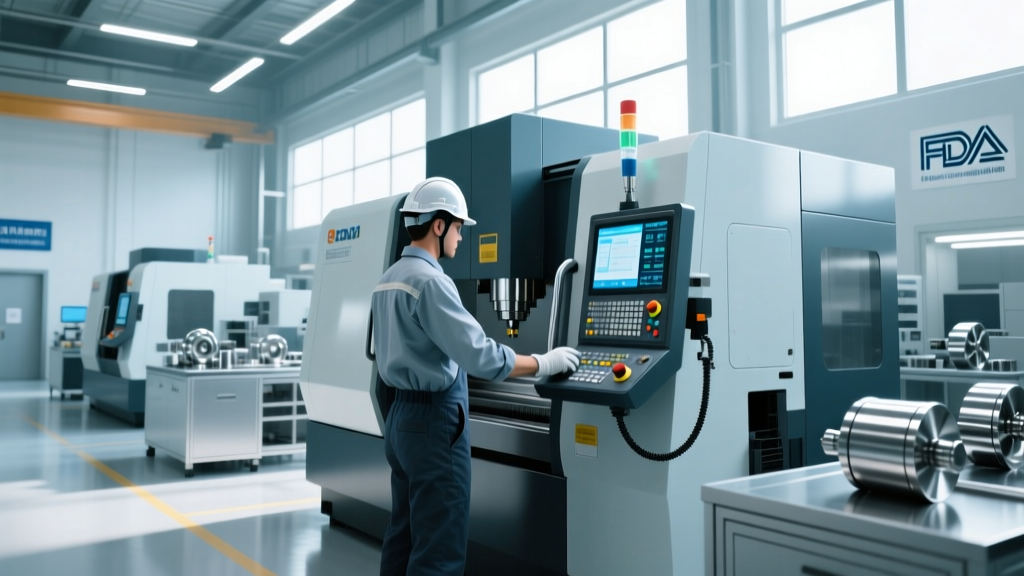
Medical device manufacturing is uniquely punishing on operators. Unlike high-volume automotive machining where cycle times and throughput dominate, medical machining involves high-mix, low-volume production with intense documentation requirements. An operator running a Citizen Cincom L32XII Swiss-type CNC to produce bone screws must manage complex guide bushing adjustments, high-pressure coolant routing, and sub-spindle synchronization.
When equipment relies on legacy, multi-layered menu structures and monochrome displays, the operator's cognitive load maxes out. This fatigue directly correlates to setup errors. In a medical context, a setup error does not just mean scrapped metal; it means a potential failure in a life-saving implant and a non-conformance report (NCR) that triggers an exhaustive root-cause analysis under FDA 21 CFR Part 820.25 training and personnel regulations.
4 Equipment Selection Criteria for Rapid Operator Onboarding
To minimize the time-to-competency and reduce human error, procurement teams must evaluate machinery based on how easily a novice or transitioning operator can master it. Integrate these four criteria into your next equipment RFQ (Request for Quote).
1. Native Digital Twin and Virtual Commissioning
The most effective way to train an operator without risking a $150,000 spindle crash is through a digital twin. When selecting 5-axis machining centers, prioritize controls like the Siemens Sinumerik ONE. This platform utilizes a 'digital native' architecture, meaning the virtual HMI on a desktop PC is identical to the physical machine panel. Operators can spend their first three weeks running virtual setups, proving out G-code for complex orthopedic knee joints, and simulating toolpaths in a zero-risk environment. According to research highlighted by NIST Advanced Manufacturing programs, digital twin integration drastically reduces physical commissioning time and accelerates operator familiarity with complex kinematics.
2. HMI Ergonomics and Touch-Native Interfaces
Medical CMs should reject equipment that requires operators to memorize deep, nested alphanumeric codes. Look for touch-native, capacitive HMIs with visual tool management. The Mazak MAZATROL SmoothAi control, for instance, features a 19-inch multi-touch screen that mimics smartphone gestures. Operators can pinch-to-zoom on complex 3D toolpaths and drag-and-drop tool offsets. This visual management reduces menu-diving fatigue and allows operators to spot potential collisions in titanium milling operations before they occur.
3. Integrated Metrology and Closed-Loop Feedback
Training operators to manually inspect microscopic medical features using traditional micrometers or optical comparators takes months. Instead, select equipment with integrated, automated metrology. Equipping CNC lathes with a Renishaw Equator gauging system allows the machine to automatically measure the part, compare it to the CAD nominal, and update the tool offsets in real-time. The operator's role shifts from 'manual inspector' to 'process monitor,' drastically lowering the training barrier for quality assurance.
4. AR-Assisted Maintenance and Setup
Downtime in a cleanroom environment is catastrophically expensive. Modern equipment should support Augmented Reality (AR) overlays for setup and maintenance. Systems integrating PTC Vuforia allow a junior operator to point a tablet at a laser welding enclosure and see step-by-step, 3D animated instructions for aligning the optical path or replacing the shielding gas nozzle. This just-in-time training reduces reliance on senior technicians and ensures standardized setup procedures.
⚠️ FDA Compliance Warning: Training DocumentationUnder FDA 21 CFR Part 820.25, it is not enough to simply train your operators; you must document their training, evaluate its effectiveness, and maintain records of their education and experience. When selecting equipment, ensure the machine's HMI supports RFID or biometric operator login. This automatically logs who ran the machine, what program was executed, and ties the production data directly to the operator's digital training matrix, streamlining FDA audits.
Training Timeline & Cost Comparison: Legacy vs. Modern HMI
The financial argument for prioritizing operator trainability in equipment selection becomes clear when analyzing the onboarding metrics for Swiss-type CNC operations in medical manufacturing.
| Metric | Legacy Controls (Pre-2018) | Modern HMI + Digital Twin |
|---|---|---|
| Time to First-Article Competency | 16 - 24 Weeks | 4 - 6 Weeks |
| Average Training Cost per Operator | $18,500 (Includes scrap & external schooling) | $6,200 (In-house virtual simulation) |
| Setup Collision Rate (First 90 Days) | 1.4 Crashes / Operator | 0.1 Crashes / Operator |
| FDA Audit Traceability (Manual vs Auto) | Manual Paper Logs (High Risk) | Automated RFID Login (Audit Ready) |
Best Practices for Structuring the Onboarding Framework
Purchasing trainability-focused equipment is only half the battle. CMs must implement a structured, phased onboarding program that leverages the machine's native capabilities. Follow this 6-week framework to ensure compliance and operational readiness.
- Weeks 1-2: Virtual Immersion and G-Code Syntax. Operators spend 100% of their time on the digital twin software. They learn machine kinematics, tool geometry setup, and program verification without touching the physical machine. Assessments are based on virtual cycle time optimization and collision avoidance.
- Weeks 3-4: Shadowing with AR and Guided Setups. Operators transition to the shop floor. Using AR tablets or the machine's built-in visual setup wizards, they perform physical tool loading, work coordinate system (WCS) probing, and guide bushing adjustments under the supervision of a lead machinist.
- Week 5: Supervised First-Article Inspection (FAI). The operator runs the first batch of medical components (e.g., PEEK spinal spacers). They are responsible for executing the automated metrology routines and filling out the AS9102 / FDA-mandated FAI documentation, verifying that the closed-loop feedback systems are functioning correctly.
- Week 6: Independent Run and Effectiveness Evaluation. The operator runs a full shift independently. Management evaluates not just the scrap rate, but the operator's adherence to OSHA safety and training development guidelines regarding ergonomic machine interaction and cleanroom protocol adherence. Upon passing, the operator's RFID badge is unlocked for independent machine access.
The ROI of Trainability in Equipment Procurement
Procurement teams often push back on the 10% to 15% price premium associated with advanced HMIs, digital twin licenses, and integrated metrology packages. However, the return on investment is easily quantifiable.
"A $25,000 premium for advanced controls and simulation software pays for itself after successfully training just two operators. The elimination of a single spindle crash on a 5-axis medical mill—often costing $40,000 in repairs and three weeks of downtime—makes the trainability premium an immediate net positive."
When competing for contracts from the top medical equipment manufacturers, your ability to rapidly scale a highly trained, FDA-compliant workforce is your strongest competitive advantage. By shifting equipment selection criteria away from pure mechanical specifications and toward operator cognitive support, CMs can drastically reduce onboarding friction, protect profit margins from scrap, and guarantee the uncompromising quality that the medical device industry demands.