Batch vs Continuous Advanced Manufacturing Equipment Applications
Compare batch and continuous advanced manufacturing equipment through real-world case studies, CapEx data, and ROI frameworks for modern facilities.
Selecting the right production architecture is the most capital-intensive decision a plant manager will make this decade. When evaluating advanced manufacturing equipment, the fundamental dichotomy always returns to batch versus continuous processing. While legacy facilities default to batch operations out of familiarity, modern continuous systems offer radical improvements in yield, footprint, and energy efficiency. However, continuous processing is not a universal panacea; its viability depends entirely on material rheology, SKU variability, and regulatory frameworks.
The Mechanical Divide: Discrete Volumes vs. Steady-State Mass Flow
Batch advanced manufacturing equipment operates on discrete, time-bound volumes. A 1,000-liter high-shear mixer processes a fixed mass of raw material through sequential stages: charging, mixing, discharging, and cleaning. The equipment is inherently flexible but suffers from dead time, scale-up nonlinearities, and high work-in-progress (WIP) inventory.
Conversely, continuous advanced manufacturing equipment relies on steady-state mass flow and precise residence time distribution (RTD). Material is continuously fed, processed, and discharged. The mechanical focus shifts from vessel capacity to feed rate accuracy, screw/impeller geometry, and in-line process analytical technology (PAT). The primary engineering challenge in continuous systems is maintaining uniform material properties despite minor upstream feed fluctuations.
Engineering Callout: The Scale-Up TrapScaling a batch process from a 50L pilot lab to a 2,000L production vessel often alters shear rates and heat transfer coefficients, requiring months of re-validation. Continuous equipment bypasses this by "scaling out" (running longer) rather than "scaling up" (building bigger vessels), maintaining identical thermodynamic and kinetic profiles from pilot to production.
Case Study 1: Pharmaceutical API Granulation
The pharmaceutical industry provides the starkest contrast between batch and continuous advanced manufacturing equipment. Historically, active pharmaceutical ingredient (API) granulation relied on batch equipment like the Diosna P 1/6 high-shear mixer paired with a Glatt fluid bed dryer. A standard 600kg batch takes 4 to 6 hours to process, followed by 3 hours of cleaning and line clearance.
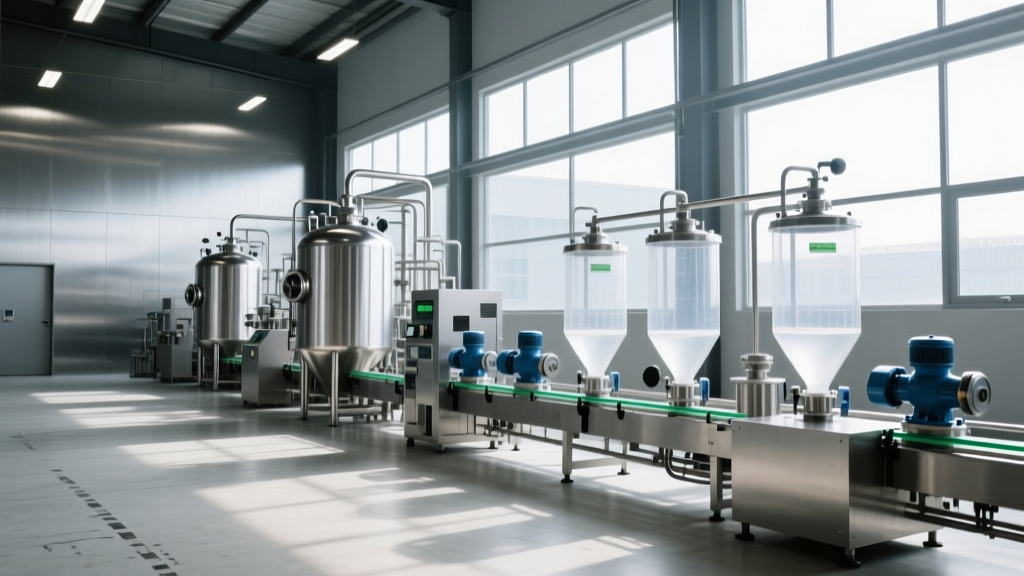
Today, facilities are adopting continuous wet granulation lines, such as the GEA ConsiGma system. This equipment integrates powder dosing, twin-screw wet granulation, and continuous fluid bed drying into a single footprint.
- Batch CapEx: $2.5M - $4M for a fully instrumented suite.
- Continuous CapEx: $8M - $14M for a turnkey ConsiGma line with integrated PAT.
- Footprint Reduction: Continuous lines reduce the required cleanroom footprint by up to 70%, drastically lowering HVAC and environmental monitoring costs.
According to the U.S. Food and Drug Administration, continuous manufacturing allows for real-time release testing (RTRT), eliminating the 14-to-21-day quarantine period required for batch lab testing. This inventory reduction often yields a faster ROI than the raw equipment cost suggests.
Case Study 2: Polymer Compounding and Extrusion
In polymer compounding, the debate shifts from regulatory compliance to thermomechanical degradation. Batch mixing utilizes internal mixers like the Farrel Banbury, which rely on high-torque rotors to shear and disperse fillers (like carbon black or glass fibers) into a polymer melt. While excellent for highly viscous, high-filler formulations, Banbury mixers operate in discrete cycles, creating temperature spikes that can degrade heat-sensitive polymers.
Continuous compounding relies on co-rotating twin-screw extruders, such as Coperion's ZSK Mc18 series. These machines feature modular barrel sections and customizable screw elements with Length-to-Diameter (L/D) ratios ranging from 40:1 to 72:1.
Thermomechanical Comparison Matrix
| Metric | Banbury Internal Mixer (Batch) | ZSK Twin-Screw Extruder (Continuous) |
|---|---|---|
| Specific Mechanical Energy (SME) | High (0.3 - 0.5 kWh/kg) | Low to Moderate (0.1 - 0.25 kWh/kg) |
| Residence Time | 5 - 15 minutes (Batch cycle) | 30 - 90 seconds (Continuous flow) |
| Temperature Control | Poor (Adiabatic heating spikes) | Excellent (Modular barrel cooling) |
| Changeover Time | 1 - 2 hours (Manual purge) | 15 - 30 minutes (Screw pull/purge) |
For engineering resins like PEEK or PPS, the short residence time and precise barrel temperature control of the ZSK extruder prevent polymer chain scission, resulting in a 12% to 15% higher tensile strength in the final pelletized product compared to batch-mixed equivalents.
Process Analytical Technology (PAT) and Control Loops
The true differentiator of modern advanced manufacturing equipment is not just the mechanical transport, but the control architecture. Batch equipment typically utilizes basic PLC logic for recipe execution (e.g., "mix at 500 RPM for 10 minutes"). Continuous equipment demands advanced Distributed Control Systems (DCS) integrated with inline PAT sensors.
Researchers at the MIT Center for Continuous Manufacturing have demonstrated that integrating Near-Infrared (NIR) spectroscopy and microwave resonance sensors directly into continuous feed frames allows for automated feedback loops. If the NIR sensor detects a 0.5% deviation in API concentration, the DCS automatically adjusts the loss-in-weight feeder speeds within milliseconds to correct the blend ratio before the material reaches the tablet press. This level of closed-loop control is mechanically impossible in a sealed batch blender.
Decision Framework: Selecting Your Architecture
Plant engineers should use the following matrix to determine whether batch or continuous advanced manufacturing equipment is appropriate for a specific product line.
Warning: The High-Mix/Low-Volume TrapDo not force continuous processing onto high-mix, low-volume product lines. If your facility runs 15 different SKUs with campaigns lasting less than 4 hours, the material wasted during continuous line start-up, steady-state stabilization, and flush-out will destroy your yield. Stick to advanced batch equipment with automated Clean-In-Place (CIP) systems for high-mix environments.
- Choose Batch When: Campaign volumes are under 5,000 kg, SKU variety is high, material rheology is highly non-Newtonian or thixotropic, and upfront CapEx is strictly constrained.
- Choose Continuous When: Annual volumes exceed 50,000 kg, the product is a single SKU or low-mix family, material flow properties are consistent, and facility footprint/cleanroom costs are prohibitive.
The Hybrid Reality of 2026 Factory Floors
Rather than a binary choice, the most efficient modern facilities deploy hybrid architectures. A common configuration in specialty chemicals involves continuous upstream reaction and compounding (using twin-screw extruders or continuous stirred-tank reactors), feeding into a continuous cooling belt, but terminating in a batch packaging and quality-assurance buffering system. This hybrid approach leverages the thermodynamic efficiency of continuous processing while accommodating the logistical realities of discrete shipping and batch-level certificate of analysis (CoA) generation.
"The transition from batch to continuous is rarely just an equipment swap; it is a fundamental rewiring of the plant's material handling, quality assurance, and supply chain logic. The equipment is merely the physical manifestation of a continuous data stream."
Ultimately, specifying advanced manufacturing equipment requires looking past the nameplate throughput. Engineers must model the total cost of ownership, factoring in the cost of cleanroom HVAC per square foot, the financial impact of WIP quarantine times, and the specific mechanical energy required to maintain material integrity. By aligning the physical processing method with the chemical and logistical realities of the product, facilities can secure a decisive margin advantage.