Plastic Manufacturing for Recreational Equipment: Batch vs. Continuous Safety
Compare batch and continuous equipment safety standards in plastic manufacturing for recreational equipment. Learn compliance, risks, and ISO guidelines.
The Compliance Divide: Batch vs. Continuous in Recreational Plastics
When engineering components for kayaks, ATV fenders, playground structures, and protective helmets, the choice between batch and continuous production dictates more than just throughput—it fundamentally alters the safety and compliance architecture of the factory floor. Plastic manufacturing for recreational equipment is heavily scrutinized by the Consumer Product Safety Commission (CPSC) and governed by strict ASTM standards, such as ASTM F1487 for public playground equipment. A failure in the manufacturing process doesn't just mean scrap; it means catastrophic field failures and severe liability.
As of 2026, the divergence in safety protocols between batch systems (like injection and rotational molding) and continuous systems (like extrusion and thermoforming) requires entirely different approaches to machine guarding, Lockout/Tagout (LOTO), and material traceability. Understanding these distinctions is critical for plant managers and safety engineers navigating ANSI/SPI B151.1 and ISO 12100 compliance.
⚠️ Critical Material Science Warning: Safety compliance in recreational plastics isn't just about guarding moving parts; it's about preventing thermal degradation. For example, when molding polycarbonate (PC) for recreational helmets via batch injection, shear heat can spike localized temperatures. Conversely, in continuous extrusion for playground plastic lumber, prolonged barrel residence time exceeding 4 minutes at 280°C causes hydrolytic degradation. Both result in brittle parts that will fail CPSC impact drop tests, creating a massive product liability hazard despite the machine's mechanical safety interlocks being fully functional.Batch Equipment Safety: High-Force, High-Cycle Molding
Batch manufacturing, primarily injection molding (e.g., Engel e-mac series) and rotational molding, operates on a discrete cycle basis. The primary safety hazards are characterized by extreme kinetic energy and high-pressure hydraulic or electric clamping forces.
Interlock Standards and Clamping Hazards
In batch injection molding, clamping forces routinely range from 50 to 3,500 tons. Under OSHA's machine guarding regulations and the ANSI/SPI B151.1 standard, the safety gates must be integrated with the machine's control system to achieve ISO 13849-1 Performance Level (PL) d or e.
- Hardwired vs. AS-i Safety Buses: Legacy machines rely on hardwired dual-channel safety relays. Modern 2026-compliant batch equipment utilizes AS-Interface (AS-i) safety buses. AS-i allows for continuous monitoring of the safety gate's position and the integrity of the wiring itself, preventing 'defeat' scenarios where operators bypass interlocks with zip-ties or tape to clear jams.
- Zero-Speed Monitoring: For large tonnage machines, simply stopping the hydraulic pump is insufficient due to flywheel inertia or trapped hydraulic pressure. Compliance requires zero-speed monitoring drives that physically verify the platen has ceased all movement before the mechanical safety gate lock disengages.
Rotational Molding and Thermal Burn Hazards
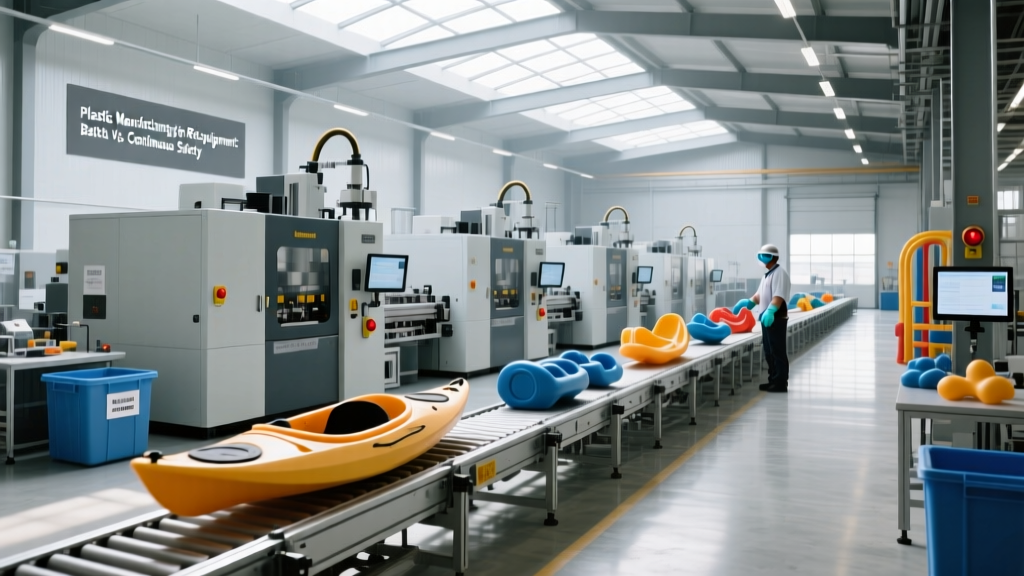
Rotational molding, heavily used for hollow recreational equipment like kayaks and coolers, presents unique thermal hazards. The molds are heated in ovens reaching 300°C (572°F) and then cooled. The primary compliance focus here is on automated cooling chambers and perimeter guarding to prevent operators from entering the cooling zone while the mold surface temperature remains above 45°C (113°F), the threshold for contact burns defined by ISO 13732-1.
Continuous Equipment Safety: Extrusion Lines and Nip-Point Hazards
Continuous manufacturing, such as extrusion (e.g., battenfeld-cincinnati BluePower lines) used for plastic decking, playground borders, and tubing, operates 24/7. The hazards shift from high-impact clamping forces to continuous draw-in hazards, nip points, and complex LOTO requirements.
Nip-Point Guarding and Web Snap-Back
Extrusion lines utilize a series of haul-offs, pullers, and nip rolls to maintain tension on the continuous plastic profile. The draw-in hazard at these nip points is severe. ANSI/SPI B151.1 mandates that nip-point guards must be positioned at a safe distance calculated by the speed of the web and the operator's reaction time. Furthermore, if a continuous plastic profile breaks under high tension, the 'snap-back' effect can cause severe lacerations or blunt force trauma. Compliance requires polycarbonate shielding (minimum 10mm thickness) around all high-tension puller units.
Zone-Based LOTO Complexity
Unlike a batch injection mold where the entire machine is locked out for maintenance, continuous extrusion lines can be up to 100 meters long, comprising a feeder, extruder, vacuum calibration tank, puller, and saw. Under OSHA's LOTO standard (1910.147), locking out the entire line for a minor jam at the saw is inefficient and often bypassed by operators.
The 2026 compliance solution is Zone-Based LOTO with Control Reliable Safety PLCs. This allows the puller and saw to be isolated and locked out via local safety disconnects while the extruder barrel remains heated and in a slow purge mode, preventing material degradation. This requires rigorous documentation and specialized training to ensure operators understand the boundaries of the isolated zones.
Compliance Matrix: Batch vs. Continuous Manufacturing
The following matrix outlines the core safety and compliance differences between the two methodologies when producing recreational plastics.
| Compliance Parameter | Batch (Injection/Rotational) | Continuous (Extrusion/Thermoforming) |
|---|---|---|
| Primary Kinetic Hazard | High-tonnage clamping force; ejector pin crush hazards. | Nip-point draw-in; continuous web snap-back. |
| Interlock Standard | ISO 13849-1 PL d/e; AS-i safety bus monitoring. | Fixed distance guarding; light curtains for feeding zones. |
| LOTO Strategy | Whole-machine energy isolation (hydraulic, thermal, electrical). | Zone-based isolation; minor servicing exceptions for web threading. |
| Thermal Risk Profile | Localized nozzle burns; mold surface contact. | Prolonged barrel residence degradation; die-head pressure blowouts. |
| Traceability for Recalls | Discrete batch/lot numbering via cavity ID and cycle counter. | Continuous laser coding or RFID embedding at the haul-off stage. |
Material Traceability: Meeting CPSC Recall Requirements
Safety compliance extends beyond the physical machine to the data it generates. When a recreational product—such as a child's playground slide or an ATV helmet—is subject to a CPSC recall, the manufacturer must be able to trace the defect back to the exact production window.
Batch Traceability
In batch manufacturing, traceability is inherently structured. Each cycle produces a discrete part. Modern injection molding machines integrate with MES (Manufacturing Execution Systems) to log the exact cavity number, melt temperature, injection pressure, and cooling time for every single shot. If a batch of polycarbonate visors fails impact testing, the safety engineer can isolate the exact 4-hour window where the barrel heater band failed, causing a 15°C drop in melt temperature and resulting in high internal stress.
Continuous Traceability Challenges
Continuous extrusion poses a massive traceability challenge. A single run of plastic lumber for playgrounds might produce 10,000 linear feet of material without a natural 'break' to assign a new lot number. To comply with modern safety auditing, continuous lines must employ inline laser coders that print a timestamp and line-speed code every 5 meters, or embed passive RFID tags directly into the plastic profile during the calibration phase. Without this, a localized failure in the vacuum calibration tank (causing a hollow void in the lumber) could compromise thousands of feet of product that cannot be accurately isolated during a safety recall.
"In recreational plastic manufacturing, the machine's safety interlocks protect the operator, but the machine's data architecture protects the end-user. A perfectly guarded extrusion line that lacks continuous inline traceability is a massive compliance failure waiting for a field incident." — Industrial Safety Audit Guidelines, 2025/2026 Edition.
Actionable Safety Audit Framework for Plant Managers
To ensure your facility meets the rigorous demands of both OSHA machinery standards and CPSC end-product safety requirements, execute this targeted audit based on your equipment type:
For Batch Molding Facilities:
- Verify Safety Gate Defeat Resistance: Inspect all injection molding machines to ensure safety gates utilize RFID-coded non-contact switches rather than simple mechanical limit switches, which are easily bypassed.
- Audit Hydraulic Accumulator Bleed-Down: Confirm that automated bleed-down valves are functioning and that pressure gauges are visible from the operator station, ensuring zero stored energy before mold changes.
- Validate Thermal Profiling: Cross-reference the machine's logged thermal profile against the material supplier's degradation limits to ensure no batches are at risk of molecular breakdown.
For Continuous Extrusion Facilities:
- Map Nip-Point Guarding Distances: Measure the distance from the nip-point guard opening to the actual draw-in point. Ensure it exceeds the reach distance calculated by the web speed and ISO 13855 standards.
- Test Zone-Based LOTO: Conduct a live drill where maintenance must isolate only the downstream puller while the extruder remains in a safe, heated idle state. Verify that the safety PLC correctly prevents the puller from restarting without a full system reset.
- Calibrate Inline Traceability: Verify that the laser coder or RFID embedder is synchronized with the line speed encoder, ensuring that timestamp data remains accurate even during line acceleration or deceleration phases.
By aligning your equipment's mechanical guarding with the specific material and traceability requirements of recreational plastics, you bridge the gap between operator safety and consumer product compliance, ensuring your manufacturing process is as resilient as the products it produces.