Lean Workstation Design: HMA Plant Equipment Manufacturer Strategies
Discover how a leading HMA plant equipment manufacturer applies lean workstation design to optimize control rooms, maintenance, and loadout efficiency.
The Architecture of Lean in Heavy Asphalt Production
Hot Mix Asphalt (HMA) facilities are traditionally viewed as massive, high-thermal civil engineering projects rather than discrete manufacturing environments. However, modern plant efficiency is entirely dictated by human-machine interaction. When a top-tier HMA plant equipment manufacturer designs a new drum mix or batch facility, the integration of lean manufacturing equipment and workstation design is what separates a 400-ton-per-hour (TPH) plant from a bottlenecked 350-TPH operation. Lean principles—specifically the elimination of muda (waste) in motion, waiting, and defects—are now hard-coded into the physical geometry of control consoles, maintenance platforms, and loadout stations.
According to the Astec Industries asphalt division, modern plant design focuses heavily on reducing operator cognitive load and physical strain. By treating the HMA facility as a series of interconnected workstations rather than a single monolithic machine, engineers can apply precise ergonomic and lean frameworks to maximize uptime and batch consistency.
Control Room Consoles: ISO 11064 and the 30-Degree Sightline
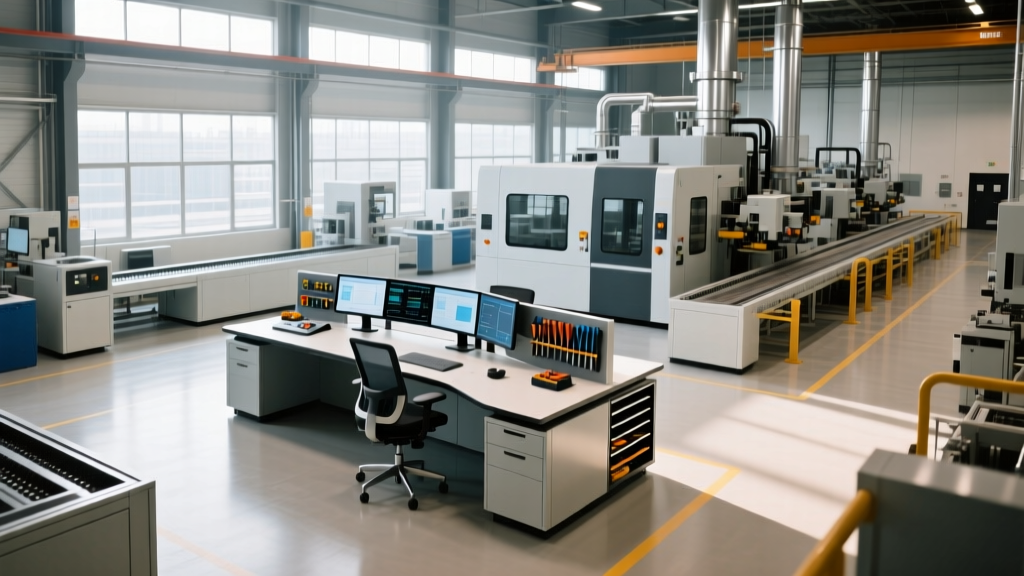
The batch control room is the nerve center of an HMA plant. Legacy plants often utilized flat desks with stacked monitors, forcing operators to constantly shift their neck and eyes to track aggregate bin gates, drum mixer temperatures (typically 300°F to 330°F), and liquid asphalt cement (AC) flow meters. Modern lean workstation design strictly adheres to OSHA and ISO 11064-6 ergonomic standards for control room layout.
Console Geometry and Reach Envelopes
A lean-compliant HMA control console utilizes a 120-degree wrap-around radius. The physical dimensions are strictly governed by human anthropometric data:
- Primary Reach Zone (0-18 inches): Reserved for critical tactile controls, including the emergency plant stop, manual burner override, and the primary HMI trackball. This zone requires zero torso rotation.
- Secondary Reach Zone (18-28 inches): Houses the main HMI touchscreens displaying the aggregate cold feed belt speeds and dryer drum exhaust temperatures.
- Visual Cone (30 degrees): Per ISO 11064-6, all critical alarm beacons and primary trend graphs must fall within a 30-degree downward viewing angle from the operator's neutral eye position to prevent cervical fatigue during 12-hour shifts.
Do not mount HMI screens directly to the console surface. Use gas-spring monitor arms (e.g., Ergotron LX series) rated for 15-25 lbs with VESA 100x100 mounts. This allows operators to adjust the focal depth based on lighting conditions and reduces screen glare from the control room windows overlooking the asphalt drum.
Maintenance Workstations and the 5S Heavy Equipment Standard
In HMA production, unplanned downtime costs upwards of $2,500 per hour in lost paving contract penalties. Lean maintenance workstations are designed to execute standardized work with zero search time. A leading HMA plant equipment manufacturer now pre-fabricates maintenance platforms with integrated 5S shadow boards and automated lubrication manifolds.
Eliminating Motion Waste at the Trunnion Bearings
The drum mixer trunnion bearings operate under extreme thermal and particulate stress. Manual greasing requires a technician to walk the catwalks, carrying a manual grease gun—a classic example of motion and transport waste. Lean design replaces this with centralized automated lubrication systems (e.g., Lincoln Quicklub Series 2). However, for manual inspection tasks, the workstation is equipped with pneumatic tool balancers.
Warning: Pneumatic Balancer CalibrationWhen outfitting maintenance platforms with 1-inch impact wrenches (such as the Ingersoll Rand 2850K-6, weighing 24 lbs), tool balancers must be calibrated to exactly 26 lbs of retraction tension. Setting the tension too low (e.g., 20 lbs) causes the tool to drag and increases operator fatigue; setting it too high (e.g., 35 lbs) creates a snap-back safety hazard when the tool is released.
Silo Loadout Stations: Eliminating Waiting and Defect Waste
The loadout silo is where the final product is dispensed into transport trucks. Inefficient truck positioning leads to asphalt spillage (defect waste) and excessive idle time (waiting waste). Lean workstation design at the loadout interface utilizes automated laser-guided positioning systems.
Using time-of-flight laser sensors (such as the SICK DT50-2), the loadout workstation projects a visual guide onto the truck bed or uses a traffic light interface. This reduces the average truck repositioning time from 45 seconds down to 4 seconds. Over a 10-hour paving day with 150 truck loads, this lean intervention recovers nearly 1.5 hours of pure production time.
Loadout Workstation ROI Matrix
| Workstation Upgrade | Lean Principle Targeted | Estimated Capital Cost | Cycle Time Impact |
|---|---|---|---|
| ISO 11064 Wrap-Around Console | Motion & Defect Reduction | $14,500 - $18,000 | -12% batch cycle variance |
| Laser Truck Alignment System | Waiting & Defect Elimination | $6,200 - $8,500 | -41 seconds per load |
| Centralized Lube Manifolds | Motion & Overprocessing | $4,500 - $7,200 | Eliminates 45 mins manual lube |
Edge Cases and Failure Modes in Plant Layouts
Even when an HMA plant equipment manufacturer implements lean workstation designs, improper operational integration can lead to specific failure modes. Understanding these edge cases is critical for plant managers and industrial engineers.
1. Acoustic Isolation Overkill in Control Rooms
The Issue: To meet NIOSH ergonomic guidelines for noise reduction, some facilities over-insulate the control room. This completely isolates the operator from the acoustic signatures of the plant.
The Fix: Experienced operators rely on the pitch of the aggregate elevator chain and the rumble of the dryer drum to detect impending mechanical failures before the HMI registers a fault. Lean design dictates the use of directional, low-frequency acoustic transducers inside the control room that pipe in specific machinery sounds, preserving the operator's sensory feedback loop while maintaining safe decibel levels.
2. Shadow Board Tool Degradation in High-Heat Zones
The Issue: Standard 5S foam shadow boards degrade rapidly when maintenance workstations are located near the asphalt storage tanks (where ambient temperatures frequently exceed 110°F in summer).
The Fix: Replace closed-cell polyethylene foam with laser-cut, high-temp silicone inserts rated for continuous 300°F exposure. This ensures the 5S visual management system survives the harsh HMA environment without requiring monthly replacement.
'Lean manufacturing in heavy civil materials is not about speeding up the conveyor; it is about designing the physical environment so that the operator's only option is to execute standard work flawlessly. When the workstation geometry forces efficiency, throughput naturally follows.'
— Senior Plant Integration Engineer, Heavy Machinery Division
Strategic Implementation for 2026 and Beyond
As the industry moves toward fully automated, low-emission asphalt production, the role of the human operator is shifting from manual machine-tending to systemic oversight. An advanced HMA plant equipment manufacturer recognizes that lean workstation design must evolve to support augmented reality (AR) maintenance overlays and predictive analytics dashboards. By anchoring these digital tools within ergonomically optimized, physically lean workstations, asphalt producers can secure a decisive advantage in margin protection and equipment longevity.