Trampoline Park Equipment Manufacturers: Startup Machinery & Safety
Discover the essential small-scale manufacturing equipment startup trampoline park equipment manufacturers need to meet ASTM F2970 safety compliance.
The ASTM F2970 Mandate for New Entrants
Entering the commercial recreation fabrication space requires navigating a minefield of liability and strict engineering tolerances. For startup trampoline park equipment manufacturers, the barrier to entry is not just capital—it is verifiable compliance. As of 2026, commercial insurance underwriters and municipal zoning boards universally mandate adherence to ASTM F2970 (Standard Practice for Design, Manufacture, Installation, Operation, Maintenance, Inspection and Major Modification of Trampoline Courts).
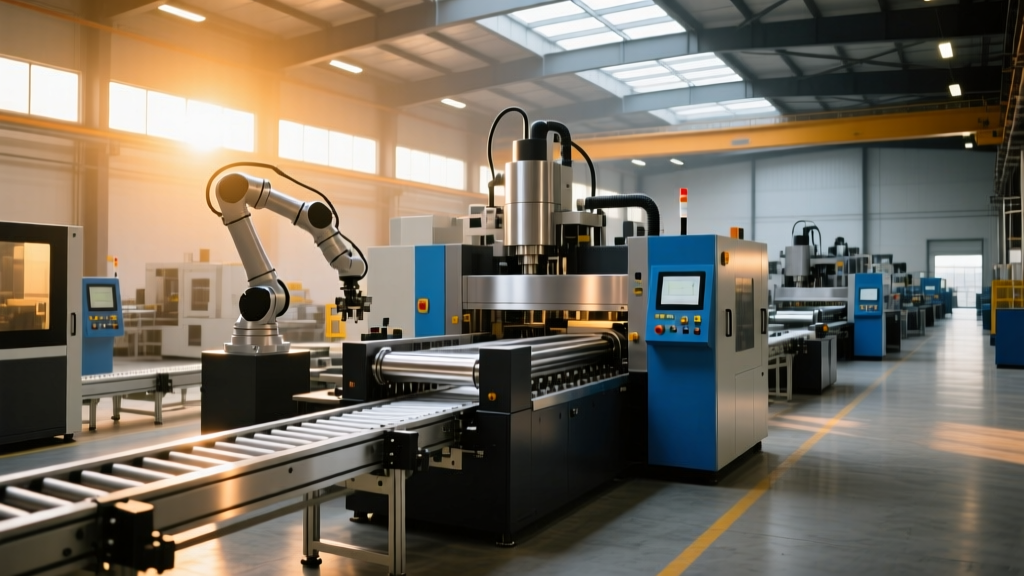
Large-scale legacy manufacturers rely on multi-million-dollar automated laser-tube cutting and robotic welding cells. Startups, however, must achieve identical structural integrity and impact attenuation metrics using small-scale, high-precision manufacturing equipment. Cutting corners on machinery directly results in frame deflection failures, pad bottom-outs, and catastrophic netting tears. This guide details the exact small-scale machinery stack required to produce compliant trampoline park components without enterprise-level capital expenditure.
⚠️ COMPLIANCE WARNING: ASTM F2970 Section 7 explicitly requires that all structural framing and suspension systems withstand dynamic loading far exceeding static weight limits. Using manual, non-CNC tube benders introduces unpredictable ovality at the bend apex, creating micro-fractures that fail under cyclic harmonic loading. Manual bending equipment is entirely unsuitable for compliant commercial frame production.Core Small-Scale Machinery for Compliant Frame Production
CNC Mandrel Tube Bending
The skeletal structure of a trampoline court relies heavily on 2.375-inch OD x 0.120-inch wall thickness galvanized steel tubing. To meet structural rigidity requirements, bends must maintain an ovality tolerance of less than 5%.
Startups should invest in a compact CNC mandrel tube bender, such as the Baileigh TB-400 CNC or equivalent Horn Bending systems. The internal mandrel supports the tube wall during the draw-bend process, preventing collapse. For ASTM compliance, the machinery must be programmed with precise 3D bend radii and springback compensation algorithms. A 1-degree deviation in bend angle across a 40-foot continuous frame rail will cause misalignment in the spring matrix, altering the bed's kinetic energy return and violating court performance standards.
Pulsed MIG Welding for Structural Joints
Welding galvanized steel presents a severe metallurgical challenge. The zinc coating vaporizes at 1,652°F (well below steel's melting point), trapping gas in the weld pool and causing porosity—a direct violation of AWS D1.1 Structural Welding Code standards for dynamic load-bearing joints.
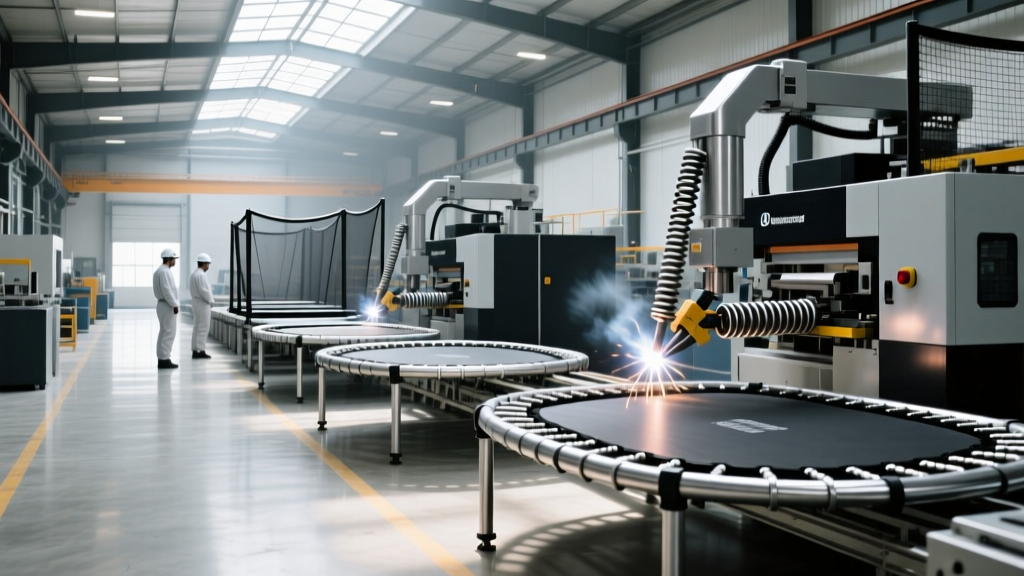
To achieve full-penetration, porosity-free welds on 11-gauge tubing without burning through the material, startups must utilize advanced pulsed MIG technology. The Miller Auto-Continuum 350i is an ideal small-footprint solution. Its pulsed-spray transfer mode allows the arc to cool slightly between droplet transfers, minimizing zinc vaporization and eliminating spatter. Operators must use ER70S-6 wire (0.035-inch diameter) with a 75% Argon / 25% CO2 shielding gas blend to ensure the weld bead ties into the base metal without compromising the surrounding galvanization.
Capital Expenditure & Compliance Matrix
| Equipment Category | Recommended Small-Scale Model | Primary Compliance Function | Est. 2026 Cost |
|---|---|---|---|
| CNC Mandrel Bender | Baileigh TB-400 CNC | Maintains <5% ovality; prevents cyclic fatigue | $38,000 - $45,000 |
| Pulsed MIG Welder | Miller Auto-Continuum 350i | Eliminates zinc porosity; ensures AWS D1.1 penetration | $12,500 - $15,000 |
| CNC Foam Router | MultiCam 3000 (Oscillating Knife) | Precision cutting for uniform G-max impact attenuation | $55,000 - $68,000 |
| Electronic Bar-Tacker | Juki LBH-1790A | Achieves >4,000 lbf break strength on suspension webbing | $9,000 - $11,500 |
Soft Goods Manufacturing: Foam and Netting Compliance
CNC Foam Routing for Impact Pads
The International Association of Trampoline Parks (IATP) and ASTM guidelines strictly regulate the impact attenuation of safety pads covering the springs and frame. Pads must be constructed from high-density, cross-linked polyethylene (EPE) foam, typically layered to achieve a specific G-max rating (usually requiring a minimum 2-inch thickness of 1.7 lb/cu ft density foam).
Die-cutting foam leads to compressed edges and inconsistent thickness, which fails drop-testing. Startups must utilize a CNC router equipped with a high-frequency oscillating knife head, such as the MultiCam 3000 series. The oscillating knife slices through multi-layer EPE foam without generating the heat or melting associated with laser cutters, preserving the cellular structure of the foam. Maintaining the exact cellular integrity is non-negotiable for passing the ASTM drop-weight impact tests required for court certification.
Programmable Bar-Tack Sewing for Webbing
Suspension systems and safety net enclosures rely on heavy-duty polyester webbing. Standard lockstitch sewing machines cannot handle the sheer tensile loads generated by a 250-lb user impacting a net at 15 mph.
The Juki LBH-1790A electronic bar-tacking machine is the industry standard for small-to-mid-scale soft goods manufacturing. It programmatically sews high-density zigzag bar-tacks (typically 42 to 84 stitches per pattern) over a 30mm x 20mm area. When using UV-bonded V-138 nylon thread on 2-inch, 6,000 lbf tensile-strength webbing, this specific machine configuration guarantees the joint will exceed the 4,000 lbf break-strength threshold mandated for commercial enclosure netting.
"The majority of soft-goods failures in commercial trampoline courts do not occur in the middle of the fabric; they occur at the attachment points. If your manufacturing process relies on manual, non-programmable sewing for load-bearing webbing joints, your equipment will fail an IATP-aligned structural audit." — Industrial Textile Engineering Guidelines, 2025 Revision
In-House QA & Testing Validation Equipment
Manufacturing the equipment is only half the battle; proving compliance requires in-house validation. Startups must allocate capital for specific testing apparatuses to generate the mill certificates and batch-test reports demanded by commercial buyers.
- Digital Durometer (Shore C Scale): Required to verify the exact density and compression deflection of every batch of EPE foam before it is routed into safety pads.
- Portable XRF Analyzer: Essential for verifying the thickness of the zinc galvanization coating on incoming steel tubing, and ensuring the pulsed MIG welding process has not burned away the corrosion protection at the weld seams.
- Electronic Force Gauge (Dynamometer): Used to perform destructive pull-testing on a randomized 5% sample of all bar-tacked webbing joints to verify the 4,000 lbf break strength.
Step-by-Step Compliance Integration Workflow
Integrating this machinery into a cohesive, compliant production line requires a strict operational workflow. Follow this sequence to ensure traceability from raw material to finished court component:
- Material Intake & XRF Scanning: Scan all incoming 11-gauge galvanized tubing. Reject any batch where the zinc coating falls below the ASTM A123 minimum thickness requirements.
- CNC Bending & Ovality Check: Run the TB-400 CNC bender. Measure the apex of the first 10 bends with digital calipers. If ovality exceeds 4.5%, halt production and recalibrate the mandrel pressure die.
- Pulsed Welding & Visual Inspection: Weld the frame nodes using the Miller 350i. Conduct immediate visual inspections for porosity. Perform a random dye-penetrant test on 1 out of every 50 welded nodes to verify subsurface fusion.
- Foam Routing & Durometer Logging: Cut the EPE foam pads. Log the Shore C durometer readings of the off-cuts into your QA database, linking the specific foam batch to the court serial number.
- Bar-Tacking & Destructive Sampling: Sew the enclosure netting webbing loops. Take one loop from every 100 sewn and subject it to a destructive pull test on the dynamometer. Document the exact failure point (lbf) in the batch record.
By strictly pairing small-scale, high-precision machinery with rigorous QA protocols, startup trampoline park equipment manufacturers can produce commercial-grade, fully compliant recreation systems that rival the output of enterprise factories, securing both market share and long-term liability protection.