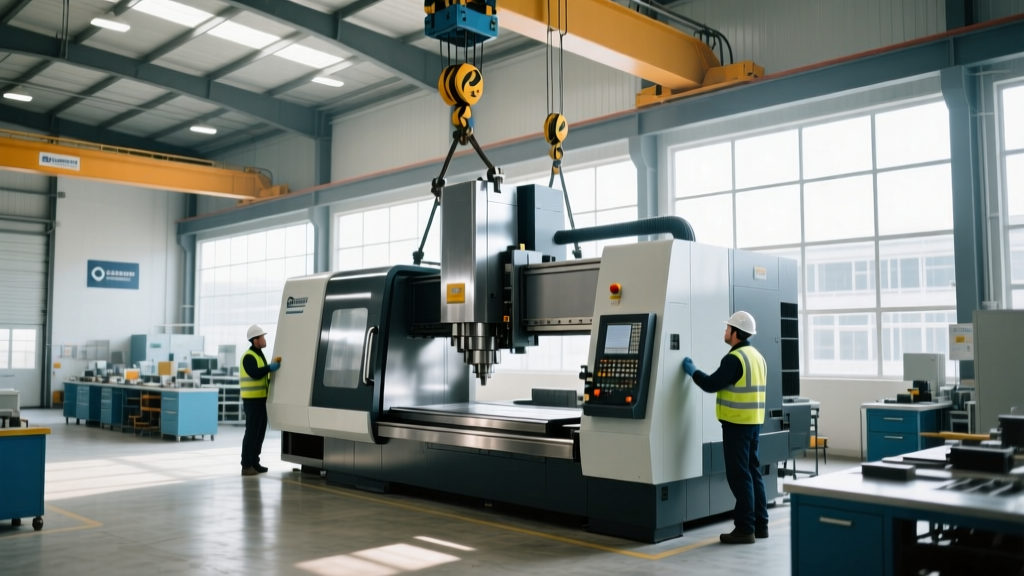
Electrical Equipment Manufacturing Poland 2026 Trends Challenges: Lean Workstation Design
Explore technical specs for lean workstations addressing electrical equipment manufacturing Poland 2026 trends challenges, from ESD compliance to cobots.
Poland's electrical equipment manufacturing sector—spanning high-voltage switchgear, industrial transformers, and EV power electronics—faces a critical inflection point in 2026. The dual pressures of a 14% deficit in skilled electromechanical assemblers and the mandate to reduce cell-level energy consumption under updated EU eco-design directives define the current operational landscape. To navigate these electrical equipment manufacturing Poland 2026 trends challenges, OEMs in hubs like Wrocław and Łódź are abandoning static, heavy-steel assembly lines in favor of modular, lean workstation architectures. This shift is not merely aesthetic; it is a highly engineered response to high-mix, low-volume (HMLV) production demands, requiring precise technical specifications in ergonomics, electrostatic discharge (ESD) mitigation, and semi-automated tooling integration.
The Technical Anatomy of a 2026 Lean Electrical Assembly Workstation
Modern lean workstations for electrical assembly rely on modular aluminum extrusion systems rather than welded steel. The industry standard has shifted to profiles like the Item Industrietechnik Profile 8 Series (40x40mm) with specialized ESD-safe anodized coatings. These profiles offer a moment of inertia (Iy) of 11.2 cm⁴, providing sufficient rigidity to support heavy testing equipment without deflection, while allowing rapid reconfiguration via T-slot nuts.
For the work surface, static-dissipative laminates are mandatory. Standard high-pressure laminates (HPL) generate triboelectric charges that can destroy sensitive IGBT (Insulated-Gate Bipolar Transistor) modules used in power inverters. Workstations must utilize surfaces with a surface resistance ($R_s$) between $10^6$ and $10^9$ ohms, compliant with the EOS/ESD Association S20.20 standard. The grounding topology requires a 1 megohm current-limiting resistor in series with the ground path to protect operators from accidental shock if the workstation contacts a live 400V busbar during testing.
⚠️ WARNING: ESD Grounding Failure ModesA common failure mode in Polish assembly plants is daisy-chaining workstation grounds to a painted steel building column. This creates a high-impedance path, rendering the ESD mat useless. Every lean cell must have a dedicated, verified ground drop (under 1 ohm resistance to earth) monitored by a continuous resistance supervisor like the Desco ZEROVOLT system.
Addressing Labor Deficits via Ergonomic Automation Integration
The most acute challenge in the 2026 Polish manufacturing labor market is the shortage of certified torque-assembly technicians. Lean workstations now integrate collaborative robots (cobots) and smart fastening tools directly into the cell's physical geometry to deskilling the assembly process while maintaining aerospace-grade quality control.
Smart Torque and Angle Monitoring
For assembling busbars and heavy terminal blocks, manual click-torque wrenches are being replaced by transducerized tools like the Atlas Copco Tensor STB21. These tools are mounted on zero-gravity balancers integrated into the workstation's overhead gantry. The Tensor STB21 measures both torque (up to 20 Nm) and the angle of rotation simultaneously. If an operator cross-threads an M8 copper terminal screw, the tool detects the abnormal angle-to-torque ratio and halts the spindle within 15 milliseconds, preventing costly rework on high-value switchgear panels.
Cobot Integration and Safety Topology
When integrating a Universal Robots UR5e into a lean cell for pick-and-place operations of heavy contactors, the workstation design must comply with ISO/TS 15066 collaborative safety limits. The workstation's physical footprint utilizes laser-scanned safety zones. Instead of bulky physical cages, lean cells use SICK microScan3 safety laser scanners mounted at the workstation's knee-level, creating a 1.5-meter protective field that slows the cobot to 250 mm/s when an operator enters the zone, and halts it at 0.5 meters.
| Component | Model / Spec | Technical Parameter | Est. Unit Cost (EUR) |
|---|---|---|---|
| Modular Framing | Item Profile 8 40x40 ESD | Surface Res: $10^6 - 10^9 \Omega$ | €45 - €60 / meter |
| Smart Fastening Tool | Atlas Copco Tensor STB21 | 0.8 - 20 Nm, 360° Angle Ctrl | €3,200 - €3,800 |
| Work Surface | Trespa TopLab VERTICAL | ESD Grade, 12mm Thickness | €180 - €220 / sqm |
| Safety Scanner | SICK microScan3 Core | 275° scan, 4.5m range | €1,450 - €1,600 |
| Ergonomic Lift | FlexQube ESD Cart Lift | 0-900mm stroke, 50kg capacity | €2,100 - €2,400 |
Energy Efficiency and Smart Metering at the Cell Level
A defining challenge of the 2026 manufacturing landscape is the granular tracking of energy consumption. Polish electrical OEMs are now required to report Scope 2 emissions at the individual product level. Lean workstations are evolving into micro-grids equipped with intelligent Power Distribution Units (PDUs).
By integrating Schneider Electric PowerLogic PM5560 smart meters directly into the workstation's main power drop, facility managers can allocate exact kilowatt-hour (kWh) consumption to specific serial numbers of assembled switchgear. Furthermore, workstations equipped with regenerative test rigs—used to cycle-test circuit breakers—now utilize active front-end (AFE) drives. These drives capture the kinetic energy of the breaker's mechanical return spring and feed it back into the workstation's localized DC bus, reducing the cell's net grid draw by up to 18% during high-volume testing shifts.
Ergonomic Mandate: According to EU-OSHA guidelines, repetitive overhead reaching in electrical panel wiring is a primary cause of rotator cuff degradation. Lean workstations must utilize vertical carousels or adjustable-height tool balancers to keep all primary fastening and wiring tasks strictly within the 'green zone' (between the operator's mid-thigh and shoulder height, typically 750mm to 1150mm from the floor).
Overcoming Supply Chain Volatility with Modular Fixturing
Supply chain disruptions for custom-machined aluminum assembly jigs have historically delayed new product introductions (NPI) in Poland's electrical sector by 6 to 8 weeks. The 2026 lean workstation solves this via on-demand, in-cell additive manufacturing of fixturing.
Decision Matrix: Traditional CNC vs. In-Cell 3D Printed Jigs
- Traditional CNC Aluminum Jig: Lead time 4-6 weeks. Cost: €450 - €800. Best for: High-volume runs (>10,000 cycles) requiring extreme thermal stability during potting processes.
- Markforged Onyx (Carbon Fiber Reinforced Nylon) Jig: Lead time 14 hours. Cost: €35 - €60 (material). Best for: HMLV prototyping, custom wire-routing combs, and ESD-safe holding fixtures for PCB integration.
By placing a Markforged Mark Two industrial 3D printer at the end of the lean assembly line, technicians can print custom wire-routing combs and terminal-holding jigs overnight. Onyx material provides a surface resistivity of $10^4$ ohms/sq, making it inherently static-dissipative and safe for handling unencapsulated power electronics, while offering a flexural strength of 81 MPa—sufficient to withstand the clamping forces of automated wire-stripping machinery.
Synthesizing the Lean Approach for 2026 and Beyond
Successfully navigating the electrical equipment manufacturing Poland 2026 trends challenges requires viewing the workstation not as a static table, but as a dynamic, data-generating node. By specifying ESD-safe modular framing, integrating torque-and-angle monitored tooling, enforcing ISO/TS 15066 collaborative safety zones, and utilizing in-cell additive manufacturing for fixturing, Polish OEMs can insulate themselves against labor volatility and energy mandates. The capital expenditure for a fully equipped, smart lean cell averages between €28,000 and €35,000, but the reduction in rework, energy waste, and NPI lead times typically yields a return on investment within 11 to 14 months of deployment.