Troubleshooting Relocation: Calf Nursery Equipment Manufacturer US Guide
Expert troubleshooting guide for relocating and installing heavy manufacturing machinery at a calf nursery equipment manufacturer US facility.
The Complexity of Agricultural Manufacturing Relocations
Relocating heavy production machinery is a high-stakes operation that demands precise mechanical, electrical, and structural coordination. For a calf nursery equipment manufacturer US facility, the production floor typically houses massive rotational molding ovens for polyethylene calf hutches, alongside high-tonnage CNC press brakes and automated laser cutters for 304-grade stainless steel feeding troughs. Moving and reinstalling this specialized equipment introduces severe transit stresses, foundation settling issues, and calibration drift. This guide provides deep-dive troubleshooting protocols for diagnosing and repairing post-relocation faults specific to agricultural manufacturing lines.
Pre-Move Teardown Diagnostics
The most critical troubleshooting phase occurs before the machinery ever leaves the original facility. Documenting baseline performance and executing a controlled teardown prevents catastrophic failures upon reinstallation.
Rotational Molding Ovens (Polyethylene Calf Hutches)
Bi-axial rotational molding machines (such as those from Ferry Industries or Rotational Molding Inc.) operate at extreme thermal cycles. Before disconnecting the gas trains, troubleshoot the refractory ceramic fiber (RCF) lining. Transit vibrations frequently cause micro-fractures in degraded RCF panels. Inspect the oven carriages for refractory gaps wider than 1/16-inch; these must be patched with high-temperature ceramic wool and rigidizer before the move, or thermal efficiency will drop by up to 18% in the new facility.
Cap all natural gas manifolds using steel threaded plugs with Teflon tape and pipe dope. Quick-disconnect fittings are prone to internal seal extrusion during transit and should be replaced with new O-rings upon reassembly to prevent low-pressure misfires.
Stainless Steel Fabrication Cells
CNC press brakes (e.g., Trumpf TruBend or Amada HRB series) used for bending 10-gauge 304 stainless steel trough panels rely on hydraulic precision. Before draining the hydraulic reservoirs, run the machine through a full cycle and log the axis positioning repeatability (typically ±0.0004 inches). Drain the hydraulic fluid and lock the cylinders in the fully retracted position to prevent rod scoring and seal blowouts caused by thermal expansion during cross-country transit.
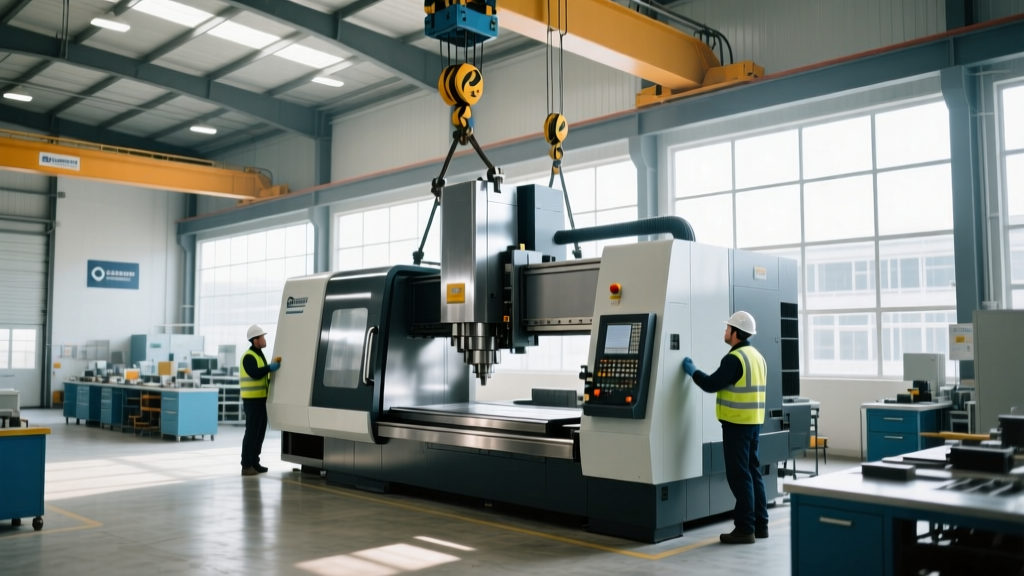
⚠️ Rigging & Safety Warning: Always adhere to OSHA 1910.184 standards for slings and rigging hardware. When lifting a 45,000 lb rotomolding oven carriage, use only rated wire rope slings with a minimum 5:1 design factor. Never use synthetic web slings on unmachined cast iron bases, as sharp casting edges can instantly sever the webbing under dynamic load.Installation and Precision Re-Leveling
Once the equipment is set on the new foundation, the primary troubleshooting challenge is achieving absolute planar alignment. Agricultural manufacturing facilities often utilize poured concrete slabs that may not meet the stringent flatness requirements of precision CNC equipment.
Foundation Grouting and Anchor Bolting
Do not rely on standard cementitious grout for heavy, high-vibration machinery. For automated stainless steel welding gantries and CNC laser tables, specify a high-modulus epoxy grout such as MasterFlow 648CP. Epoxy grout provides superior vibration dampening and cures to a compressive strength of 14,000 psi within 24 hours, compared to the 28-day cure time of cementitious alternatives. Troubleshoot any 'soft foot' conditions by using precision tapered stainless steel shims (never plastic or brass) under the leveling pads before pouring the grout.
Laser Interferometry for Press Brakes
Re-leveling a 250-ton press brake requires more than a machinist's level. Use a laser interferometer or a high-precision digital electronic level (capable of 0.001° resolution) to map the bed deflection. The tolerance must be held to 0.002 inches over 10 feet. If the ram exhibits uneven deflection during the first test bend, troubleshoot the foundation by checking for voids in the epoxy grout using a tap-test (a dull thud indicates a void requiring injection grouting).
Post-Installation Fault Matrix
The following table outlines the most common failure modes encountered during the first 72 hours of operation in a newly relocated facility, along with targeted corrective actions.
| Equipment Type | Symptom | Root Cause | Corrective Action & Cost Estimate |
|---|---|---|---|
| Rotomolding Oven | Burner misfires / Lockouts | Gas train pressure drop due to transit-induced regulator diaphragm stiffness. | Replace Maxitrol or Eclipse regulators. Recalibrate manifold pressure to 7" WC. ($450 - $800) |
| CNC Press Brake | Y1/Y2 Axis positioning errors | Linear scale misalignment from forklift tine impacts during unloading. | Re-seat Heidenhain glass scales. Run axis reference cycle. ($1,200 - $2,500) |
| Automated TIG Welder | Porosity in stainless welds | Shielding gas hose micro-leaks from dry-rot or crushing during packing. | Replace all PTFE gas lines. Purge torch with 100% Argon for 5 mins. ($150 - $300) |
| Hydraulic Shear | Cylinder drift / Slow ram descent | Counterbalance valve spool stuck due to contaminated fluid left in transit. | Flush system, replace 10-micron return filters, and rebuild valve spool. ($800 - $1,500) |
Electrical and VFD Re-commissioning
Electrical faults account for nearly 40% of post-relocation downtime. When reconnecting 480V 3-phase power to heavy manufacturing equipment, phase rotation is the first critical checkpoint.
Phase Rotation and VFD Troubleshooting
If a hydraulic pump on a stainless steel sheet shear is wired with reverse phase rotation, it will run backward, starving the pump of fluid and destroying the gear set within seconds. Always use a phase rotation meter at the main disconnect before closing the breaker. For machinery utilizing Variable Frequency Drives (VFDs) to control conveyor speeds in automated calf feeder assembly lines, transit vibrations can loosen terminal block screws on the DC bus and IGBT modules. Torque all VFD power terminals to the manufacturer's exact specification (usually between 40-60 in-lbs for mid-range drives) to prevent arcing and catastrophic drive failure upon startup.
Grounding and Noise Mitigation
A new facility's electrical grid may have different harmonic distortion levels than the previous site. If CNC controllers are experiencing random E-stop faults or screen flickering, troubleshoot the grounding network. Ensure the equipment ground is tied to a dedicated ground rod or a verified building steel grid, maintaining a ground impedance of less than 5 ohms. Install line reactors on the input side of sensitive VFDs if total harmonic distortion (THD) exceeds 5%.
Calibration and Quality Verification
Once the machinery is mechanically and electrically sound, the final troubleshooting phase involves verifying product quality against strict agricultural manufacturing standards. Calf nursery equipment must withstand harsh environmental conditions, including UV exposure, ammonia, and frequent high-pressure washdowns.
For 304-grade stainless steel feeding troughs, the welding process must not compromise the material's corrosion resistance. Post-installation, run test coupons through the automated TIG welding cells and subject them to ASTM B117 salt spray testing. If rust blooms appear within 48 hours, troubleshoot the weld parameters: the shielding gas flow rate is likely too low, or the travel speed is too slow, causing carbide precipitation (sensitization) in the heat-affected zone.
For polyethylene calf hutches produced on the relocated rotomolding machines, conduct an impact test (dropping a 30 lb dart from 6 feet) at -20°F. If the plastic shatters instead of denting, the oven's thermocouple calibration has drifted during the move. Troubleshoot the temperature controllers by comparing the digital readout against an independent infrared pyrometer aimed directly at the mold surface, adjusting the PID offsets until the variance is less than ±3°F.
Relocating a manufacturing plant is an exercise in controlled problem-solving. By systematically addressing mechanical alignment, hydraulic integrity, electrical phase sequencing, and thermal calibration, facility managers can minimize downtime and ensure their new production lines meet the rigorous demands of modern agricultural manufacturing.