Cleanroom Requirements: Troubleshooting Bulgarian Tire Recycling Mills
Troubleshoot ISO 7 cleanroom HVAC, HEPA, and pressure systems in rCB facilities utilizing Bulgarian tire recycling and pyrolysis milling equipment.
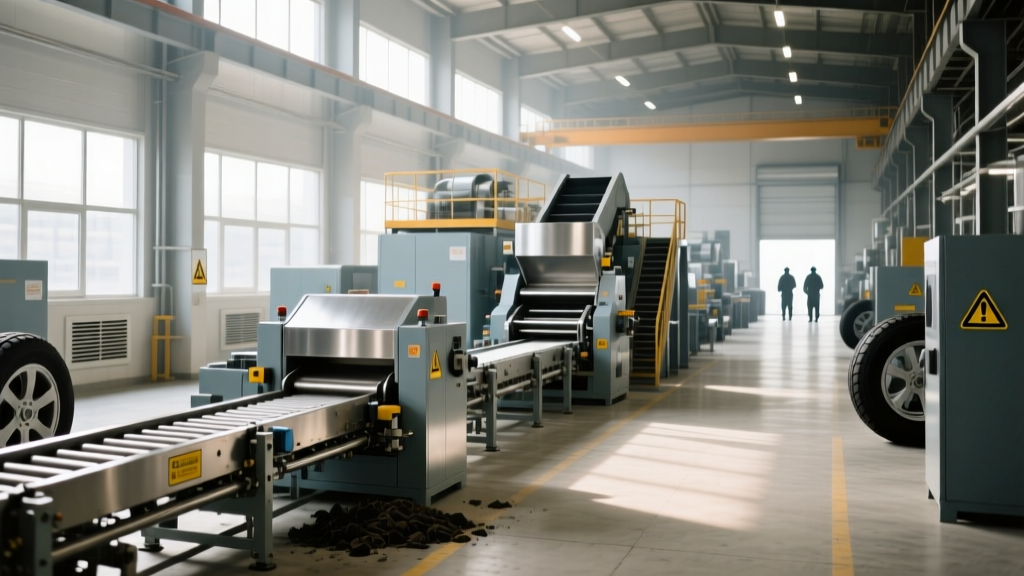
Producing battery-grade recovered Carbon Black (rCB) from end-of-life tires requires more than just thermal decomposition; it demands stringent ISO 14644-1 Class 7 (ISO 7) cleanroom environments for final milling, classification, and packaging. When facility operators source primary pyrolysis reactors and cryogenic shredders from heavy industrial hubs in Eastern Europe, they frequently encounter severe integration failures. The structural vibrations and conductive carbon dust inherent to these heavy-duty operations directly compromise delicate cleanroom HVAC, HEPA filtration, and positive pressure systems.
This troubleshooting guide addresses the specific mechanical and environmental conflicts that arise when pairing high-purity cleanroom manufacturing equipment requirements with the heavy industrial footprint of modern tire pyrolysis plants.
The Vibration and Particulate Ingress Problem
Standard modular cleanroom panels are engineered for static environments. However, industrial rotary kilns and multi-stage shredders generate low-frequency structural vibrations ranging from 15 Hz to 45 Hz. When these vibrations travel through the facility slab, they cause micro-fractures in standard epoxy floor seals and dislodge the gel-seats on terminal HEPA filters.
CRITICAL WARNING: ATEX Compliance & Carbon DustCarbon black is highly conductive and poses a severe deflagration risk. Standard cleanroom HVAC systems that allow static buildup on filter media can trigger dust explosions. According to EU OSHA guidelines on dust explosions, any cleanroom handling rCB must integrate Electrostatic Discharge (ESD) safe components and maintain strict ATEX Zone 21/22 compliance. Never use standard fiberglass HEPA media in an rCB milling anteroom.
Troubleshooting Matrix: HVAC & Pressure Cascades
Maintaining the required pressure cascade is the most common point of failure in hybrid industrial-cleanroom facilities. The cleanroom packaging zone must maintain a minimum positive pressure of +15 Pascals (Pa) relative to the adjacent anteroom, and +30 Pa relative to the raw pyrolysis floor. Below is a diagnostic matrix for common pressure and airflow failures.
| Symptom | Root Cause in Hybrid Facilities | Repair & Calibration Protocol |
|---|---|---|
| Pressure drops below +15 Pa during kiln operation | Vibration-induced compression of standard neoprene door seals, creating micro-leaks. | Replace all perimeter seals with hollow-core silicone bulb seals. Install automatic door drop-seals calibrated to engage at 2mm clearance. |
| HEPA filter gel-seal degradation / bypass leakage | Abrasive rCB dust infiltrates the filter housing, breaking down standard polyurethane gel. | Upgrade to PTFE-coated gel seals. Implement a quarterly PAO (Polyalphaolefin) aerosol leak test schedule. |
| Airflow turbulence & localized dead zones | Thermal plumes from the adjacent pyrolysis reactor hall alter the cleanroom return-air thermal gradient. | Rebalance Variable Air Volume (VAV) boxes. Shift from ceiling-return to low-wall return grilles to force particulate downward. |
| Frequent HVAC motor burnout | Conductive carbon dust bypasses pre-filters, shorting out standard ECM blower motors. | Install ATEX-rated, enclosed blower motors. Upgrade MERV 8 pre-filters to MERV 14 bag filters with static-dissipative frames. |
HEPA Filter Integrity in Conductive Carbon Environments
Validating HEPA filter integrity in an rCB facility requires strict adherence to the ISO 14644-1:2015 standard for cleanrooms and associated controlled environments. However, standard photometric testing using DOP (Dioctyl Phthalate) is obsolete and hazardous. Facilities must use PAO-4 aerosol testing with a photometer equipped with an ESD-safe probe.
Step-by-Step PAO Testing Protocol for rCB Cleanrooms
- Aerosol Generation: Introduce PAO-4 aerosol into the HVAC ductwork upstream of the HEPA bank, ensuring a uniform challenge concentration of 10–80 µg/L.
- Probe Selection: Use an ESD-grounded photometer probe. Standard plastic probes will attract conductive carbon dust, blinding the sensor and yielding false-positive leak readings.
- Scan Rate: Scan the filter face and gel-seal perimeter at a velocity not exceeding 3 cm/s, keeping the probe 25mm from the filter surface.
- Leak Threshold: Any reading exceeding 0.01% of the upstream challenge concentration constitutes a failure. In carbon environments, gel-seal failures are 4x more common than media punctures.
Airlock & Air Shower Calibration for rCB Operators
Operators moving from the 'dirty' pyrolysis floor to the 'clean' ISO 7 packaging zone carry significant particulate loads on their PPE. Standard 10-second air showers are insufficient for removing embedded carbon dust from nomex coveralls.
"In carbon black recovery, the primary vector for ISO 7 cleanroom contamination is not the HVAC system; it is the operator's PPE. If your air shower is not running at a minimum of 25 m/s with a 4-second interlock delay, you are essentially pumping conductive dust directly into your battery-grade packaging line."
— Facility Integration Engineer, Advanced Materials Recovery Sector
Required Air Shower Specifications:
- Nozzle Velocity: 25 m/s (minimum) at the operator's center of mass.
- Cycle Duration: 18 seconds minimum, with a mandatory 4-second door interlock delay post-cycle to allow particulate settling into the floor return grilles.
- Filtration: Dual-stage filtration (MERV 14 pre-filter + H13 HEPA) with an ESD-grounded housing.
- Floor Matting: Install static-dissipative tack mats rated for 10^6 to 10^9 ohms/sq to prevent static cling of rCB particles to footwear.
Sourcing & Integration Framework: Bridging Heavy Machinery and Cleanrooms
When drafting the User Requirement Specification (URS) for a new rCB plant, the physical decoupling of the heavy industrial zone from the clean manufacturing zone is paramount. Below is a standard integration checklist utilized when evaluating primary processing lines and aligning them with cleanroom manufacturing equipment requirements.
URS Integration Checklist for rCB Facilities
- Primary OEM Sourcing: tire recycling equipment manufacturers bulgaria europe (Focus: Rotary kilns, cryogenic shredders, primary conveyors)
- Structural Isolation: Specify a minimum 50mm structural expansion joint filled with acoustic dampening polyurethane between the pyrolysis slab and the cleanroom modular sub-floor.
- Material Transfer: Replace open belt conveyors with enclosed, dense-phase pneumatic transfer lines utilizing rotary airlock valves to maintain the cleanroom pressure envelope.
- Vibration Dampening: Require all primary milling equipment to be mounted on tuned mass dampers or elastomeric isolation pads rated for the specific operating frequency (Hz) of the motor.
- HVAC Independence: The cleanroom Air Handling Unit (AHU) must be 100% outside air (no return air mixing) to eliminate the risk of recirculating fugitive carbon dust.
Preventative Maintenance vs. Downtime Costs
The financial penalty for cleanroom contamination in battery-grade rCB production is severe. A single batch rejection due to metallic or silica particulate ingress can exceed $85,000 in lost material and delayed shipment penalties. Conversely, a robust preventative maintenance contract focusing on quarterly PAO testing, bi-annual VAV rebalancing, and continuous vibration monitoring typically costs between $12,000 and $18,000 annually.
Facility managers must shift from reactive filter replacements to predictive maintenance. Installing IoT-enabled differential pressure sensors across the HEPA banks allows for real-time monitoring of filter loading. In high-carbon environments, filters do not just load with dust; the conductive nature of the carbon can cause localized arcing if the static charge is not continuously bled to ground. By treating the cleanroom not as an isolated box, but as a highly sensitive instrument integrated into a heavy industrial ecosystem, operators can achieve consistent ISO 7 compliance and secure high-margin contracts in the lithium-ion battery supply chain.
For further technical specifications on cleanroom testing methodologies, facility engineers should consult the Institute of Environmental Sciences and Technology (IEST) Recommended Practices, specifically IEST-RP-CC006.3 for testing cleanrooms and IEST-RP-CC001.6 for HEPA and ULPA filter media standards in specialized industrial applications.