Eco-Friendly Cardboard Box Manufacturing Equipment Specs
Explore the technical specifications and mechanics of sustainable cardboard box manufacturing equipment, from servo-driven flexo presses to closed-loop ink systems.
The Mechanics of Sustainable Corrugated Converting
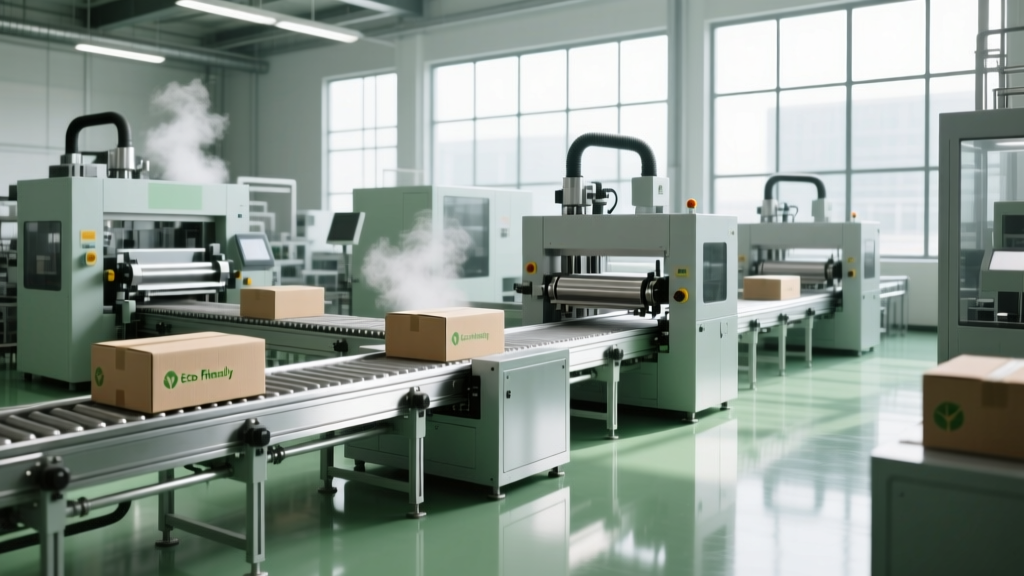
Modern corrugated packaging facilities are undergoing a massive architectural shift. The transition toward sustainable manufacturing equipment and green technology is no longer driven solely by corporate ESG mandates; it is fundamentally an exercise in thermodynamic efficiency and precision engineering. When evaluating eco-friendly cardboard box manufacturing equipment, plant managers must look beyond basic energy star ratings and examine the electromechanical design, fluid dynamics of ink delivery, and AI-driven waste reduction protocols that define next-generation flexo folder gluers and corrugators.
Servo-Driven Architectures vs. Mechanical Line Shafts
Traditional flexo folder gluers rely on a single massive main drive motor (typically 110kW to 150kW) connected to a continuous mechanical line shaft. Power is distributed to print units, slotter heads, and die-cut stations via a complex network of gears, belts, and clutches. This mechanical distribution inherently loses 15% to 22% of input energy to friction, heat dissipation, and rotational inertia.
Next-generation sustainable cardboard box manufacturing equipment eliminates the line shaft entirely. Instead, machines like the Göpfert Evo or Bobst Matic utilize a distributed servo architecture. Each print cylinder, anilox roll, and die-cut station is driven by its own direct-drive AC servo motor (such as the Bosch Rexroth IndraDrive Mi series). This localized power delivery yields three critical sustainability advantages:
- Elimination of Parasitic Loss: Without mechanical linkages, energy is only consumed by the stations actively engaged in the production run. If a 6-color press is running a 3-color job, the unused servo motors remain in a zero-power idle state.
- Regenerative Braking: During deceleration or web tension control on the unwind/rewind stands, the servo motors act as generators. An Active Front End (AFE) drive captures this kinetic energy and feeds it back into the plant's local microgrid, reducing net power draw by up to 18%.
- Instantaneous Register Adjustment: Servo motors adjust print-to-cut register electronically in microseconds, eliminating the mechanical backlash and subsequent startup scrap associated with gear-driven systems.
Energy & Waste Comparison: Mechanical vs. Servo Flexo Presses
| Metric | Legacy Mechanical Line-Shaft | Modern Distributed Servo-Drive |
|---|---|---|
| Peak Energy Consumption (per hour) | 145 kWh | 98 kWh |
| Startup Setup Waste (sheets) | 40 - 60 sheets | 3 - 5 sheets |
| Register Adjustment Latency | 800ms (mechanical clutch engagement) | <5ms (electronic phase shifting) |
| Lubricant & Coolant Requirements | High (centralized oil baths) | Negligible (sealed lifetime bearings) |
Closed-Loop Water-Based Ink and VOC Elimination
The environmental impact of corrugated printing is heavily tied to ink chemistry and delivery mechanics. While the industry has largely transitioned to water-based inks to comply with EPA sustainable manufacturing guidelines regarding Volatile Organic Compounds (VOCs), the mechanical delivery of these inks presents unique technical challenges. Water-based inks require strict viscosity and pH control—ideally maintained between 8.5 and 9.5 pH and 22 to 26 seconds on a #2 Zahn cup.
Sustainable cardboard box manufacturing equipment integrates closed-loop chamber doctor blade systems (such as those engineered by Tresu or Sun Chemical). Unlike traditional open-pan fountains that expose ink to ambient air—causing rapid water evaporation, pH drift, and ammonia off-gassing—chambered systems encapsulate the anilox roll. Ink is pumped under low pressure (1.5 to 2.5 bar) directly into a sealed chamber. This mechanical isolation yields a 40% reduction in ink waste and virtually eliminates VOC emissions from the print station.
Maintenance Gotcha: Anilox Cell PluggingWhile closed-loop systems are vastly superior for the environment, they are unforgiving of maintenance negligence. If the automated pH dosing pump fails and the ink drops below 8.0 pH, the acrylic resins in the water-based ink will begin to precipitate and cross-link. In a sealed chamber system, this precipitate is forced directly into the microscopic cells of the anilox roll (typically 120 to 160 lines per inch). This causes irreversible cell plugging, requiring aggressive ultrasonic cleaning or laser ablation to restore volume. Always install redundant inline pH sensors with automatic machine-stop interlocks.
AI-Vision Scrap Reduction and Edge-Trim Optimization
Material waste is the heaviest carbon footprint contributor in corrugated converting. According to data from the Fibre Box Association, optimizing fiber yield is the most direct path to lowering the lifecycle emissions of a corrugated box. Modern eco-friendly equipment utilizes high-speed line-scan camera systems (such as BST or Erhardt+Leimer) integrated directly into the web path.
These AI-vision systems operate at sampling rates exceeding 1,000 lines per second. They do not merely detect print defects; they actively interface with the machine's PLC to perform real-time edge-trim optimization. By mapping the exact lateral weave of the corrugated web, the system dynamically adjusts the slitter scores on the fly. This reduces the mandatory side-trim allowance from the industry-standard 15mm down to 8mm. Across a high-volume plant running 24/7, saving 7mm of linerboard width translates to tens of thousands of dollars in salvaged fiber annually, directly reducing the facility's raw material carbon footprint.
Technical Specifications of a Tier-1 Sustainable Flexo Press
When specifying a green-technology flexo folder gluer for a new facility or major upgrade, the following technical parameters represent the current benchmark for sustainable cardboard box manufacturing equipment in 2026:
- Maximum Web Width: 1,200mm to 1,650mm (accommodating standard US and metric pallet footprints without excessive trim).
- Design Speed: 400 m/min (with sustained operational speeds of 320 m/min to optimize motor efficiency curves).
- Servo Motor Torque Density: Minimum 45 Nm per print cylinder, utilizing rare-earth permanent magnet rotors for maximum efficiency at low RPMs.
- Ink Viscosity Tolerance: Automated dosing capable of maintaining ±0.5 seconds variance on a #2 Zahn cup.
- Wash-up Water Consumption: <12 liters per color station per wash cycle, utilizing high-pressure (40 bar) low-volume oscillating spray manifolds.
- Dryer Technology: Infrared (IR) and hot-air hybrid dryers with variable frequency drive (VFD) exhaust fans that scale energy draw linearly with line speed, rather than running at 100% capacity continuously.
Thermodynamic Upgrades in the Corrugator Single Facer
While the flexo press handles printing and cutting, the corrugator is the heart of the plant's energy profile. The single facer and double backer sections traditionally consume massive amounts of steam to gelatinize starch adhesive and bond the medium to the liner. Sustainable corrugator designs now incorporate variable-wrap preheaters and infrared pre-conditioners.
By utilizing the Department of Energy's Better Plants program frameworks for thermal efficiency, modern plants are replacing fixed-wrap steam drums with motorized wrap-arm preheaters. This allows the operator to dial in the exact thermal load required based on the paper basis weight and ambient humidity. Furthermore, replacing traditional steam-heated hot-plates in the double backer with internally circulated hot-oil or advanced thermodynamic plate systems reduces overall plant steam consumption from an average of 2.5 kg/sqm down to 1.7 kg/sqm. This directly lowers the natural gas consumption of the plant's boiler systems.
Calculating the ROI on Green Converting Equipment
The capital expenditure for fully sustainable cardboard box manufacturing equipment is substantial. A top-tier, 4-color servo-driven flexo folder gluer with integrated AI-vision and closed-loop ink systems typically ranges from $1.45 million to $1.85 million, compared to $950,000 for a baseline mechanical equivalent. However, the total cost of ownership (TCO) calculation heavily favors the green technology.
Factoring in a 30% reduction in electrical draw, a 40% reduction in ink waste, a 60% reduction in wash-up water and effluent treatment costs, and a 2% increase in overall fiber yield, the payback period for the premium servo-driven architecture averages 28 to 34 months in a two-shift operation environment. Beyond the balance sheet, this equipment ensures compliance with increasingly stringent municipal wastewater discharge limits and positions the manufacturer to secure premium contracts from CPG brands demanding verified low-carbon packaging supply chains.