Lean Workstations for the Largest Gym Equipment Manufacturer Compared
Compare lean workstation systems like Bosch, Item, and FlexQube used by the largest gym equipment manufacturer to assemble heavy commercial fitness machines.
The Assembly Challenge in Commercial Fitness OEM
When analyzing the production floors of the largest gym equipment manufacturer, the physical architecture of the assembly line is just as engineered as the fitness machines themselves. Commercial treadmills, elliptical cross-trainers, and multi-station cable systems present unique manufacturing hurdles. A standard commercial treadmill frame weldment weighs between 110 and 140 lbs, while the 4HP continuous-duty AC motors used in premium models add another 65 lbs. Final assembled units routinely exceed 350 lbs.
Standard wood-top workbenches or light-duty aluminum tables fail catastrophically under these dynamic loads, torque forces, and the repetitive impact of drop-testing. To maintain a takt time of 4.5 to 6 minutes per station while adhering to strict ergonomic limits, top-tier fitness OEMs deploy specialized lean manufacturing workstations. These systems must integrate zero-gravity tool balancers, heavy-duty articulating arms, and modularity to accommodate frequent model changeovers.
Comparing the Big Three Lean Workstation Systems
For heavy equipment assembly, the market is dominated by three primary modular workstation ecosystems. Each offers distinct advantages depending on the specific assembly phase—from sub-component kitting to heavy weldment mating and final console wiring.
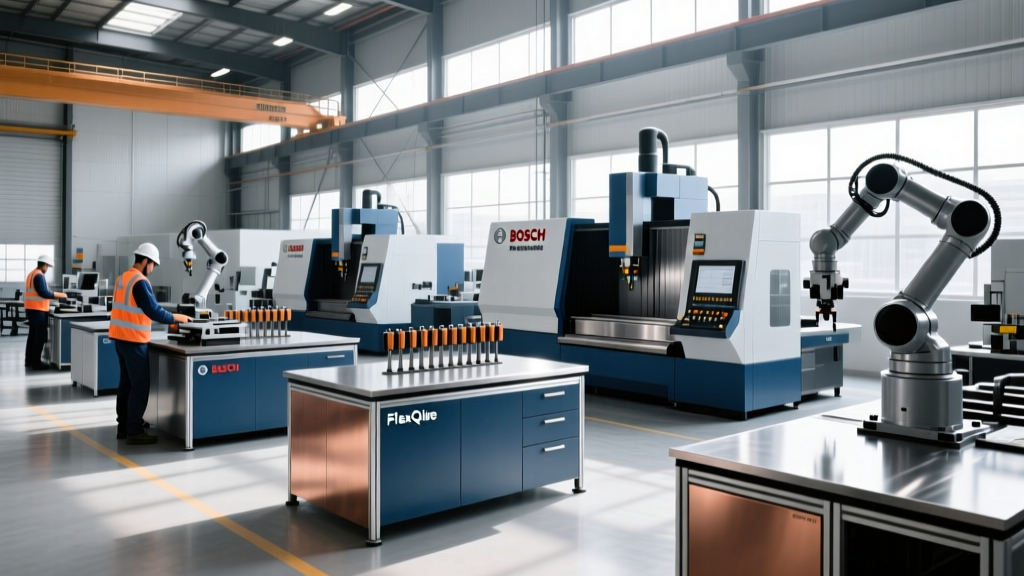
Bosch Rexroth: The Heavy-Duty Sub-Assembly Standard
Bosch Rexroth’s Basic Mechanical Elements (aluminum profile framing) remain the gold standard for high-load, static workstations. The 45x45L and 90x90 profiles provide exceptional rigidity, handling deflection loads exceeding 1,300 N without permanent deformation. In fitness equipment manufacturing, Bosch profiles are typically deployed at the motor-mounting and deck-attachment stations.
- Best Application: Heavy sub-assembly, motor mating, and pneumatic press stations.
- Load Capacity: Up to 3,000 N per linear meter on heavy-duty profiles.
- Cost Estimate: $5,500 to $8,200 per fully outfitted heavy-duty station (including pneumatic lifts and integrated torque reaction arms).
- Drawback: High initial capital expenditure and requires specialized T-slot fastening expertise to prevent joint loosening under high-vibration tool usage.
According to Bosch Rexroth Assembly Technology specifications, the use of heavy-duty fastening elements in their MB building kit ensures that the structural integrity of the workstation remains intact even when operators use high-torque DC nutrunners set to 45 Nm for deck bolts.
Item Industrietechnik: The Modular Ecosystem Leader
Item’s MB Building Kit System is the direct competitor to Bosch, offering a slightly more expansive ecosystem of ergonomic add-ons. Item excels in stations requiring complex operator interfaces, such as the console wiring and software flashing stations on commercial treadmills. Their integrated monitor arms, ESD-safe (electrostatic discharge) work surfaces, and modular lighting systems make it ideal for precision electronics assembly.
- Best Application: Electronics integration, console wiring, and quality assurance testing.
- Load Capacity: Medium to High (Profile Series 8 handles up to 2,500 N/m).
- Cost Estimate: $4,200 to $6,500 per station.
- Drawback: The vast catalog can lead to over-engineering; assembly times for the workstation itself are 15-20% longer than competing tubular systems.
FlexQube: The Ergonomic Kitting and Flow Alternative
FlexQube utilizes a modular tubular steel and aluminum system (eQar) that prioritizes mobility and flow. Unlike the heavy, bolted aluminum extrusions of Bosch and Item, FlexQube workstations are often mounted on heavy-duty casters. In a lean fitness equipment plant, FlexQube is the undisputed leader for supermarket kitting carts, shadow-board tool stations, and mobile flow racks that deliver pre-sorted hardware to the main assembly line.
- Best Application: Material handling, kitting carts, mobile shadow boards, and light sub-assembly.
- Load Capacity: Medium (Tubular joints typically rated for 150-200 kg per shelf tier).
- Cost Estimate: $1,800 to $3,200 per mobile unit.
- Drawback: Not suitable for high-torque operations or supporting heavy pneumatic tooling; lacks the sheer mass required to absorb vibration from impact wrenches.
System Comparison Matrix
| Feature | Bosch Rexroth (Aluminum Profile) | Item Industrietechnik (MB System) | FlexQube (Modular Tube) |
|---|---|---|---|
| Primary Use Case | Heavy structural assembly, motor drops | Electronics, wiring, QA testing | Kitting, flow racks, mobile carts |
| Max Static Load | Very High (3,000 N/m) | High (2,500 N/m) | Medium (Tubular joint limits) |
| Avg. Station Cost | $6,850 | $5,350 | $2,500 |
| Mobility | Static (Bolted to floor) | Mostly Static | Highly Mobile |
| Reconfiguration Time | 4-6 hours | 3-5 hours | 45-90 minutes |
| Vibration Dampening | Excellent | Good | Poor |
Cost and ROI Matrix for a 50-Station Treadmill Line
To understand the financial impact of workstation selection, consider a hypothetical 50-station final assembly line for a premium commercial treadmill. The largest gym equipment manufacturer will rarely use a single system; instead, they deploy a hybrid approach optimized for specific process steps.
Hybrid Line Deployment Example (50 Stations Total):- 10 Heavy Sub-Assembly Stations (Bosch Rexroth): $68,500
- 15 Electronics & Wiring Stations (Item): $80,250
- 20 Kitting & Flow Racks (FlexQube): $50,000
- 5 Final Packout & Palletizing (Custom Heavy Steel): $35,000
- Total Capital Expenditure: $233,750
By utilizing a hybrid model rather than outfitting all 50 stations with premium Bosch extrusions, the OEM saves approximately $108,750 in initial CapEx while actually improving line flexibility.
Decision Framework: Matching the Station to the Process
Selecting the correct lean workstation alternative requires mapping the physical demands of the assembly step to the structural properties of the workstation system. Use this framework when designing or upgrading fitness equipment assembly cells:
Step 1: Analyze the Tooling and Torque Requirements
If the station requires DC torque controllers set above 20 Nm (common for securing running decks to the steel frame), the workstation must absorb significant rotational force. Decision: Use bolted aluminum extrusion (Bosch/Item) anchored to the concrete floor. Tubular systems will flex, causing operator fatigue and inaccurate torque readings.
Step 2: Evaluate the Component Weight and Lift Frequency
Operators frequently lift 40 lb flywheels or 65 lb motors. According to NIOSH Ergonomic Controls, repetitive lifting of these weights requires mechanical assistance. Decision: Integrate an aluminum extrusion workstation with an overhead gantry track to support a zero-gravity tool balancer or a pneumatic manipulator arm.
Step 3: Assess ESD and Cleanliness Requirements
Modern commercial fitness equipment features complex PCBs, touchscreen consoles, and RFID reader integrations. Decision: Utilize Item or Bosch profiles equipped with ESD-safe laminates, integrated grounding straps, and ionizing blowers to prevent static discharge from damaging sensitive electronics during the wiring phase.
Step 4: Determine Material Replenishment Flow
Hardware (bolts, washers, cable pulleys) must be presented to the operator without requiring them to turn or reach excessively. Decision: Deploy FlexQube gravity-fed flow racks positioned behind the primary assembly table. When a bin is empty, the material handler replaces it from the aisle side without interrupting the operator's takt time.
"The biggest mistake fitness OEMs make is treating the workstation as a static table rather than an active tool. When assembling a 400-lb multi-station cable machine, the workstation must rotate the weldment, present the hardware at the golden zone between the operator's knees and shoulders, and absorb the shock of a 3 lb steel weight stack dropping into place. If the table doesn't do those three things, you are paying for it in cycle time and workers' compensation claims." — Senior Manufacturing Engineer, Commercial Fitness Division
Integrating Poka-Yoke and Smart Tooling
The physical structure of the workstation is only half the equation. The largest gym equipment manufacturers integrate advanced Poka-Yoke (mistake-proofing) directly into the lean workstation architecture.
- Tool Tethering and Counters: Overhead extrusions house smart tool balancers that track whether the operator has completed all 14 required torque sequences on a treadmill motor mount before the PLC allows the pallet to advance.
- Pick-to-Light Integration: Item and Bosch profiles easily accommodate wiring channels for pick-to-light sensors on hardware bins, ensuring the operator selects the correct M10x30 flange bolt versus the visually similar M10x25 variant.
- Shadow Foam and 5S: FlexQube shadow boards are positioned at eye level, ensuring that specialized alignment jigs for elliptical pivot arms are instantly accounted for at the start of every shift.
Final Considerations for Heavy Equipment OEMs
Designing lean workstations for heavy fitness equipment requires a departure from standard light-duty electronics assembly paradigms. By strategically deploying heavy-duty aluminum extrusions for high-torque structural assembly, modular ecosystems for precision electronics, and tubular steel for agile material flow, manufacturers can drastically reduce ergonomic strain and cycle time variances. Adhering to OSHA's Ergonomics guidelines ensures that the physical plant supports both the massive scale of production and the long-term health of the assembly workforce.