Modular Solar Panel Manufacturing Equipment: 2026 Flexibility Trends
Discover how modular solar panel manufacturing equipment enables flexible production, rapid changeovers, and scalable capacity in 2026 factory setups.
The CapEx Paradigm Shift: From Monolithic to Agile Micro-Factories
For the past decade, the dominant strategy in photovoltaic manufacturing was scaling up: building massive, monolithic 5GW to 10GW gigafactories optimized for a single cell format. By 2026, this rigid approach is failing mid-tier manufacturers and regional producers facing fragmented market demands. The shift toward modular solar panel manufacturing equipment is no longer a niche preference; it is a survival mechanism against rapid cell architecture evolution.
According to the Fraunhofer ISE Photovoltaics Report, the market is simultaneously demanding M10 (182mm), G12 (210mm), rectangular shingled, and emerging perovskite-silicon tandem formats. A monolithic line requires 4 to 6 weeks and $150,000+ in mechanical retooling to switch between these formats. Modular systems isolate these processes into independent, AGV-linked islands, allowing simultaneous production of different SKUs on the same factory floor.
2026 CapEx vs. OpEx Reality Check:While monolithic lines offer a lower baseline CapEx per watt ($14M - $16M per GW), modular lines carry a 12-18% CapEx premium ($17M - $19M per GW). However, modular setups reduce initial entry CapEx by allowing 500MW phased deployments. Furthermore, modular lines maintain an Overall Equipment Effectiveness (OEE) of 88-92% during product transitions, compared to a 65% OEE drop in monolithic lines during multi-week changeovers.
Anatomy of a Flexible Solar Assembly Line
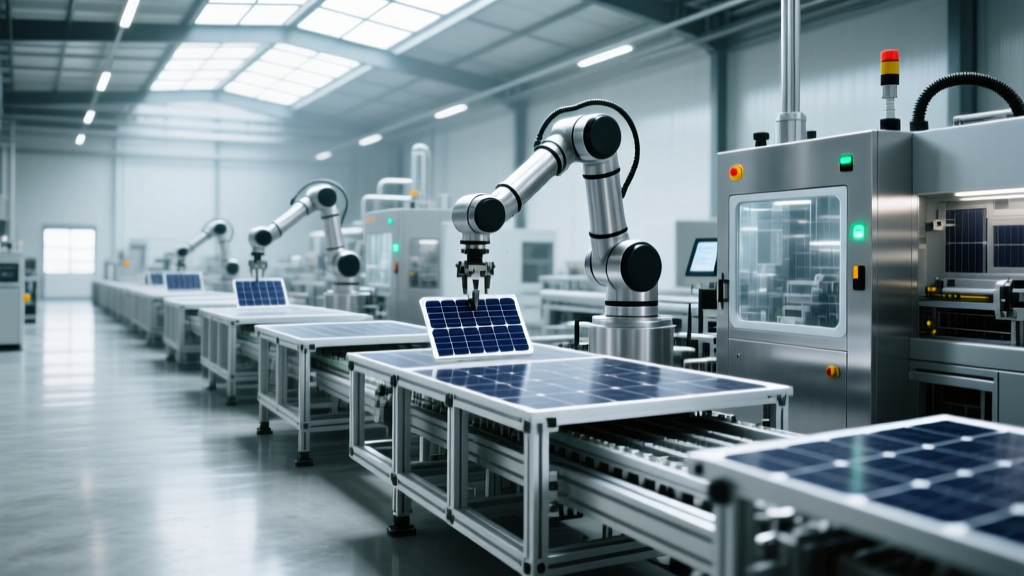
True modularity in solar panel manufacturing equipment relies on standardized mechanical interfaces and unified SECS/GEM communication protocols. Here is how the core islands operate independently while maintaining synchronous throughput.
1. Vision-Guided Smart Stringers
Modern stringers, such as those developed by Teamtechnik and Ecoprogetti, utilize multi-camera machine vision and induction-based soldering. In a modular setup, the stringer island is equipped with automated cassette loaders. When the Manufacturing Execution System (MES) triggers a changeover from 182mm half-cut cells to 210R rectangular cells, the stringer automatically purges the remaining 182mm wafers, downloads the new thermal profile for the induction heaters, and adjusts the flux-spray nozzles.
- Changeover Time: 8 to 12 minutes (automated recipe loading).
- Throughput: 3,800 to 4,500 cells per hour per lane.
- Edge Case Mitigation: Induction soldering prevents the thermal shock micro-cracks common in older infrared (IR) reflow ovens, critical for the thinner 110μm wafers standard in 2026.
2. Modular Layup and EL Testing Cells
The layup station (glass, EVA/POE encapsulant, matrix, backsheet) is traditionally the biggest bottleneck during format shifts. Modular layup tables utilize magnetic pucks and programmable servo-driven gantries rather than hard-tooled fixtures. Following layup, inline Electroluminescence (EL) testing islands use AI-driven defect recognition to identify micro-cracks <0.1mm before lamination, rejecting faulty matrices via a lateral shuttle without stopping the main conveyor.
Monolithic vs. Modular Equipment: 2026 Performance Matrix
| Metric | Monolithic Line (5GW+) | Modular Flexible Line (1GW) |
|---|---|---|
| Initial CapEx | $75M - $80M (Full deployment required) | $17M - $19M (Phased 500MW start) |
| Format Changeover | 2 to 6 weeks (Mechanical retooling) | 8 to 15 minutes (Software/Servo driven) |
| Concurrent SKUs | 1 (Strict sequential batching) | Up to 4 (Parallel island processing) |
| AMR/AGV Dependency | Low (Fixed conveyors) | High (Requires fleet management) |
| Lamination Tech | Continuous roll-to-roll | Multi-chamber batch (POE optimized) |
Real-World Edge Cases: Where Modular Designs Fail
While the NREL Manufacturing Cost Models highlight the long-term ROI of flexible manufacturing, facility planners frequently encounter specific failure modes when integrating modular solar panel manufacturing equipment.
Warning: The AMR Transit Latency TrapModular islands rely on Autonomous Mobile Robots (AMRs) to transport cassettes between the stringer, layup, and laminator. A common failure mode is under-provisioning the AMR fleet. If the stringer outputs 4,500 cells/hour but the AMR transit time across a 100-meter factory floor exceeds 4 minutes, the layup station starves, dropping OEE below 75%. Fix: Calculate AMR requirements using Little's Law and add a 20% buffer for battery swap cycles and floor-traffic congestion.
MES and SCADA Integration Bottlenecks
In monolithic lines, a single PLC (Programmable Logic Controller) manages the entire sequence. In modular setups, each island has its own edge controller. If the overarching MES cannot handle the asynchronous data polling from 15 different island controllers, you experience packet loss and ghost-stops (where the line halts because the MES fails to confirm a cassette handoff). Ensure your MES architecture supports MQTT or OPC UA protocols with edge-computing nodes localized to each island to buffer telemetry data.
Decision Framework: Should You Build Modular in 2026?
Use this operational logic tree to determine if modular equipment aligns with your factory's strategic profile:
- Do you manufacture for localized, distributed markets (e.g., EU or US regional incentives)?
- Yes: Proceed with modular. Regional markets demand diverse form factors (residential vs. utility-scale) and rapid response to local content laws.
- No (Exporting bulk utility modules to single buyers): Stick to monolithic. High-volume, single-SKU runs negate the flexibility premium.
- Is your product roadmap including Perovskite-Silicon Tandem cells within 36 months?
- Yes: Modular is mandatory. Tandem cells require low-temperature lamination processes (under 150°C) and specialized encapsulants that will destroy standard high-temp monolithic conveyors. Modular allows you to swap the lamination island without scrapping the stringer.
- Is your available factory footprint under 10,000 square meters?
- Yes: Modular islands can be arranged in U-shapes or L-shapes to fit existing industrial warehouses, whereas monolithic lines require a strict 150-meter straight-line footprint.
Future-Proofing for Next-Gen Encapsulants
As the industry transitions from EVA to POE (Polyolefin Elastomer) and EPE co-extruded encapsulants to prevent PID (Potential Induced Degradation) in harsh climates, curing times and temperature profiles change drastically. Modular multi-chamber laminators allow operators to isolate specific chambers for POE's longer cross-linking cycles while running standard EVA in adjacent chambers. This asynchronous lamination capability is the defining advantage of modular solar panel manufacturing equipment for high-reliability tier-1 producers navigating the 2026 supply chain landscape, as noted in the IEA Special Report on Solar PV Global Supply Chains.