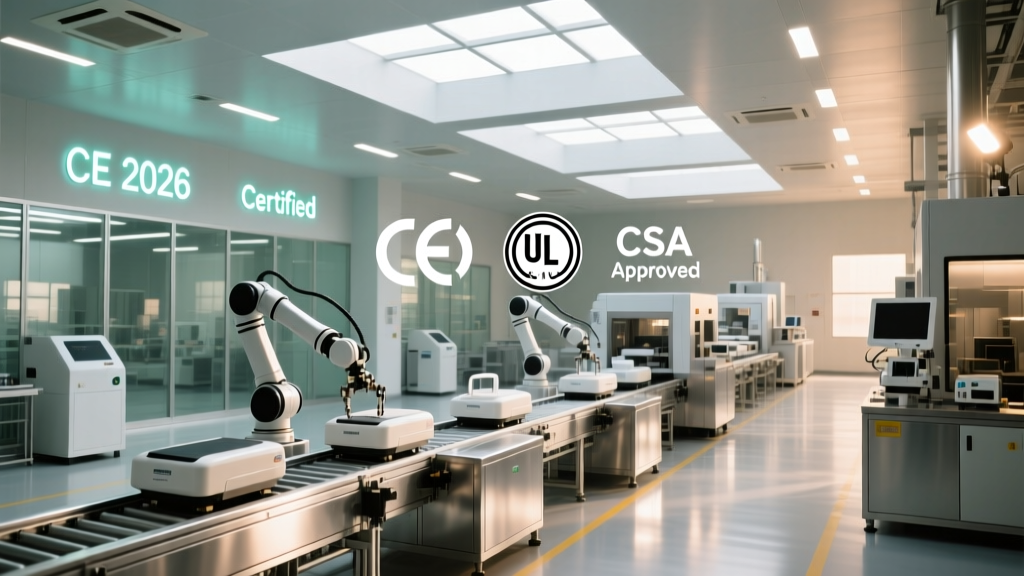
Vetting Reputable China Medical Spa Equipment Manufacturers: 2026 CE, UL & CSA Compliance Guide
Learn how to verify CE, UL, and CSA marks when sourcing from reputable China medical spa equipment manufacturers. Avoid forged certs and customs seizures.
The global medical aesthetics equipment market is projected to exceed $6.8 billion by 2027, driving a massive surge in North American and European clinics sourcing directly from manufacturing hubs in Guangzhou, Beijing, and Shenzhen. While direct importing offers 40% to 60% cost savings on devices like 808nm diode lasers, fractional CO2 systems, and bipolar RF microneedling platforms, it introduces severe regulatory risks. The most critical hurdle for buyers is verifying legitimate manufacturing equipment compliance—specifically CE, UL, and CSA marks.
Many buyers assume a 'CE' sticker on the back of a laser console guarantees safety. In reality, a significant percentage of Chinese medical spa equipment exported globally carries forged, self-issued, or entirely invalid compliance marks. This guide provides a technical framework for identifying reputable China medical spa equipment manufacturers and auditing their compliance documentation against current 2026 regulatory standards.
⚠️ The 'China Export' Trap: A common deception involves a fake CE mark where the 'C' and 'E' are spaced closely together, supposedly standing for 'China Export'. Legitimate European Conformity (CE) marks for medical devices must feature standard spacing and, crucially, a 4-digit Notified Body identification code for Class IIa and higher devices. If there is no 4-digit code, the device is illegally self-certified.The Anatomy of Legitimate Medical Spa Equipment Certifications
Medical spa equipment typically falls under strict electrical and medical device regulations due to the use of high-voltage RF currents, Class 4 lasers, and cryogenic cooling systems. Understanding the jurisdictional boundaries of each mark is the first step in supplier vetting.
| Mark | Target Market | Governing Standards | Verification Database | Avg. Cost & Timeline (Class IIb Laser) |
|---|---|---|---|---|
| CE (EU MDR) | European Union, UK (UKCA), Middle East | IEC 60601-1, IEC 60825-1, EU MDR 2017/745 | European Commission NANDO | $45,000–$85,000 / 12–18 months |
| UL / cUL | United States, Canada | UL 60601-1, CSA C22.2 No. 60601-1 | OSHA NRTL Directory | $30,000–$60,000 / 6–10 months |
| CSA | Canada, United States (cCSAus) | CSA C22.2 No. 60601-1 | Standards Council of Canada (SCC) | $35,000–$65,000 / 8–12 months |
Case Study: Sourcing a 10,600nm Fractional CO2 Laser from Guangzhou
In late 2025, a mid-sized North American medspa consortium attempted to source a fleet of 10,600nm fractional CO2 lasers directly from a prominent Guangzhou manufacturer. The supplier's Alibaba profile boasted 'CE, FDA, and ISO certified' status, offering the units at $18,500 each (compared to $65,000 for domestic equivalents).
During the technical audit, the buyer's compliance officer requested the EC Declaration of Conformity and the specific Notified Body certificate. The supplier provided a 'Certificate of Compliance' issued by a local Shenzhen testing laboratory.
Audit Finding: The Shenzhen laboratory was an ISO 17025 testing facility, but it was not an EU Notified Body. Furthermore, the test report only covered IEC 60601-1 (general electrical safety) and completely omitted IEC 60825-1 (laser radiation safety), which is mandatory for Class 4 surgical and aesthetic lasers. The 'CE' mark was legally invalid for the European market, and the lack of an NRTL mark meant the device would violate OSHA workplace safety regulations if used in a US clinic.
The consortium walked away, avoiding a potential $185,000 customs seizure and the catastrophic liability of operating non-compliant Class 4 lasers. They ultimately sourced from a reputable China medical spa equipment manufacturer in Beijing that held legitimate TÜV SÜD certification for EU MDR and an active UL listing, paying $28,000 per unit—a premium that bought legal immunity and insurability.
Step-by-Step Verification Framework for Buyers
To separate legitimate manufacturers from trading companies hawking forged paperwork, execute this 4-step verification protocol before issuing a purchase order.
- Extract the 4-Digit Notified Body Code: Look at the CE mark on the device's data plate. If it is a medical device (Class IIa, IIb, or III), there must be four digits next to the CE logo (e.g., CE 0123).
- Query the NANDO Database: Enter that 4-digit code into the European Commission's NANDO database. Verify that the Notified Body is currently active and explicitly accredited for EU MDR 2017/745 (not the obsolete MDD 93/42/EEC, which was fully phased out).
- Verify NRTL Status for North America: If the supplier claims 'UL approved', do not accept a generic test report. Demand the UL File Number (e.g., EX12345). Cross-reference this file number on the OSHA NRTL directory or UL's Product iQ database to ensure the specific model number is listed.
- Audit the ISO 13485 Scope: A reputable China medical spa equipment manufacturer must hold an ISO 13485 certificate. However, you must read the scope on the certificate. If it reads 'Assembly of electronic hardware,' they are not certified to design and manufacture medical devices. The scope must explicitly state 'Design and Manufacturing of Medical Laser/Aesthetic Equipment'.
Spotting Forged Test Reports: 5 Critical Red Flags
- Mismatched Model Numbers: The test report lists 'Model X-100', but the supplier is quoting you for the 'Model X-100 Pro'. In regulatory compliance, a changed power supply or laser diode invalidates the entire report.
- PDF Metadata Manipulation: Open the provided PDF certificate in a viewer and check the document properties. Forged certificates often show creation dates from 2026 but list 'Author' as a graphic design software or feature mismatched font embeddings.
- The 'FDA Registration' Mirage: Many Chinese suppliers claim 'FDA CE'. The FDA does not issue 'CE' marks, nor does it 'approve' most Class II aesthetic lasers (it clears them via 510(k)). If a supplier shows an 'FDA Certificate' with a gold seal and signature, it is a fake generated by a third-party registration portal, not the FDA.
- Missing EMC Data: Medical spas are electrically noisy environments. A valid IEC 60601-1-2 (EMC) test report must include radiated emissions and electrostatic discharge (ESD) immunity data up to 8 kV contact / 15 kV air.
- Expired ISO Scopes: Check the expiration date on the ISO 13485 certificate. Many suppliers let their quality management system certifications lapse to save on annual audit fees, rendering their CE self-declarations void.
The Financial Reality of Non-Compliant Imports
Sourcing non-compliant equipment to save $15,000 on a single laser console is a mathematically disastrous decision when weighed against 2026 enforcement penalties.
Cost of Non-Compliance Breakdown
- Customs Seizure & Destruction: US CBP and EU Customs actively target unmarked or falsely marked medical devices. Destruction fees and fines typically range from $10,000 to $50,000 per shipment.
- Voided Malpractice Insurance: If a patient suffers a burn from a device lacking a valid NRTL (UL/CSA) mark, the clinic's liability insurance will deny the claim, citing the use of 'illegal, non-certified equipment'.
- State Licensing Revocation: Medical boards in states like California, Texas, and Florida require proof of FDA clearance or recognized safety marks for clinic licensing audits. Non-compliant devices can trigger immediate facility closure.
FAQ: Compliance Edge Cases in Medical Spa Sourcing
Can I use a CSA mark instead of UL for my US-based medspa?
Yes. As long as the CSA mark includes the 'us' indicator (cCSAus) and the testing body is accredited by the Standards Council of Canada (SCC) and recognized by OSHA as an NRTL, it holds the exact same legal and insurance weight as a UL mark in the United States.
The supplier says their CE mark is valid under the 'RoHS' directive. Is that enough?
No. RoHS (Restriction of Hazardous Substances) only certifies that the device doesn't contain excessive lead or mercury. It has zero bearing on electrical safety (IEC 60601-1) or laser radiation safety (IEC 60825-1). A medical device must comply with the EU MDR, not just RoHS.
Do I need to verify compliance if I am buying the equipment for export to South America or Africa?
Yes. While local customs in some emerging markets may be lax, top-tier private hospitals and high-end medspas in Brazil, Mexico, and South Africa increasingly demand IEC 60601-1 test reports from ISO 17025 accredited labs to pass their own municipal health inspections (e.g., ANVISA in Brazil). Furthermore, if the device causes an injury, the manufacturer's liability traces back to the point of origin.
Identifying reputable China medical spa equipment manufacturers requires moving beyond marketing claims and conducting rigorous, database-driven compliance audits. By demanding verifiable NANDO codes, active NRTL listings, and precise ISO 13485 scopes, buyers can safely leverage global manufacturing economics without exposing their clinics to existential regulatory risks.