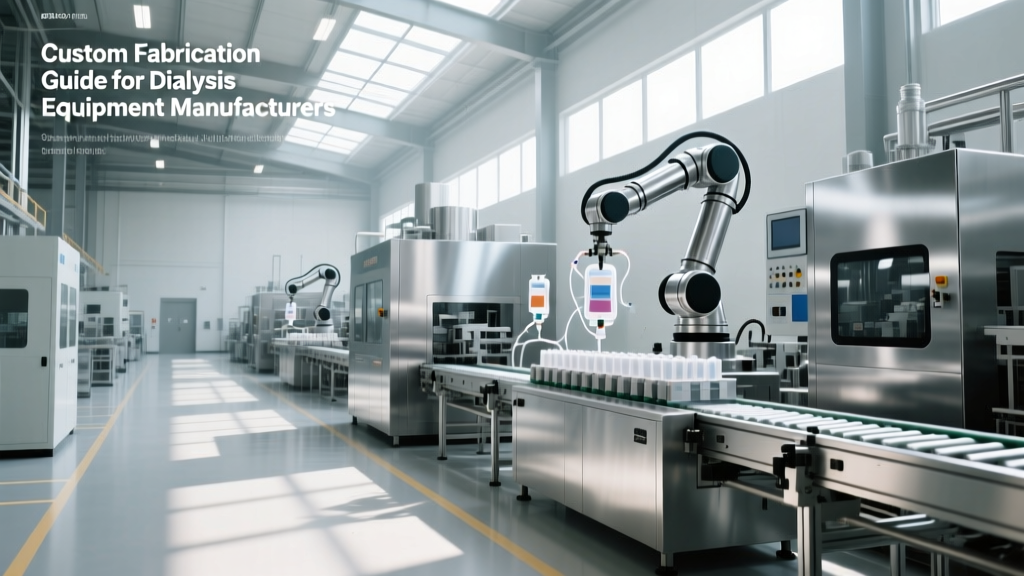
Custom Fabrication Guide for Dialysis Equipment Manufacturers
A comprehensive sourcing guide for dialysis equipment manufacturers seeking custom manufacturing equipment design and fabrication partners.
Dialysis equipment manufacturing operates at the intersection of extreme fluidic precision, stringent biocompatibility, and high-volume production. For dialysis equipment manufacturers, off-the-shelf automation rarely meets the exacting tolerances required for hollow-fiber dialyzer potting, non-DEHP bloodline extrusion, or precision dosing pump assembly. Sourcing custom manufacturing equipment design and fabrication partners requires navigating FDA 21 CFR Part 820 compliance, ISO 13485 quality systems, and complex validation protocols.
Core Fabrication Requirements for Dialysis Systems
Designing custom manufacturing equipment for dialysis requires addressing three distinct production domains, each with unique mechanical and regulatory challenges:
- Dialyzer Assembly: Custom centrifugal potting equipment, automated hollow-fiber bundling, and precision header cutting machinery.
- Bloodline Manufacturing: Extrusion monitoring, ultrasonic welding for Y-sites, and automated drip-chamber assembly stations.
- Fluidic and Monitoring Modules: Precision dosing pump fabrication, conductivity sensor integration, and ultrafiltration control valve assembly.
Evaluating Custom Equipment Design Capabilities
When auditing a potential fabrication partner, dialysis equipment manufacturers must look beyond standard CNC machining and PLC programming capabilities. The fabricator must demonstrate deep expertise in cleanroom-compatible design and micro-fluidic validation.
Cleanroom Assembly and Material Traceability
Custom equipment destined for ISO Class 7 or Class 8 cleanrooms must be designed to minimize particulate generation. This requires the use of brushless servomotors, enclosed belt drives, and specialized lubricants that do not off-gas. Furthermore, the fabricator must provide full material traceability (mill certs) for all 316L stainless steel, titanium, and PVDF components that contact dialysate or blood paths.
Micro-Tolerance Machining for Peristaltic Pumps
The peristaltic pump rotor and stator assemblies dictate the accuracy of blood flow and heparin dosing. Custom fabrication partners must hold machining tolerances of ±0.01mm on pump beds to prevent hemolysis (red blood cell damage) caused by uneven tubing compression.
Standard Automation vs. MedTech-Specific Fabricators
Choosing between a general automation integrator and a specialized medical device fabricator impacts both upfront capital expenditure and long-term regulatory risk. The matrix below outlines the operational differences as of 2026.
| Feature | General Industrial Integrator | MedTech-Specific Fabricator |
|---|---|---|
| Base Equipment Cost | 15% - 25% Lower | Premium (Justified by validation) |
| Validation Documentation (IQ/OQ/PQ) | Basic FAT/SAT only | Full GAMP 5 compliant IQ/OQ/PQ |
| Cleanroom Design Experience | Rare; requires client oversight | Native ISO Class 7/8 design standards |
| FDA Audit Support | None | Direct support for 21 CFR Part 820 audits |
| Lead Time (Design to Delivery) | 4 - 7 Months | 9 - 14 Months |
Key Custom Technologies in Dialysis Fabrication
Automated Polyurethane Potting and Centrifugation
The header of a hemodialyzer is sealed using a polyurethane potting compound. Custom centrifugal casting equipment must precisely control the mixing ratio (typically 100:45 isocyanate to polyol) and maintain resin temperature between 35°C and 45°C to prevent micro-bubbles. The custom centrifuge must dynamically balance the dialyzer bundle within 0.1 grams to ensure uniform potting distribution across thousands of polysulfone hollow fibers.
Ultrasonic and Laser Welding for Bloodlines
Modern bloodlines utilize non-DEHP plastics (such as TOTM-plasticized PVC or polyolefins) which are highly sensitive to thermal degradation. Custom fabrication partners must integrate precision ultrasonic welders with real-time energy monitoring to ensure hermetic seals on Y-sites and drip chambers without generating particulate flash or compromising the biocompatibility of the fluid path.
'The shift toward home hemodialysis and portable peritoneal systems is forcing manufacturers to rethink equipment design. We are seeing a massive demand for custom, modular assembly cells that can handle smaller batch sizes and rapid changeovers, rather than the monolithic, high-speed rotary dials of the past decade.' — Director of Manufacturing Engineering, Global Renal Care Division
The IQ/OQ/PQ Validation Framework and Costs
For dialysis equipment manufacturers, the physical machine is only half the deliverable; the validation documentation is equally critical. Under FDA Quality Systems Regulation, custom equipment must undergo rigorous qualification.
- Installation Qualification (IQ): Verifies that the custom equipment is installed according to the manufacturer's specifications, including utility connections, calibration of sensors, and software version control.
- Operational Qualification (OQ): Tests the equipment at the extreme edges of its operating parameters (e.g., maximum centrifuge speed, minimum potting temperature) to ensure it functions correctly under stress.
- Performance Qualification (PQ): Runs the equipment under normal production conditions using actual dialyzer components to prove consistent output and a Cpk (Process Capability Index) of ≥ 1.33.
Cost Impact: Comprehensive IQ/OQ/PQ documentation packages from specialized fabricators typically add $45,000 to $85,000 to the base equipment cost. However, this investment saves over 2,000 internal engineering hours and prevents costly FDA Form 483 observations related to inadequate process validation.
2026 Cost Benchmarks and Procurement Timelines
Capital planning for custom dialysis manufacturing equipment requires accurate, up-to-date financial modeling. Below are the current benchmark ranges for specialized fabrication projects:
- Custom Dialyzer Potting and Centrifugation Line: $850,000 - $1,400,000 | Lead time: 9-12 months
- Automated Bloodline Extrusion and Assembly Station: $350,000 - $650,000 | Lead time: 6-8 months
- Precision Peristaltic Pump Rotor Machining & Assembly Cell: $120,000 - $250,000 | Lead time: 4-6 months
- Automated Optical Inspection (AOI) for Dialyzer Headers: $180,000 - $300,000 | Lead time: 5-7 months
Frequently Asked Questions
Can we use standard 316L stainless steel for all dialysate fluid paths in custom equipment?
No. While 316L is common, the aggressive nature of concentrated dialysate (particularly acidic concentrates containing acetic acid and chlorides) can cause pitting corrosion over time. Custom equipment designers should specify titanium, PVDF (polyvinylidene fluoride), or highly passivated 316L with electropolished internal surfaces (Ra < 0.4 µm) for long-term reliability in fluidic modules.
How does USP Class VI biocompatibility affect custom equipment design?
Any custom tooling, fixtures, or conveyor belts that physically contact the interior of the bloodline or dialyzer during assembly must be manufactured from USP Class VI certified materials. This dictates the use of specific grades of PEEK, PTFE, or medical-grade silicones for custom grippers and mandrels, preventing leachable compounds from contaminating the medical device during fabrication.