Manufacturing Equipment Vaccine: IIoT Sensor Training Guide
Train operators to deploy the manufacturing equipment vaccine using IIoT sensors. Learn calibration, baselines, and predictive immunity best practices.
In modern reliability engineering, the term manufacturing equipment vaccine refers to a proactive Industrial IoT (IIoT) sensor and edge-AI protocol designed to inoculate production assets against catastrophic failure. Just as a biological vaccine introduces a controlled antigen to build antibodies, an IIoT digital vaccine introduces baseline telemetry mapping to build algorithmic 'antibodies' that instantly recognize and neutralize the threat of unplanned downtime. For factory operations in 2026, deploying this digital immunity is no longer solely an IT function; it requires rigorous operator training to physically administer the sensors, calibrate the edge gateways, and interpret early-stage anomaly alerts.
The Anatomy of an IIoT Digital Vaccine
A successful manufacturing equipment vaccine relies on three active ingredients working in concert at the machine edge. According to frameworks established by the NIST Smart Connected Systems Division, localized condition monitoring requires tight integration between physical transducers and edge compute nodes to prevent latency-induced blind spots.
- The Antigen (Sensors): Tri-axial accelerometers (e.g., Banner Engineering QM42VT2 or IFM VVB020) and thermal-current nodes that continuously sample machine health at 10kHz to 50kHz.
- The Delivery Mechanism (Edge Gateway): Industrial routers like the Advantech ICR-3231 that aggregate sensor payloads via IO-Link or Modbus TCP, performing local Fast Fourier Transform (FFT) calculations.
- The Antibodies (Edge AI Models): Lightweight machine learning algorithms residing on the gateway that flag deviations from the 14-day operational baseline without requiring cloud round-trips.
Operator Training Protocol: Administering the Sensor Array
The efficacy of the manufacturing equipment vaccine is entirely dependent on physical sensor placement. Operators must be trained to treat sensor mounting with the same precision as a medical professional administering an injection. Improper mounting introduces 'attenuation'—the loss of high-frequency vibration data—which blinds the AI to early-stage bearing defects.
Mounting Methods and Signal Attenuation
Operators must select the correct mounting technique based on the machine's geometry and the target failure mode. The following matrix should be standard in operator onboarding:
| Mounting Method | Application Scenario | High-Freq Attenuation (>5kHz) | Operator Installation Time |
|---|---|---|---|
| Tapped Hole / Stud Mount | Spindle housings, gearboxes, permanent critical assets | < 1% (Optimal) | 25-40 mins (requires drilling/tapping) |
| Industrial Epoxy | Curved motor casings, cast iron housings where drilling is prohibited | 5% - 12% | 15 mins (+ 24hr cure time) |
| Rail / Clamp Mount | Extrusions, linear guides, temporary diagnostics | 15% - 25% | 5 mins |
| Magnetic Base | Flat steel surfaces for quick baseline sweeps | 40% - 60% (Poor for bearing defect detection) | 1 min |
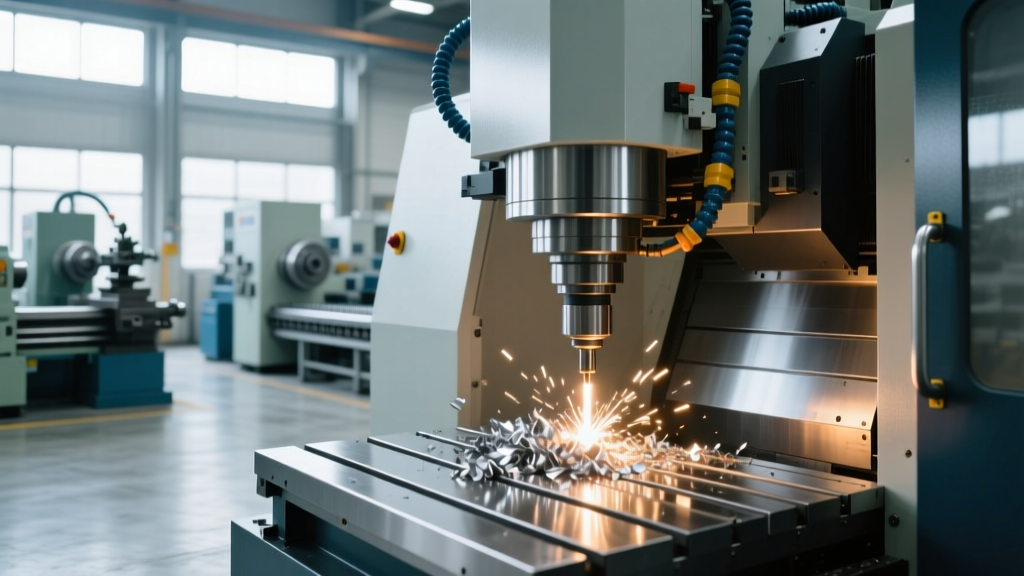
When mounting tri-axial sensors on CNC milling centers, operators must align the Z-axis of the sensor perfectly perpendicular to the spindle centerline. A misalignment of just 5 degrees causes radial vibration to 'leak' into the axial data channel, triggering false positive alerts in the edge AI model. Always use a digital protractor during installation.
The 14-Day Burn-In: Building Algorithmic Immunity
Once the hardware is physically administered, the machine must undergo a 'burn-in' period to establish its unique telemetry DNA. This is the core of the manufacturing equipment vaccine. Operators and reliability technicians must guide the machine through all standard operational states while the edge gateway records the baseline FFT spectrums.
- Days 1-3 (Cold Start & Warm-Up): Capture the thermal expansion and viscosity changes in way lube and spindle oil as the machine transitions from ambient temperature (typically 68°F/20°C) to operating temperature (110°F/43°C).
- Days 4-8 (Steady-State Cutting): Run standard production cycles. The AI learns the specific harmonic frequencies of the primary tooling, including the gear mesh frequencies of the spindle drive.
- Days 9-11 (Transient States): Program the machine to execute rapid traverses, automatic tool changes (ATC), and pallet swaps. These high-shock events create massive, but normal, vibration spikes that the AI must learn to ignore.
- Days 12-14 (Idle & Coolant Flow): Establish the baseline for coolant pump cavitation and hydraulic unit pressure ripples.
Adhering to condition monitoring standards like ISO 17359 ensures that the baseline data is statistically valid and accounts for normal environmental variances.
Troubleshooting 'Vaccine Rejection' (False Positives)
In biological terms, vaccine rejection occurs when the body attacks the antigen. In IIoT terms, it occurs when the edge AI flags normal operational variance as a critical fault, leading to alarm fatigue. Operators must be trained to diagnose these false positives using the following decision tree:
Symptom: Sudden Spike in High-Frequency Vibration (10kHz+)
- Cause A: Loose magnetic mount or degraded epoxy. Fix: Re-mount using a tapped stud or fresh two-part steel epoxy.
- Cause B: Electromagnetic Interference (EMI) from a newly installed Variable Frequency Drive (VFD). Fix: Reroute sensor cables away from power lines and ensure the use of shielded, twisted-pair (STP) M12 cables grounded at the gateway only.
Symptom: Gradual Thermal Drift Alert Over 3 Weeks
- Cause A: Ambient factory HVAC seasonal changes. Fix: Recalibrate the AI's thermal threshold band to account for seasonal ambient shifts (e.g., widening the delta-T allowance from 3°C to 5°C during summer months).
- Cause B: Degradation of spindle cooling jacket glycol. Fix: Flush and replace the spindle chiller fluid; check the chiller pump impeller for cavitation.
Cost vs. ROI: Justifying the IIoT Immunization Strategy
Plant managers often hesitate at the upfront cost of deploying a manufacturing equipment vaccine across an entire fleet. However, when broken down to the individual asset level, the economics heavily favor proactive immunization.
Deployment Cost Breakdown (Per 3-Axis CNC Cell):- 2x Industrial Tri-Axial Accelerometers (e.g., IFM VVB020): $900
- 1x Edge Gateway (shared across 4 machines via IO-Link Master): $150 (allocated)
- Cabling, Mounting Hardware, & Labor: $350
- Total Hardware Cost per Machine: ~$1,400
Standard Operating Procedures (SOPs) for Daily Telemetry
Operators should not be expected to read raw FFT spectrums. Instead, the edge gateway must translate data into simple, actionable traffic-light indicators on the machine's HMI or a localized tablet.
- Green (Immunized/Healthy): All vibration and thermal parameters within 1.5 standard deviations of the 14-day baseline. Operator action: None. Proceed with standard production.
- Yellow (Antibody Response/Warning): Specific frequency bands (e.g., 3x spindle rotational speed) show a 15% amplitude increase. Operator action: Log the alert, finish the current batch, and schedule maintenance inspection within 7 days.
- Red (Infection/Critical Fault): Overall RMS vibration exceeds ISO 10816 Zone C thresholds, or thermal delta exceeds 12°C in under 5 minutes. Operator action: Execute immediate E-stop to prevent secondary damage to the machine casting.
For deeper cybersecurity frameworks protecting these edge devices from network intrusion, operators and IT staff should consult the NIST Internet of Things (IoT) cybersecurity guidelines to ensure the digital vaccine isn't compromised by external threats.
Summary: The Operator as the First Line of Defense
The manufacturing equipment vaccine is not a software package you simply install and forget. It is a cyber-physical protocol that requires skilled operators to physically mount sensors with precision, guide the AI through rigorous baseline burn-ins, and intelligently troubleshoot environmental anomalies. By investing in this specialized operator training, factories transform their workforce from reactive machine-minders into proactive reliability engineers, ensuring maximum OEE and asset longevity in 2026 and beyond.