Smart Relocation: How HVAC Equipment Manufacturers Use Digital Twins
Discover how leading HVAC equipment manufacturers use digital twins, AR, and IoT to cut installation downtime and prevent rigging failures.
Beyond the Forklift: The Digital-First Relocation Standard
When a semiconductor fab, pharmaceutical cleanroom, or heavy manufacturing plant relocates, the movement of critical climate and process cooling systems represents one of the highest-risk phases of the project. Moving a 20-ton industrial chiller or a 50,000 CFM custom air handling unit (AHU) is no longer just a logistical challenge of cranes and flatbeds; it is a precision engineering operation. Today, top HVAC equipment manufacturers are shifting from delivering raw 'iron' to delivering digital-physical integrated systems. By leveraging Digital Twins, Augmented Reality (AR), and IoT baseline calibration, these manufacturers are drastically reducing installation downtime and eliminating the catastrophic failure modes associated with traditional rigging.
The True Cost of Misaligned Rigging
Traditional rigging of a 15-ton process chiller typically costs between $12,000 and $18,000 and requires 3 to 5 days of onsite labor. However, the hidden cost lies in post-installation failures. A misalignment of just 0.05mm on a magnetic bearing compressor flange can cause harmonic vibration, leading to premature bearing failure and upwards of $85,000 in emergency replacement costs and line-stoppage downtime. Digital-first installation protocols mitigate this risk entirely.
The Pre-Arrival Phase: BIM and Digital Twin Mapping
The most critical phase of modern equipment relocation occurs before the machinery ever leaves the factory floor. Leading manufacturers now utilize Level of Development (LOD) 400 Building Information Modeling (BIM) to create exact digital replicas of the equipment and its destination environment. Using platforms like Autodesk Tandem, facility managers and OEM installation teams collaborate in a shared digital twin environment.
This pre-flight check allows engineers to simulate the exact rigging path, identifying spatial clashes with existing piping, structural columns, or overhead cable trays. For example, when relocating a Trane CenTraVac CVHE chiller (capable of up to 4,000 tons of cooling), the digital twin calculates the exact center of gravity and maps the load distribution across the facility's concrete slab, ensuring the floor's live-load capacity is not exceeded during the temporary staging phase.
AR-Assisted Rigging: Eliminating the 'Tape Measure' Guesswork
Once the equipment arrives on-site, Augmented Reality (AR) has replaced the traditional laser levels and tape measures. Installation crews equipped with Microsoft HoloLens 2 headsets overlay the 3D digital twin onto the physical installation pad. This provides real-time, millimeter-accurate guidance for placing vibration isolation mounts and aligning heavy flanges.
Step-by-Step AR Placement Flow
- Anchor Scanning: The crew scans the pre-installed AR fiducial markers on the facility floor, locking the holographic model to the physical space with sub-millimeter accuracy.
- Holographic Overlay: The 3D model of the chiller or AHU is projected onto the rigging path. The AR system highlights structural hazards in red and the optimal lifting path in green.
- Live Tolerance Feedback: As the crane lowers the unit, the AR headset displays live distance-to-pad metrics. The rigger receives audio cues when the equipment is within 5mm of the target isolation springs.
- Flange Alignment Verification: Before torqueing, the AR system overlays the exact bolt-tightening sequence (e.g., star-pattern torqueing to 140 ft-lbs) to prevent uneven pipe strain.
Traditional vs. Digital-First Relocation Matrix
The transition to tech-enabled installation yields measurable ROI across time, cost, and precision metrics. The following matrix compares legacy methods with the 2026 digital-first standard employed by premium OEMs.
| Metric | Traditional Rigging & Installation | Digital Twin & AR-Enabled Protocol |
|---|---|---|
| Onsite Installation Time | 72 - 120 hours | 14 - 24 hours |
| Pipe Strain / Misalignment Incidents | 18% (industry average) | < 1% |
| Direct Labor & Rigging Cost | $14,500 average | $8,000 average |
| Post-Install Commissioning Time | 3 - 5 days | 4 - 8 hours (automated) |
Post-Installation: IoT Vibration Baselining and Refrigerant Commissioning
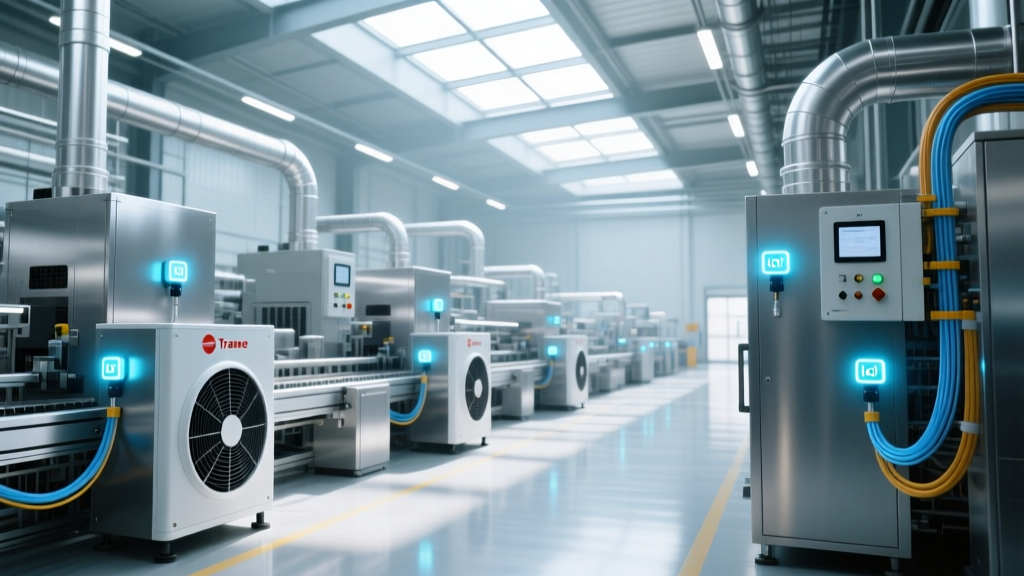
The installation process does not end when the bolts are torqued. Modern HVAC equipment manufacturers integrate IoT sensors directly into the chassis to perform automated baseline calibration immediately upon startup. For units utilizing active magnetic bearings (AMB), such as the Daikin Magnitude chiller line, post-installation vibration baselining is non-negotiable.
Upon initial power-up, embedded SKF Multilog IMx sensors record the ambient harmonic signature of the facility. The system's edge-computing module compares this live data against the factory digital twin. If the vibration amplitude on the Z-axis exceeds 2.5 mm/s RMS, the system automatically flags a 'Soft Foot' or pipe-strain error, preventing the compressor from engaging and protecting the internal clearances (which are often tighter than 0.02mm).
Critical Edge Case Failure Modes During Relocation
Even with advanced technology, plant managers must be vigilant against non-obvious failure modes that occur specifically during the relocation of heavy HVAC and process cooling equipment:
- Flange Strain on Magnetic Bearings: If the connected chilled water piping is not independently supported and perfectly aligned before bolting to the chiller evaporator, the weight of the pipe transfers to the compressor housing. This shifts the magnetic bearing rotor off its electromagnetic center, causing the AMB controller to draw excessive amperage and eventually trip the VFD.
- Oil Logging in Relocated Evaporators: When large DX or flooded evaporator coils are moved, residual compressor oil can pool in low-point U-traps. If the system is started without a prolonged nitrogen blowout and localized heating of the traps, the oil will slug back into the compressor upon startup, causing catastrophic hydraulic lock and shattered valve plates.
- Vibration Isolator Pre-Load Collapse: Spring isolators are rated for specific static loads. If a facility upgrades a chiller's internal heat exchanger (adding weight) but reuses the original isolation springs from the previous pad, the springs will bottom out, transferring 100% of the 60Hz compressor vibration directly into the building's structural slab.
Decision Matrix: Mandating Smart Installation Protocols
Not every equipment move requires a $50,000 digital twin mapping operation. Plant managers and facility directors should use the following framework to determine when to mandate advanced installation protocols from their OEM partners:
When to Require Digital-First Installation:
- Equipment Mass & Value: Any single piece of equipment exceeding 10,000 lbs or valued over $250,000 (e.g., large centrifugal chillers, custom make-up air units).
- Facility Environment: Installations within active cleanrooms (ISO 5 to ISO 8), semiconductor fabs, or bio-pharma facilities where particulate generation from traditional cutting and grinding is prohibited.
- Downtime Tolerance: Projects where production line stoppage costs exceed $10,000 per hour, making the premium for AR-assisted rapid placement economically justified.
- Complex Piping Integration: Systems requiring integration with existing, undocumented legacy piping networks where 3D laser scanning and BIM clash-detection are mandatory to avoid onsite rework.
The era of relying solely on experience-based rigging and manual commissioning is over. By demanding digital twin integration, AR-guided placement, and IoT-verified baselining from HVAC equipment manufacturers, industrial facilities can transform equipment relocation from a high-risk liability into a predictable, data-verified science. Ensuring these protocols are written directly into the OEM purchase agreements is the first step toward safeguarding multi-million-dollar manufacturing operations.