Evaluating Trane Industrial Air Purifiers via IoT Maintenance Sensors
Learn how facility managers evaluate Trane industrial air purifiers using IoT sensors for predictive maintenance, filter tracking, and service schedules.
The transition from calendar-based to condition-based maintenance is redefining factory operations in 2026. For heavy manufacturing, pharmaceutical cleanrooms, and automotive paint booths, industrial air quality is not just a comfort metric—it is a critical production variable. When facility engineers evaluate large-scale climate and filtration systems, they are rarely looking at standalone consumer-style air purifiers. Instead, they are assessing massive Air Handling Units (AHUs) and Rooftop Units (RTUs) equipped with MERV-16, HEPA, and UV-C purification stages. Integrating Industrial IoT (IIoT) sensors into these systems has become the gold standard for optimizing service schedules, reducing energy waste, and preventing catastrophic filter blowouts.
The Shift from Calendar to Condition-Based HVAC Maintenance
Historically, maintenance teams replaced industrial HVAC filters on rigid 90-day or 180-day schedules. This approach is inherently flawed: in a high-particulate environment like a metalworking facility, a MERV-14 filter might reach its terminal pressure drop in 45 days, while in a clean electronics assembly plant, that same filter could easily last 10 months. Blindly adhering to a calendar schedule results in either premature media disposal (wasting thousands of dollars annually) or delayed replacements that strain Variable Frequency Drive (VFD) blower motors and compromise indoor air quality (IAQ).
By deploying IIoT telemetry, engineers can monitor the exact degradation of filtration stages in real-time. According to the U.S. Environmental Protection Agency (EPA), maintaining strict IAQ parameters in large industrial facilities requires continuous monitoring of ventilation rates and particulate ingress, both of which are heavily dependent on filter integrity and fan performance.
How Facility Managers Evaluate the HVAC Equipment Manufacturing Company Trane on Air Purifiers
When procurement teams and plant engineers evaluate the hvac equipment manufacturing company trane on air purifiers and advanced filtration AHUs (such as the Trane IntelliPak or Sintesis lines), the primary differentiator in 2026 is IoT readiness. Trane's industrial air purification solutions are evaluated not just on their MERV or HEPA efficiency, but on how seamlessly their native controls integrate with aftermarket IIoT sensor networks.
Native Telemetry vs. Aftermarket IIoT Retrofits
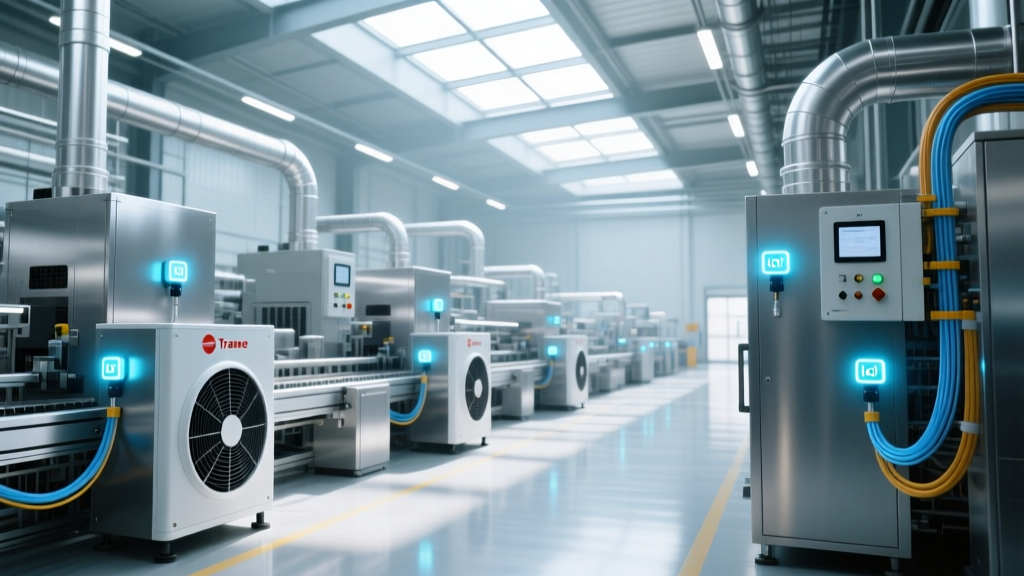
Trane's proprietary Tracer Ensemble building management system (BMS) provides excellent baseline telemetry, including supply fan status, VFD speed, and basic coil temperatures. However, for granular predictive maintenance on the purification and filtration stages, facility engineers often supplement native controls with specialized IIoT edge sensors communicating via MQTT or BACnet/IP.
| Sensor Type | Target Parameter | Typical Model / Brand | Maintenance Trigger Threshold | Est. Unit Cost (2026) |
|---|---|---|---|---|
| Differential Pressure (dP) | Filter media loading | Dwyer MS2 Magnesense II | > 1.2 in. w.g. (MERV-14) | $185 - $240 |
| Triaxial Vibration | Supply fan bearing health | Banner QM42VT | > 0.25 in/s RMS velocity | $350 - $420 |
| VOC / PM2.5 Laser | Post-filter IAQ slip | Sensirion SEN6x Series | PM2.5 > 12 µg/m³ (Cleanroom) | $90 - $130 |
| Current Transducer (CT) | Motor amp draw / strain | CR Magnetics CR9580 | > 15% over nominal FLA | $65 - $85 |
Architecting the Predictive Service Schedule
Implementing IIoT sensors allows maintenance managers to build dynamic service schedules. Instead of scheduling a filter swap for the first weekend of October, the BMS generates a work order automatically when the differential pressure across the HEPA bank hits the terminal threshold, provided the post-filter PM2.5 sensors confirm that no media bypass has occurred.
⚠️ Warning: Sensor Fouling in High-VOC EnvironmentsWhen deploying laser-based PM2.5 sensors downstream of Trane purification units in environments with high volatile organic compounds (e.g., automotive paint booths or chemical processing), the sensor optics can become coated with sticky VOC residue. This causes false high-particulate readings. Engineers must specify sensors with hydrophobic optical coatings or install inline PTFE membrane pre-filters on the sensor sampling tubes to ensure accurate IAQ telemetry.
The integration of vibration sensors adds a secondary layer to the maintenance schedule. As filters load with particulate, static pressure increases. The VFD compensates by ramping up the fan speed to maintain the required cubic feet per minute (CFM) as dictated by ASHRAE Standard 62.1. This increased load alters the vibration signature of the blower motor bearings. By correlating dP filter data with vibration telemetry, engineers can predict bearing failure weeks before a catastrophic seizure occurs, bundling the bearing replacement with the scheduled filter swap to minimize production downtime.
Real-World Failure Modes and Edge Cases
While IIoT condition monitoring is highly effective, facility engineers must account for specific edge cases when evaluating Trane equipment and sensor deployments:
- Gasket Bypass vs. Media Loading: If a dP sensor shows a sudden drop in pressure, but the downstream PM2.5 sensor shows a spike in particulates, the filter media has not cleaned itself. The negative pressure has likely blown out the filter gasket seal, causing dirty air to bypass the HEPA bank entirely. The BMS must be programmed to flag this inverse correlation as a critical emergency, not a normal operating variance.
- UV-C Lamp Degradation: Many Trane industrial purification setups include UV-C arrays for coil and airstream sterilization. UV-C intensity degrades over time even if the bulb remains illuminated. Integrating UV-C radiometers (measuring irradiance in µW/cm²) into the IoT network ensures that maintenance teams replace lamps based on actual germicidal output thresholds (typically dropping below 60% of initial output) rather than arbitrary annual schedules.
- VFD Harmonic Interference: High-frequency VFDs used on Trane supply fans can introduce electrical noise into unshielded 4-20mA analog sensor loops, causing erratic dP readings. Using digital BACnet MS/TP or wireless IoT edge gateways eliminates analog signal degradation in noisy manufacturing plants.
Economic Impact: Filter Lifecycle and Energy Consumption
The financial justification for IIoT sensor integration on industrial air purifiers is rooted in energy and labor optimization. A standard 20,000 CFM Trane AHU serving a manufacturing floor requires a 30HP blower motor. When MERV-16 filters become fully loaded, the static pressure can increase by 0.8 to 1.0 inches of water gauge (in. w.g.). To overcome this resistance, the VFD increases power consumption by approximately 18% to 22%.
"By utilizing continuous differential pressure monitoring and optimizing filter change-out intervals based on actual loading rather than time, industrial facilities typically reduce HVAC filtration energy costs by 12% to 18% annually, while simultaneously cutting filter media waste by up to 30%."
— 2025 Industrial Energy Efficiency Report, Manufacturing Engineering Council
Furthermore, a single industrial HEPA filter bank replacement requires a two-person crew and approximately 4 hours of downtime. At a fully burdened labor rate of $85/hour per technician, plus the $3,500 cost of the media, a premature swap wastes over $4,100. Multiplying this across a dozen AHUs on a factory campus yields massive OPEX savings when maintenance is strictly condition-based.
The 2026 Procurement Checklist for Facility Engineers
When drafting RFQs for new Trane industrial air handling and purification systems, ensure the following IIoT maintenance specifications are explicitly mandated:
- Native Sensor Ports: Require factory-installed, threaded tap ports for differential pressure sensors across every filtration stage (pre-filter, final filter, and carbon/VOC beds).
- Open Protocol Integration: Verify that the Trane Tracer SC+ or Ensemble controller supports native MQTT or BACnet/IP mapping for third-party IIoT edge devices without requiring expensive proprietary gateway licenses.
- Motor Telemetry Readiness: Specify VFDs (e.g., Trane Trane or compatible Danfoss/ABB drives) that natively broadcast motor torque, amp draw, and thermal data over the building network, eliminating the need for external current transducers.
- Automated Work Order Generation: Ensure the BMS software is configured to push API webhooks to your facility's CMMS (like Fiix or UpKeep) the moment a sensor breaches the predictive maintenance threshold, automatically reserving parts and scheduling labor.
Ultimately, evaluating industrial air purification equipment in the modern manufacturing landscape requires looking far beyond the MERV rating on the spec sheet. The true value lies in the system's ability to communicate its own degradation, allowing maintenance teams to service the equipment exactly when required, ensuring pristine air quality, protecting expensive blower motors, and driving down operational costs.