Extrication Equipment Manufacturer: Startup Machinery Setup
Learn how an extrication equipment manufacturer scales production. Discover the small-scale CNC, hydraulic test rigs, and CapEx needed for startup success.
The global rescue and demolition tool market is undergoing a massive transition. Traditional gas-powered hydraulic pumps are being rapidly replaced by battery-operated, high-pressure electro-hydraulic systems. For a new extrication equipment manufacturer, this shift lowers the barrier to entry regarding legacy engine integration but drastically raises the precision requirements for compact pump housings and brushless motor assemblies. Launching a production line for life-saving hydraulic cutters, spreaders, and rams requires a highly specialized, small-footprint manufacturing setup capable of handling extreme pressures and aerospace-grade materials.
Market Shift Data: Battery-Powered Rescue Tools
By 2026, battery-powered hydraulic extrication tools account for over 78% of new municipal fire department procurement in North America. These tools operate at standard pressures of 10,500 PSI, requiring electro-hydraulic pumps that fit inside the tool body. This demands ultra-compact, 5-axis machined manifolds and high-tolerance piston seals.
Core Machining: 5-Axis CNC for Electro-Hydraulic Housings
The heart of modern battery-powered extrication equipment is the integrated electro-hydraulic pump housing. These components must route complex internal hydraulic galleries, house the brushless DC motor, and withstand continuous 10,500 PSI internal pressure without micro-fractures. Startups typically machine these from 7075-T6 aluminum alloy, which offers a tensile strength of 83,000 PSI while keeping the tool lightweight for first responders.
For a small-scale manufacturing startup, floor space and capital expenditure are critical constraints. The Haas UMC-500SS is the industry benchmark for this application. It provides full 5-axis simultaneous machining capability within a 65-square-foot footprint.
- Spindle Speed: 12,000 RPM inline direct-drive spindle is optimal for clearing chips when pocketing 7075 aluminum.
- Tooling Strategy: Utilizing 3-flute carbide end mills with a ZrN (Zirconium Nitride) coating prevents aluminum adhesion and extends tool life by up to 300% compared to standard TiN coatings.
- Tolerance Requirement: Internal hydraulic gallery bores must hold a true position tolerance of ±0.0005 inches to prevent internal cross-leakage at peak pressure.
Precision Turning for Hardened Steel Piston Rods
Extrication spreaders and cutters generate up to 200,000 pounds of spreading force. The piston rods driving the tool arms must resist bending and severe abrasion. These are typically machined from 4140 chromoly steel, pre-hardened to 28-32 HRC, and subsequently hard-chrome plated.
A startup does not need a massive turning center for these components. A compact CNC lathe with live tooling, such as the Haas ST-10Y, provides the necessary Y-axis and C-axis capabilities to machine the complex clevis ends and cross-drilled hydraulic ports on the piston rods in a single setup. Eliminating secondary operations reduces cumulative tolerance stack-up, which is the primary cause of hydraulic cylinder seal failure in the field.
"In life-saving extrication equipment, a microscopic scoring defect on a piston rod will shred a polyurethane seal under 10,000 PSI of pressure. Single-setup turning and achieving an Ra 0.8 µm surface finish directly off the machine is non-negotiable."
— Lead Manufacturing Engineer, Advanced Rescue Systems
Small-Scale Machinery Comparison Matrix
Selecting the right machinery footprint is critical for startups operating in 5,000 to 10,000 square foot leased industrial spaces. Below is a comparison of optimal small-scale equipment for an extrication equipment manufacturer.
| Machine Model | Footprint (Sq Ft) | Est. CapEx (2026) | Primary Application |
|---|---|---|---|
| Haas UMC-500SS | 65 | $135,000 | 5-Axis pump housings & manifolds |
| Haas ST-10Y | 42 | $78,000 | Piston rods & clevis ends |
| Tormach 15L Slant-PRO | 28 | $32,000 | Prototyping pins, bushings, valves |
| Enerpac Custom Test Bench | 35 | $45,000 | 15,000 PSI hydrostatic proof testing |
Hydrostatic & Battery Assembly Test Benches
Machining the components is only half the battle. An extrication equipment manufacturer must validate every assembly before it ships to a firehouse. Small-scale startups must invest heavily in end-of-line testing equipment to ensure compliance with NFPA 1936 (Standard on Powered Rescue Tools).
Hydrostatic Proof Testing
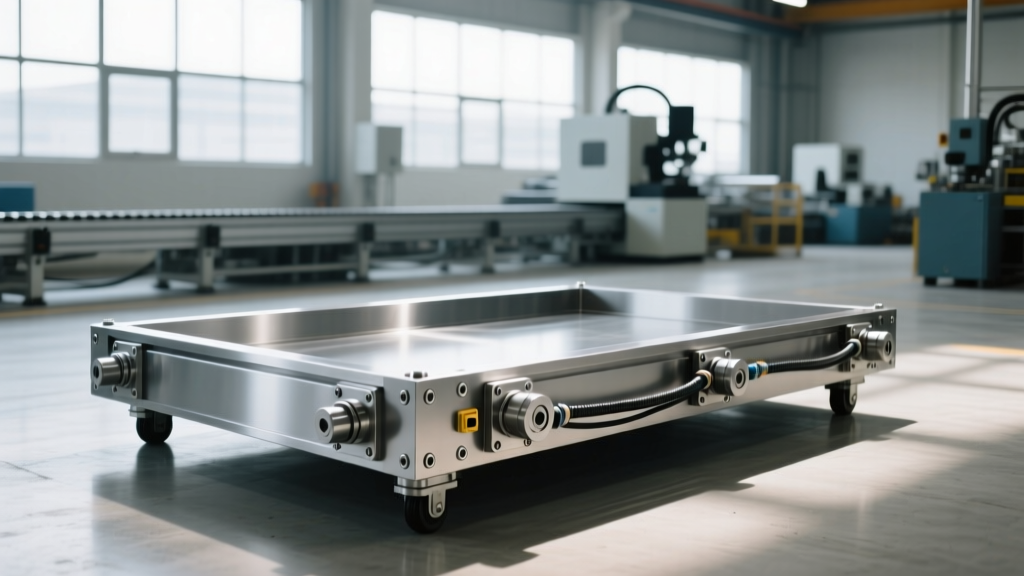
Every hydraulic manifold and cylinder must undergo hydrostatic proof testing at 150% of its maximum working pressure. For a 10,500 PSI tool, the test pressure is 15,750 PSI. Startups utilize closed-loop test benches equipped with 10-micron inline filtration and digital pressure transducers. A custom-built Enerpac test rig with a 30-gallon reservoir and an air-driven hydraulic pump can safely automate this cycle, logging data directly to a central MES (Manufacturing Execution System) for traceability.
Battery & Motor Load Testing
Modern extrication tools utilize 56V or 80V lithium-ion battery packs. Testing these packs under simulated hydraulic load requires a dynamometer-style test bench that can draw 80+ amps continuously while monitoring cell temperature and voltage sag. Startups often integrate Chroma ATE battery testing modules, which cost between $15,000 and $25,000, to automate pass/fail diagnostics on the assembly line.
Case Study: Scaling 'Vanguard Rescue Tools' from Garage to Production
To understand the real-world application of this machinery, consider the trajectory of Vanguard Rescue Tools, a representative startup that transitioned from R&D prototyping to low-volume production of battery-powered hydraulic cutters.
Initially, Vanguard outsourced their 7075-T6 pump housings to a local machine shop. However, lead times of 8 weeks and high scrap rates due to complex internal gallery porosity threatened their first municipal contract. Leveraging resources and guidance from the NIST Manufacturing Extension Partnership (MEP), Vanguard secured equipment financing and moved production in-house to a 6,000-square-foot facility.
Phase 1 CapEx & Implementation Breakdown
- CNC Machinery: $213,000 (1x UMC-500SS, 1x ST-10Y, tooling, and workholding).
- Facility Upgrades: $45,000 (3-phase 480V power drop, compressed air lines, and oil mist collectors).
- Testing & QC: $68,000 (Hydrostatic bench, CMM inspection table, and battery load tester).
- Material Inventory: $35,000 (7075-T6 billet, 4140 steel bar stock, and polyurethane seal kits).
- Total Initial CapEx: $361,000.
By bringing 5-axis machining in-house, Vanguard reduced their pump housing cycle time from 4.5 hours to 85 minutes using optimized trochoidal milling toolpaths. More importantly, they achieved a 99.2% first-pass yield rate on internal hydraulic galleries, virtually eliminating the cross-leakage issues that plagued their outsourced parts.
Regulatory Compliance & Environmental Testing Equipment
Extrication tools are dropped onto concrete, left in freezing winter air, and exposed to extreme heat at crash scenes. To achieve NFPA 1936 certification, a manufacturer must subject their tools to rigorous environmental and physical abuse testing.
For a small-scale manufacturer, purchasing full-sized industrial environmental chambers is cost-prohibitive. Instead, startups utilize compact, specialized testing rigs:
- Thermal Shock Chambers: Small footprint reach-in chambers (e.g., from Thermotron) that can cycle tools from -20°F to 140°F in under 30 minutes to test O-ring and seal integrity.
- Drop-Test Towers: A simple 2-meter guided drop-test rig with a calibrated concrete anvil base to validate the structural integrity of the fiberglass-reinforced polymer handles and motor housings.
- Vibration Tables: Small electrodynamic shakers to simulate transport and long-term vehicular mounting vibrations, ensuring internal wiring harnesses and PCB connections do not fatigue.
Strategic Takeaways for Startup Manufacturers
Entering the rescue tool market requires a fundamental commitment to precision and traceability. An extrication equipment manufacturer cannot rely on general-purpose, low-cost machinery when human lives depend on tool reliability. By strategically investing in compact, high-precision 5-axis CNC equipment and automated hydrostatic testing benches, startups can achieve the tight tolerances required for 10,500 PSI electro-hydraulic systems while maintaining the agility and low overhead necessary to disrupt legacy brands.