Modular Line Troubleshooting for Data Center Equipment Manufacturers
Expert troubleshooting guide for modular manufacturing skids used by data center equipment manufacturers to build AI servers and cooling systems.
The Shift to Plug-and-Produce in Data Center Hardware
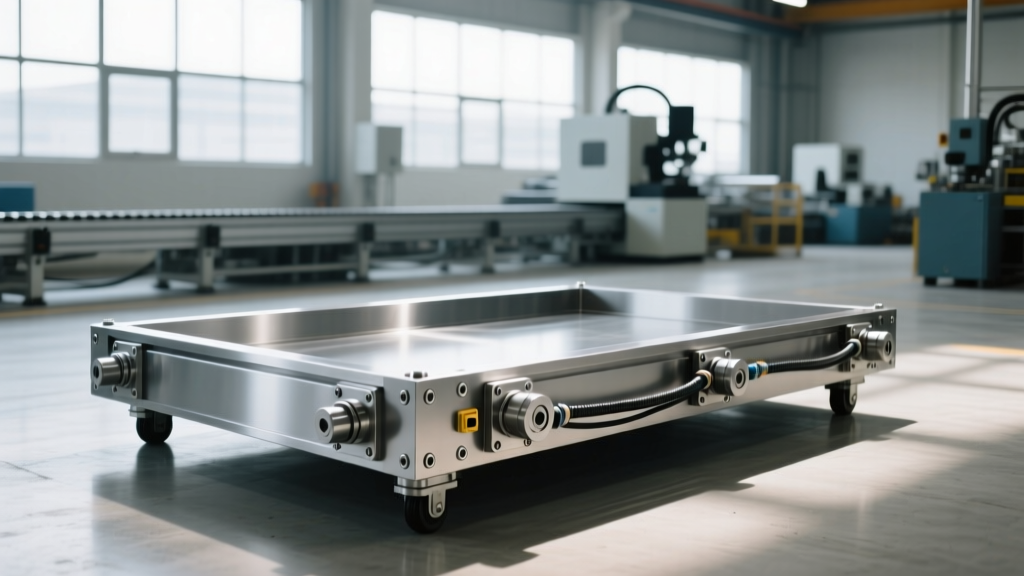
Data center equipment manufacturers operate in an environment of extreme volatility. The rapid transition from standard air-cooled 19-inch server racks to high-density direct-to-chip (D2C) liquid cooling manifolds and 48V DC busbars requires production lines that can reconfigure overnight. To achieve this, manufacturers have abandoned fixed hard-automation in favor of modular manufacturing equipment—skid-based, plug-and-produce cells that can be hot-swapped or rearranged to handle new product geometries.
However, modular skids introduce unique fault domains. When a reconfigurable assembly cell fails, the root cause is rarely a simple mechanical jam; it is usually a breakdown in the physical or digital interfaces that allow modules to communicate, dock, and synchronize. This guide provides advanced troubleshooting protocols for the specific modular architectures used in data center hardware production.
Diagnostic Prerequisite: Before probing any modular skid, verify that the master PLC (e.g., Siemens S7-1500 or Allen-Bradley ControlLogix) is running in RUN mode and that the PROFINET/EtherCAT topology map shows all expected MAC addresses. Swapping identical skids without updating the GSDML/ESI files will cause immediate bus rejection.Modular Skid Fault Isolation Matrix
Use this decision matrix to rapidly isolate the subsystem responsible for a modular cell failure before deploying physical tools.
| Fault Symptom | Module Subsystem | Root Cause Analysis | Resolution Protocol |
|---|---|---|---|
| Skid docks but PLC shows 'Module Missing' | Data Link / Physical Layer | M12 X-coded connector pin retraction or docking sensor misalignment. | Torque M12 to 0.6 Nm; recalibrate inductive docking sensor to 2mm gap. |
| Pressure decay test fails on CDU manifold skid | Fluidic Quick-Disconnects | O-ring extrusion in flat-face couplers due to glycol viscosity changes. | Replace with FKM (Viton) O-rings; update test algorithm for ambient temp. |
| Safety loop breaks immediately upon skid engagement | RFID Interlock / Safety Relay | Code mismatch on Pilz PSENcode sensor; actuator mounted backwards. | Teach new RFID actuator code via IO-Link master; verify mounting polarity. |
| Skid stuck in 'Aborting' state during changeover | PackML State Model | Uncleared fault in the 'Clearing' state transition logic. | Force PackML state to 'Stopped' via HMI; acknowledge alarms manually. |
Troubleshooting PROFINET IRT Drops in Hot-Swappable Skids
Modular manufacturing equipment relies heavily on PROFINET IRT (Isochronous Real-Time) or EtherCAT to maintain sub-millisecond synchronization between the main line and the modular skids. Data center equipment manufacturers building heavy AI server chassis use synchronized servo-drives across multiple skids to lift and align 150lb chassis simultaneously. If the network drops, the drives fault out to prevent mechanical shearing.
The Physical Layer: M12 Connector Degradation
The most common cause of intermittent bus drops in modular systems is the physical docking interface. Unlike fixed lines with hardwired RJ45 or sealed M12 connections, modular skids use automated docking stations with blind-mate M12 X-coded connectors.
- Contact Wear: Every time a skid is rolled into position, the M12 pins undergo mechanical friction. After 2,000 docking cycles, the gold-plated contacts can wear down, increasing insertion loss and causing packet jitter.
- Torque Specifications: Maintenance technicians often hand-tighten replacement M12 connectors on the skid-side panel. According to PROFINET installation guidelines, M12 connectors require exactly 0.6 Nm of torque. Under-torquing leads to vibration-induced micro-disconnects when the skid's pneumatic cylinders fire.
- Shielding Continuity: Modular skids must maintain a continuous equipotential bonding path. If the skid's grounding brush is worn, high-frequency noise from the servo drives will bleed into the PROFINET cable shield, corrupting the cyclic data telegrams.
Fluidic Quick-Disconnect Failures in CDU Testing Modules
A major growth area for data center equipment manufacturers is the production of Coolant Distribution Units (CDUs) and liquid-cooled server blades. Modular test skids are used to pressure-test these manifolds using a 50/50 propylene glycol and water mixture. These test skids connect to the product via automated flat-face quick-disconnects.
Diagnosing Pressure Decay Faults
When a modular test skid repeatedly fails the pressure decay test (indicating a leak), technicians often blame the product manifold. However, 60% of the time, the fault lies within the skid's own fluidic coupling.
- Viscosity and Temperature Compensation: Glycol viscosity changes significantly with ambient temperature. If the test skid's PLC algorithm uses a fixed pressure drop threshold (e.g., 0.5 psi over 10 seconds) without compensating for the fluid's temperature-induced viscosity changes, it will trigger false rejects. Verify that the skid's RTD temperature sensor is properly calibrated and feeding live data to the test algorithm.
- O-Ring Extrusion: Flat-face quick disconnects rely on internal O-rings to seal upon connection. High-pressure test cycles (often 100+ psi for burst testing) can cause standard NBR (Nitrile) O-rings to extrude into the clearance gaps. Replace all NBR seals with FKM (Viton) or EPDM compounds rated for glycol compatibility and high-pressure extrusion resistance.
- Trapped Air Volumes: Modular test lines often feature auto-venting valves. If the vent valve solenoid fails open, the system will continuously bleed pressure during the decay test phase, mimicking a massive product leak. Check the solenoid coil resistance and valve spool movement.
Safety Interlock Desynchronization During Module Changeovers
Flexible production requires operators to physically roll modular skids in and out of the main assembly line. This introduces severe safety risks, governed by ISO 13849. To protect operators, modular skids use RFID-coded safety sensors (such as the Pilz PSENcode series) to ensure the correct skid is locked in the correct physical location before the safety relays close the circuit.
The 'Ghost Skid' Phenomenon
A frequent troubleshooting headache is the 'Ghost Skid' error, where the safety PLC refuses to acknowledge a newly docked skid, even though the mechanical locks are engaged.
- Actuator Polarity: RFID safety actuators are often asymmetrical. If a replacement actuator is mounted 180 degrees out of phase on the new skid, the sensor will read the RFID chip but reject the safety code matrix. Always verify the physical alignment marks on the sensor and actuator.
- Teaching New Codes: When replacing a damaged safety sensor, the new sensor must be 'taught' to recognize the existing skid actuators. If this IO-Link teaching sequence is skipped, the sensor defaults to a safe-state (open circuit). Use the manufacturer's IO-Link master configuration tool to execute the teach-in sequence while the actuator is within the 5mm sensing range.
- Cross-Talk Interference: In dense modular cells, two skids might be docked within 150mm of each other. If the RFID sensors are not configured with alternating frequencies or physical shielding, they may read the adjacent skid's actuator, causing a safety fault. Maintain a minimum 200mm separation distance between non-coded RFID safety sensors.
PackML State Model Desynchronization
To ensure that modular skids from different OEMs can communicate seamlessly with the main line, data center equipment manufacturers increasingly mandate compliance with the OMAC PackML standard. PackML defines a strict state model (Aborting, Clearing, Stopped, Starting, Idle, Execute, Holding, etc.) for all equipment.
When a skid becomes 'stuck' and refuses to transition from Stopped to Starting, the issue is almost always a logic trap in the Clearing state.
Clearing the Clearing State
The Clearing state is designed to allow the machine to move to a safe, home position before starting a new cycle. If a servo axis on the modular skid is mechanically bound, or if a cylinder fails to reach its home proximity sensor within the configured timeout window (typically 3000ms), the PackML state machine will halt in Clearing and immediately transition to Aborting.
Troubleshooting Steps:
- Access the skid's local HMI and navigate to the PackML State Control screen.
- Force the state command to Reset. This clears the abort latch and returns the state machine to Stopped.
- Manually jog the offending axis or cylinder to its physical home position using the local jog pendant.
- Verify that the home sensor LED is illuminated and that the PLC input bit is high.
- Issue the Clear command via the HMI. Monitor the PLC trace to ensure the state transitions through Clearing to Stopped without timing out.
Preventative Calibration Schedule for Modular Interfaces
Because modular equipment relies on repeated physical mating, preventative maintenance must focus on the interfaces rather than just the internal mechanics. Implement the following schedule to prevent unplanned downtime:
- Weekly: Inspect all M12 and M8 blind-mate connectors for pin retraction. Use a go/no-go gauge to verify pin depth. Clean contacts with isopropyl alcohol and apply dielectric grease.
- Monthly: Calibrate all inductive docking sensors. The gap between the skid-mounted sensor and the main-line target must be maintained at exactly 2.0mm ± 0.2mm to prevent false triggers from line vibration.
- Quarterly: Perform a full pressure decay test on the skid's internal fluidic manifold with the quick-disconnects capped. This isolates the skid's internal plumbing from the product interface, allowing you to identify internal valve leaks before they affect production yield.
- Bi-Annually: Backup and verify all IO-Link parameter sets and RFID safety codes. Physical tags on skids can be swapped during maintenance; digital verification ensures the PLC topology matches the physical reality.
By shifting the troubleshooting focus from internal component failure to interface degradation and state-model logic, maintenance teams can drastically reduce the mean-time-to-repair (MTTR) for modular production lines, ensuring the continuous output of critical data center infrastructure.