Batch vs Continuous Manufacturing Equipment Depreciation Life
Compare batch vs continuous manufacturing equipment depreciation life, MACRS tax impacts, and ROI case studies for pharma and food processing.
The Financial Reality of Production Architecture
Capital expenditure (CapEx) planning in industrial manufacturing requires a strict distinction between tax depreciation schedules and actual economic useful life. When evaluating production architectures, the manufacturing equipment depreciation life of batch processing systems diverges significantly from continuous flow systems. While the IRS groups both under similar Modified Accelerated Cost Recovery System (MACRS) asset classes, the physical degradation, technological obsolescence, and ultimate ROI timelines of these systems operate on entirely different trajectories.
For plant managers and manufacturing CFOs, understanding these differences is critical—especially as tax incentives shift. Under the Tax Cuts and Jobs Act (TCJA) phase-down schedule, bonus depreciation drops to 20% for property placed in service in 2026. This reduction forces a heavier reliance on accurate economic lifecycle forecasting rather than front-loaded tax shields to justify multi-million-dollar production line investments.
Financial Definition: Tax vs. Economic LifeMACRS Tax Life: The statutory recovery period defined by the IRS (typically 7 years for manufacturing machinery under Asset Class 00.4).
Economic Useful Life: The actual period the equipment generates positive cash flow before maintenance costs exceed replacement costs or technological obsolescence occurs.
Batch Manufacturing Equipment: Depreciation Drivers & Case Study
Batch manufacturing relies on discrete, sequential processing steps. Equipment such as glass-lined chemical reactors, pharmaceutical blenders, and industrial fermentation tanks are subjected to intense thermal cycling, aggressive chemical cleaning (Clean-In-Place or CIP), and mechanical stress from start-stop agitator operations.
Case Study: Pharmaceutical API Glass-Lined Reactors
Consider a mid-sized Active Pharmaceutical Ingredient (API) facility utilizing 2,000-gallon Pfaudler G-Series glass-lined steel reactors. The initial CapEx for a fully instrumented skid, including the condenser and drive assembly, ranges from $250,000 to $450,000 per unit.
- MACRS Depreciation Life: 7 Years (Asset Class 00.4).
- Actual Economic Life: 8 to 12 Years.
- Primary Depreciation Driver: Glass lining degradation and technological obsolescence.
The glass lining is highly susceptible to thermal shock and halogen-induced corrosion. Over a decade of batch cycles, micro-fractures develop. While localized repairs using tantalum plugs cost roughly $2,500 per incident, a full vessel re-glassing can exceed $60,000 and requires 12 weeks of downtime. Furthermore, as the FDA increasingly encourages continuous manufacturing for pharmaceuticals to improve quality control, batch reactors face accelerated market obsolescence long before their physical steel shells fail.
Continuous Manufacturing Equipment: Longevity & Capital Recovery
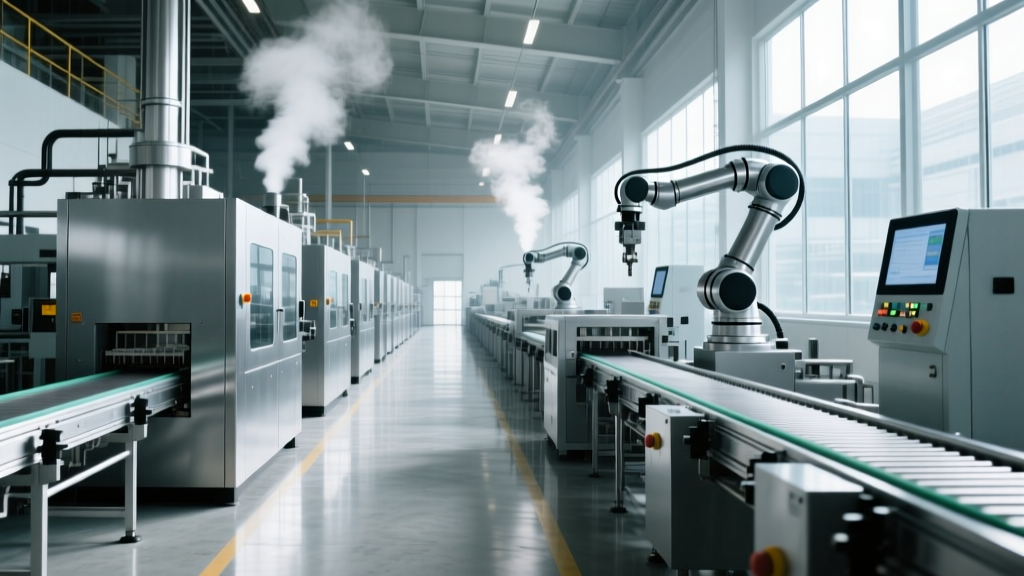
Continuous manufacturing systems—such as extrusion lines, distillation columns, and High-Temperature Short-Time (HTST) pasteurizers—operate at steady-state for thousands of hours annually. The initial CapEx is substantially higher, often 3x to 5x that of an equivalent-capacity batch setup, but the physical asset life is dramatically extended due to the absence of thermal and mechanical cycling.
Case Study: Dairy HTST Pasteurization Systems
A high-capacity dairy processing plant installing a GEA or Tetra Pak continuous HTST pasteurization system will face an upfront capital outlay of $1.2 million to $2.5 million, depending on flow rate (e.g., 10,000 to 30,000 liters per hour) and automation integration.
- MACRS Depreciation Life: 7 Years.
- Actual Economic Life: 20 to 25 Years.
- Primary Depreciation Driver: Gasket fatigue and plate crevice corrosion.
Because the system operates at a constant temperature and pressure, the 316L stainless steel frame and piping experience minimal structural fatigue. The primary wear components are the elastomeric gaskets and the heat exchanger plates. If CIP flow velocity is maintained above 1.5 meters per second to prevent biofilm buildup and crevice corrosion, the core capital asset will generate positive ROI for two decades. The equipment continues to produce value for 13 to 18 years after it has been fully depreciated on the corporate balance sheet, creating a massive backend margin advantage.
Direct Comparison: Depreciation & Wear Matrix
The table below contrasts the real-world wear profiles and financial timelines of standard batch versus continuous assets across heavily regulated industries.
| Metric | Batch Equipment (e.g., Pharma Reactors) | Continuous Equipment (e.g., Flow Chemistry / HTST) |
|---|---|---|
| Typical CapEx Range | $150k - $500k per modular skid | $1.5M - $5M+ for integrated lines |
| IRS MACRS Class | 7 Years (Class 00.4) | 7 Years (Class 00.4) |
| Average Economic Life | 8 - 12 Years | 18 - 25+ Years |
| Primary Wear Mechanism | Thermal shock, mechanical agitation stress | Seal degradation, steady-state friction |
| Obsolescence Risk | High (Process recipe changes) | Low (Flexible flow parameters) |
The "Scale-Up" Obsolescence Trap in Batch Processing
A hidden factor that severely truncates the manufacturing equipment depreciation life of batch systems is the scale-up trap. In industries like specialty chemicals and biotech, a product may be commercialized using a 500-liter batch mixer. When market demand spikes, the company does not typically buy ten 500-liter mixers; they purchase a single 5,000-liter reactor.
The original 500-liter equipment is instantly orphaned. Its economic life drops to zero, regardless of its physical condition or remaining MACRS schedule. Continuous systems avoid this trap through "scale-out" or "numbering-up"—adding identical parallel microreactor modules (such as Corning Advanced Fluidic Reactors) to increase capacity without rendering the original CapEx obsolete.
Warning: 2026 Bonus Depreciation Phase-DownAccording to IRS Publication 946, the TCJA bonus depreciation allowance falls to 20% for assets placed in service in 2026. Manufacturers can no longer rely on 100% first-year expensing to mask poor long-term asset utilization. High-CapEx continuous lines must be justified on 20-year operational cash flows, while batch equipment must be evaluated for rapid product-cycle agility.
Strategic Tax & Maintenance Planning for 2026
To optimize the financial lifecycle of your production floor, align your maintenance strategy with the tax code. For batch equipment with a short economic life, utilize Section 179 expensing (which allows full deduction up to the annual inflation-adjusted limit, exceeding $1.2M in 2026) to immediately write off modular skids that you expect to replace or heavily refurbish within a decade.
For continuous manufacturing infrastructure, focus CapEx on high-grade metallurgy and automated CIP systems. Investing an extra $150,000 in 316L stainless steel orbital-welded piping and automated flow-control valves during installation will prevent crevice corrosion and extend the asset's economic life from 15 years to 25 years. Because the IRS requires you to depreciate the base asset over 7 years via MACRS, any capital improvements that extend the life of the continuous system must be carefully classified—often qualifying for separate depreciation schedules or immediate expensing under the de minimis safe harbor rules, depending on your corporate accounting policy.
"The shift toward continuous flow chemistry isn't just about yield and footprint reduction; it fundamentally rewrites the depreciation model. We are seeing assets that are fully written off on the balance sheet continuing to produce high-margin APIs with only marginal gasket and pump seal maintenance costs for another fifteen years." — Director of Process Engineering, Mid-Cap CDMO
Decision Framework: Which Architecture Fits Your Asset Strategy?
- Choose Batch If: Your product lifecycle is under 7 years, you manufacture high-mix/low-volume specialty chemicals, or your process requires complex, multi-stage hold times that cannot be achieved in a continuous flow tube.
- Choose Continuous If: You produce low-mix/high-volume commodities (food, beverage, base polymers), your demand is highly predictable, and your corporate strategy prioritizes long-term backend margins post-depreciation over initial CapEx conservation.
Ultimately, matching your physical engineering choices to the reality of the manufacturing equipment depreciation life ensures that your production floor remains a driver of enterprise value, rather than a graveyard of orphaned, prematurely obsolete steel.