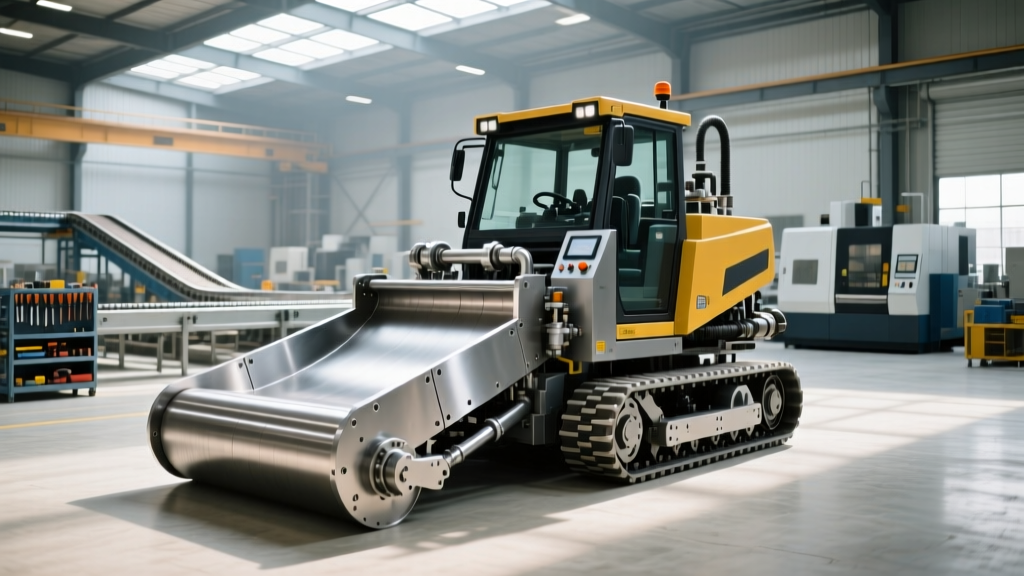
Custom Paving Equipment Manufacturers: Design & Fabrication Guide
Procure bespoke slipform pavers and MTVs. Compare NRE costs, FAT protocols, and vetting criteria for custom paving equipment manufacturers.
Procuring off-the-shelf asphalt or concrete pavers works for standard highway lanes, but specialized infrastructure—such as high-speed rail beds, airport taxiways, and custom canal linings—demands bespoke machinery. When standard catalogs fall short, infrastructure contractors must partner with custom paving equipment manufacturers capable of ground-up design and fabrication. This guide details the engineering criteria, Non-Recurring Engineering (NRE) costs, and acceptance testing protocols required to successfully commission custom paving machinery in 2026.
The Economics of Custom Paving Fabrication
Commissioning a bespoke slipform paver or specialized Material Transfer Vehicle (MTV) is a capital-intensive endeavor. Unlike modifying an existing chassis, ground-up fabrication requires extensive kinematic modeling and structural Finite Element Analysis (FEA).
⚠️ Procurement Warning: The NRE MultiplierWhen requesting quotes from paving equipment manufacturers, anticipate Non-Recurring Engineering (NRE) fees accounting for 18% to 25% of the total build cost. A custom concrete slipform paver with a base manufacturing cost of $550,000 will typically incur $99,000 to $137,500 in upfront engineering, 3D simulation, and prototyping charges. Ensure your contract clearly separates NRE from unit production costs if you plan to order a fleet.
Evaluating Manufacturer Engineering Capabilities
Not all heavy equipment fabricators possess the specialized tribology and material flow expertise required for paving machinery. When vetting manufacturers, demand evidence of the following engineering infrastructure:
1. Discrete Element Method (DEM) Simulation
Custom material hoppers and auger systems must handle highly viscous, temperature-sensitive mixes without segregation. Top-tier manufacturers utilize DEM software to simulate aggregate and binder flow through the hopper and auger flights, optimizing pitch and rotational speed to prevent mix tearing. Ask to see case studies where DEM reduced material segregation by at least 15% compared to baseline designs.
2. Advanced Screed Dynamics Modeling
The screed is the critical path for achieving the International Roughness Index (IRI) targets mandated by the Federal Highway Administration. Custom manufacturers must demonstrate multi-body dynamics (MBD) modeling to predict screed flotation and tamper bar resonance. For high-density concrete applications, look for designs integrating variable-frequency tamper bars capable of reaching 120 Hz, paired with 3-phase 480V electric heating elements that maintain ±1°C thermal uniformity across a 12-meter extrusion width.
3. Chassis and Track Drive FEA
Paving equipment exerts immense ground-bearing pressure. Custom manufacturers must perform structural FEA on the undercarriage and track drive assemblies to prevent chassis twisting under full hopper loads. Demand fatigue life reports for the track roller frames, ensuring they are rated for a minimum of 15,000 operational hours before requiring major structural overhaul.
Off-the-Shelf vs. Custom Paving Equipment Matrix
| Parameter | Catalog Paver (Modified) | Ground-Up Custom Fabrication |
|---|---|---|
| Lead Time | 6 – 9 Months | 12 – 18 Months |
| NRE Costs | $15,000 – $40,000 | $100,000 – $250,000+ |
| Metallurgy Upgrades | Limited to OEM options | Full spec (e.g., Hardox 500, Tungsten Carbide) |
| Machine Control Integration | Dealer-installed 2D/3D add-ons | Native CAN-bus integration with GNSS/Total Stations |
| Best Application | Widened standard lanes, minor profile changes | Canal linings, bespoke rail beds, ultra-wide airport runs |
Defining Technical Specifications for the RFP
Ambiguity in the Request for Proposal (RFP) leads to costly change orders. Before approaching custom paving equipment manufacturers, lock down these exact parameters:
- Extrusion Tolerances: Define the maximum allowable deviation. For instance, the National Concrete Pavement Technology Center recommends slipform extrusion tolerances not exceeding ±2mm over a 3-meter straightedge for high-speed applications.
- Material Transfer Rates: Calculate the exact tons-per-hour (TPH) required to keep the paver moving continuously at your target paving speed (e.g., 450 TPH for a 12.5-meter wide, 300mm deep concrete pour at 1.5 meters/minute).
- Track Drive and Steering Logic: For custom slipform pavers exceeding 10 meters in width, specify independent closed-loop hydrostatic track drives with electronic cross-flow compensation. This ensures straight-line tracking accuracy within 5mm over a 100-meter distance, preventing the crabbing effect that ruins edge alignment.
- Wear Component Metallurgy: Specify abrasion-resistant materials for high-wear zones. Mandate Hardox 500 steel for auger flights and specify tungsten carbide impregnation for the bottom edges of the screed plates to extend service life by 300% compared to standard AR400 steel.
- Machine Control Architecture: Require native, factory-installed CAN-bus architecture compatible with major 3D machine control providers (Topcon, Trimble, Hexagon) to eliminate latency issues common with retrofitted hydraulic valve blocks.
Factory Acceptance Testing (FAT) Protocols
Never take delivery of custom paving equipment without a rigorous, on-site Factory Acceptance Test. Standard hydraulic pressure checks are insufficient. Your FAT protocol must include:
- Thermal Uniformity Mapping: Use infrared thermography to scan the screed heating system. The temperature delta across the entire screed width must not exceed 2°C after 45 minutes of operation.
- Load-Bearing Deflection Test: Simulate the hydrostatic pressure of wet concrete against the slipform molds using hydraulic rams. Measure deflection at the mold's center point; it must remain under 1.5mm under maximum rated pressure.
- CAN-Bus Latency Verification: Inject simulated GNSS correction data into the machine control network. Measure the time delta between the digital elevation command and the physical movement of the screed tow point cylinders. Acceptable latency for high-speed paving is under 40 milliseconds.
- Emergency Stop Kinematics: Trigger the E-stop at maximum paving speed and travel speed. Measure the exact stopping distance to ensure it complies with ASME safety standards for mobile heavy machinery, verifying that no material is extruded post-trigger.
"In 2026, the primary bottleneck in custom paving equipment fabrication is not steel or hydraulics, but the procurement of heavy-duty, high-torque electric drive motors and advanced PLC controllers. Contractors who secure their supply chain allocations for these electronic sub-assemblies before finalizing the mechanical design will shave months off their delivery timeline." — Director of Heavy Equipment Procurement, Tier-1 Infrastructure Group
Finalizing the Contract and IP Rights
When engaging in ground-up design, clarify Intellectual Property (IP) ownership in the final contract. If your firm funded 100% of the NRE costs for a proprietary canal-lining slipform mold, ensure the contract explicitly assigns the design patents and CAD files to your company. This prevents the manufacturer from selling your bespoke solution to a competitor. Conversely, if the manufacturer absorbed the NRE costs to add the design to their catalog, negotiate a most favored nation pricing clause for all future fleet expansions and guarantee priority access to replacement wear parts for a minimum of 10 years.