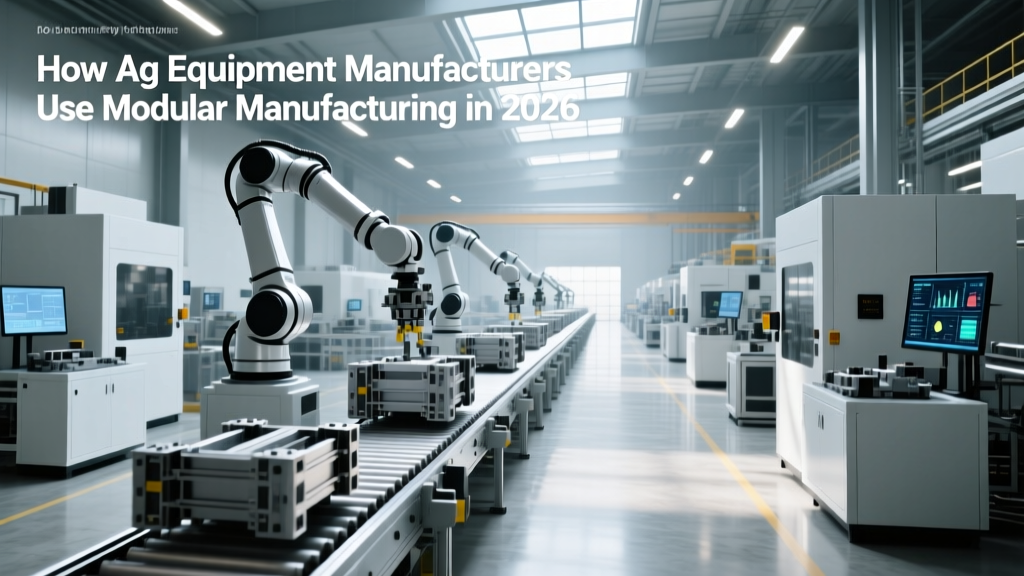
How Ag Equipment Manufacturers Use Modular Manufacturing in 2026
Discover how ag equipment manufacturers leverage modular manufacturing equipment in 2026 to achieve flexible, high-mix production for custom machinery.
The Shift from Dedicated Lines to High-Mix Flexibility
Agricultural machinery demand is highly cyclical and increasingly customized. A farmer ordering a modern Class 8 tractor or a high-capacity combine harvester expects specific tire configurations, precision guidance integrations, and bespoke header widths. Traditional dedicated assembly lines, engineered for mass-producing identical units, fail catastrophically under this high-mix, low-volume reality. To survive margin compression and seasonal demand spikes, ag equipment manufacturers are aggressively retiring rigid conveyor systems in favor of modular manufacturing equipment.
According to operational analyses by McKinsey & Company, agile factories utilizing modular production architectures can reduce changeover times by up to 70% while cutting work-in-progress (WIP) inventory by 30%. For agricultural OEMs, this transition is not merely an operational upgrade; it is a fundamental redesign of the factory floor to accommodate payloads exceeding 5,000 kg while maintaining the flexibility to switch from assembling a standard plow to a complex air seeder in under an hour.
2026 CapEx Reality Check
While modular manufacturing equipment requires a 15% to 22% higher initial CapEx compared to traditional fixed-automation lines, the ROI timeline has compressed. Due to the integration of standardized OPC-UA communication protocols and off-the-shelf heavy-duty skid systems, ag equipment manufacturers are now seeing payback periods of 2.4 years, down from 4.1 years in 2022.
Heavy-Duty Modular Skid Systems: Beyond Aluminum Extrusions
Standard modular conveyors, such as aluminum-friction systems, typically max out at 40 kg to 100 kg payloads. Agricultural equipment assembly requires moving bare chassis, diesel powertrains, and fully ballasted axles. Modern ag plants are deploying heavy-duty modular skid systems built on reinforced steel base profiles and high-torque chain-drive mechanics.
Platforms like those detailed in Bosch Rexroth's heavy assembly solutions utilize standardized pallets that can be dynamically routed. If a specific tractor variant requires an extended cab installation, the PLC simply holds the skid in a buffering loop while the main line continues processing standard models. This asynchronous routing eliminates the bottlenecks inherent in synchronous, hard-linked chains.
Key Specifications for Ag-Grade Modular Skids
- Payload Capacity: 2,000 kg to 8,000 kg per skid, utilizing dual-strand hardened steel chains.
- Positioning Accuracy: ±0.1 mm at workstations, achieved via pneumatic locating pins and servo-driven lift-and-locate units.
- Drive Technology: Decentralized motor-rollers with integrated frequency inverters, allowing individual skid speed control from 2 to 15 meters per minute.
Reconfigurable Robotic Welding and Fixturing Cells
The fabrication of implement frames—such as those for disc rippers or field cultivators—involves heavy, thick-walled tubular steel. Historically, manufacturers built dedicated welding fixtures for every implement width. In 2026, the standard is modular fixturing paired with high-payload robotics.
By utilizing modular workholding systems (e.g., Bluco modular tombstones and quick-change clamping towers), a single robotic cell equipped with a Yaskawa GP280 (280 kg payload) can weld a 30-foot air drill frame in the morning and a 12-foot moldboard plow in the afternoon. The changeover relies on automated tool changers and 2D vision systems, such as the Cognex In-Sight 2800, which scan the raw steel drop-offs, identify the part variant via a laser-etched QR matrix, and automatically load the corresponding welding path and clamping sequence to the robot controller.
"The bottleneck in agricultural welding is no longer the arc-on time; it is the fixture changeover and part loading. Modular fixturing reduces non-value-added loading time from 45 minutes to under 8 minutes per batch."
— Senior Manufacturing Engineer, Tier 1 Ag Implement Supplier
Decision Matrix: Line Architecture Selection
Not every sub-assembly requires full modular flexibility. Plant managers must map component variance against production volume to select the correct architecture. The Association of Equipment Manufacturers (AEM) frequently highlights the danger of over-engineering low-variance lines. Use the following framework to allocate capital:
| Component Type | Variance / Mix | Volume | Recommended Architecture |
|---|---|---|---|
| Standard Hydraulic Cylinders | Low | High | Dedicated Hard Automation |
| Combine Harvester Headers | High | Low/Medium | AGV-Based Flexible Workstations |
| Tractor Chassis / Powertrain | Medium | Medium/High | Heavy-Duty Modular Skid Conveyors |
| Implement Frame Weldments | High | Medium | Modular Fixturing + Robotic Cells |
Implementation Framework: Retrofitting Legacy Ag Plants
Greenfield facilities are rare in the heavy equipment sector. Most ag equipment manufacturers are integrating modular equipment into 40-year-old brownfield plants. Executing this requires a phased, data-driven approach to avoid disrupting peak-season production runs.
- Kinematic and Payload Auditing: Before ordering modular skids, conduct a 3D laser scan of the existing facility. Heavy modular conveyors require perfectly leveled floors (within 2 mm per 10 meters). Legacy concrete often suffers from subsidence; failing to remediate the floor will cause premature chain wear and skid derailment under 5,000 kg loads.
- Decentralized Control Migration: Legacy plants rely on monolithic PLCs (e.g., older Allen-Bradley PLC-5 systems). Modular equipment demands decentralized I/O blocks and edge controllers. Migrate to an OPC-UA over TSN (Time-Sensitive Networking) architecture to ensure deterministic communication between modular skid drives and stationary torque-tool controllers.
- Phased Buffer Integration: Do not replace the main line in one shutdown. Introduce modular buffering loops at high-variance stations (e.g., cab installation or precision-ag tech integration) first. This allows the main synchronous line to keep moving while the modular buffer absorbs the cycle-time variance.
- Digital Twin Validation: Utilize software like Siemens Tecnomatix to simulate the modular skid routing logic. Simulate the exact mix of 2026 order configurations to identify potential deadlocks in the asynchronous routing algorithms before physical commissioning.
Edge Cases and Real-World Failure Modes
Modular manufacturing equipment is highly reliable, but the harsh realities of heavy equipment assembly introduce specific failure modes that plant engineers must anticipate.
Vibration-Induced Fastener Loosening
When modular skids carry a tractor chassis through an inline cold-test station (where the diesel engine is motored to check compression and oil pressure), the high-frequency vibration can loosen the modular conveyor's structural fasteners. Solution: Specify Nord-Lock washers or structural adhesives (e.g., Loctite 243) on all load-bearing modular extrusion joints, and implement a quarterly ultrasonic bolt-tension audit.
Coolant and Swarf Intrusion
If modular machining cells are integrated directly into the assembly flow, cutting fluids and heavy steel swarf can jam the skid transfer mechanisms. Solution: Deploy IP67-rated decentralized motors and utilize positive-air-purge seals on the linear guide rails to prevent particulate ingress.
Summary: The Strategic Imperative
For ag equipment manufacturers, the transition to modular manufacturing equipment is no longer an experimental pilot project; it is the baseline requirement for 2026 competitiveness. By matching heavy-duty skid systems to high-payload assembly tasks and deploying modular fixturing for high-mix welding, OEMs can effectively decouple production volume from product variance. The result is a factory floor capable of delivering highly customized agricultural machinery without sacrificing the throughput economics of mass production.