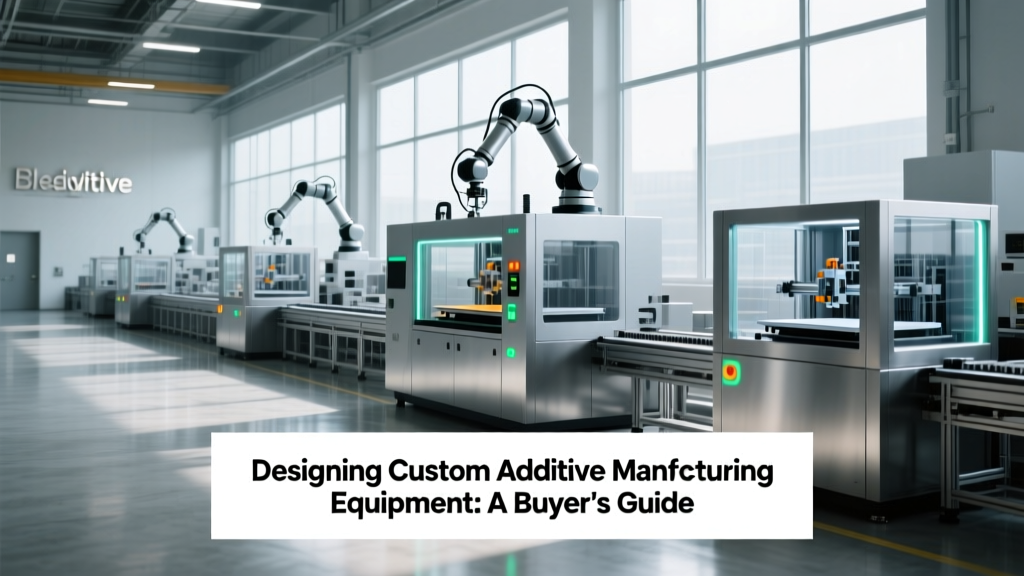
Designing Custom Additive Manufacturing Equipment: A Buyer's Guide
Evaluate when to design custom additive manufacturing equipment vs. buying off-the-shelf. Includes component specs, cost matrices, and integration tips.
When scaling production beyond standard geometries, procurement teams face a critical inflection point: purchase a turnkey system or engineer custom additive manufacturing equipment. While off-the-shelf polymer and metal 3D printers dominate the SMB market, heavy industry, aerospace, and energy sectors frequently require bespoke directed energy deposition (DED) or hybrid CNC-AM platforms. Designing custom additive manufacturing equipment requires navigating complex kinematics, thermal dynamics, and inert atmospheric controls.
The Build vs. Buy Decision Framework
Before allocating capital to custom fabrication, engineering managers must validate the necessity of a bespoke system. Turnkey metal AM systems like the EOS M 400-4 or Trumpf TruPrint 5000 offer validated process parameters and immediate support, but they cap out at fixed build volumes (typically under 800x800x1000mm) and restrict material flexibility.
Custom Fabrication Justification Matrix
- Build Volume Exceeds 1.5m³: Standard powder bed fusion (PBF) machines cannot accommodate large structural aerospace components (e.g., rocket engine nozzles or titanium hull ribs).
- Hybrid Subtractive/Additive Needs: Integrating a laser cladding head into an existing 5-axis CNC mill (e.g., retrofitting a DMG Mori NTX 2000) requires custom tool-changer and shielding gas fabrication.
- Exotic Material Deposition: Processing highly reactive alloys like Tantalum or Niobium requires bespoke vacuum chambers that commercial systems do not offer.
- Continuous Production Lines: Designing automated powder-recycling and part-extraction conveyors for high-volume AM cells.
Core Subsystems for Custom AM Integration
Designing custom additive manufacturing equipment is essentially an exercise in systems integration. You are combining motion platforms, high-energy sources, and material delivery mechanisms into a cohesive, closed-loop environment.
Motion Systems and Kinematics
The choice between a Cartesian gantry and a multi-axis robotic arm dictates your system's stiffness and volumetric error. For high-precision DED applications requiring tolerances under ±0.05mm, a custom linear gantry driven by Siemens Simotics servo motors and Rexroth ball screws is mandatory. Robotic arms, such as the KUKA KR 240 R2900, offer superior reach (2.9 meters) and 6-axis flexibility for repairing complex turbine blades, but they suffer from lower structural rigidity, requiring real-time kinematic compensation software to prevent layer-shifting during high-force deposition.
Energy Sources and Deposition Heads
The deposition head is the heart of your custom equipment. For wire-arc additive manufacturing (WAAM), systems typically integrate a Fronius CMT (Cold Metal Transfer) power source paired with a custom water-cooled torch. For laser-based DED, the industry standard involves pairing an IPG Photonics YLS-6000 (6kW fiber laser) with a Precitec YC52 coaxial cladding head. The YC52 allows for precise powder focus adjustment, critical when switching between 316L stainless steel and Inconel 718.
Cost and Lead Time Analysis: Turnkey vs. Custom
| System Type | Estimated Capital Cost | Integration Lead Time | Process Validation Burden |
|---|---|---|---|
| Turnkey PBF (e.g., SLM Solutions NXG XII 600) | $1.2M - $1.8M | 6 - 9 Months | Low (OEM pre-validated) |
| Custom Robotic DED Cell (KUKA + IPG + Precitec) | $450,000 - $750,000 | 12 - 18 Months | High (Requires internal DOE) |
| Hybrid CNC Retrofit (Laser head on existing mill) | $250,000 - $400,000 | 4 - 6 Months | Medium (Collision/safety checks) |
Engineering the Environment: Atmospheric Control
A common failure point in custom additive manufacturing equipment design is inadequate atmospheric shielding. When processing titanium alloys (Ti-6Al-4V), oxygen contamination above 50 parts per million (ppm) causes severe embrittlement. Standard commercial systems use enclosed, actively purged chambers. When fabricating custom large-format equipment, building a rigid, welded stainless steel chamber is cost-prohibitive.
Instead, modern custom designs utilize flexible, heavy-duty polymer enclosures (such as those fabricated from 20mm PVC-coated polyester) with localized argon flooding. To maintain the required <50 ppm O2 levels in a 15m³ flexible enclosure, engineers must specify Atlas Copco GXe 15 compressors paired with Parker Hannifin nitrogen/argon generators, ensuring a continuous positive pressure flow rate of at least 40 CFM to counteract leakage at the robotic arm pass-through seals.
"The most overlooked aspect of custom AM fabrication is thermal management of the optics. A 6kW laser operating at 80% duty cycle generates massive secondary radiation. If your custom deposition head lacks active water chilling rated for 40 liters per minute at 2 bar pressure, the collimating lenses will experience thermal blooming, destroying your beam profile within 45 minutes of continuous printing."
Control Architecture and Software Integration
Unlike desktop 3D printers that run on open-source G-code, industrial custom additive manufacturing equipment requires deterministic, real-time control. The Siemens Sinumerik One CNC controller is the preferred architecture for hybrid and gantry-based AM systems. It natively supports "Additive Manufacturing" technology cycles, allowing seamless switching between milling (subtractive) and laser cladding (additive) within the same NC program.
For robotic arm configurations, integrating the KUKA.PLC mxAutomation library allows the robot to communicate directly with the laser power source and powder feeder (e.g., Oerlikon Metco Twin-System) via PROFINET. This ensures that if the robot encounters a singularity or pauses for a toolpath recalculation, the laser and powder flow shut off in under 10 milliseconds, preventing catastrophic material buildup on the substrate.
Real-World Failure Modes and Troubleshooting
Designing custom equipment means you inherit the troubleshooting burden. Below are specific failure modes encountered during the commissioning of bespoke DED and WAAM systems, along with engineered solutions.
1. Powder Flow Instability in Coaxial Nozzles
Symptom: Asymmetric melt pools and uneven layer heights, particularly when depositing on inclined surfaces (>30 degrees).
Root Cause: Gravity affects the internal powder disk distribution in the cladding head. Standard nozzles are optimized for flat-plane (Z-axis) deposition.
Engineering Fix: Retrofit the deposition head with a fluidized powder feed system and install a Keyence IL-S600 laser displacement sensor. This creates a closed-loop height control system that dynamically adjusts the Z-offset and wire-feed speed based on real-time melt pool topography.
2. Substrate Warping and Delamination
Symptom: The base plate curls upward at the edges during the first 10 layers of a large Inconel 718 build, snapping the support tacks.
Root Cause: Unmanaged residual thermal stress and lack of active substrate heating.
Engineering Fix: Integrate a Weldlogic active heating platen beneath the build substrate, maintaining the base metal at a constant 150°C. This reduces the thermal gradient (ΔT) between the newly deposited 2000°C melt pool and the base plate, reducing residual stress by up to 40% according to NIST additive manufacturing research.
3. Arc Wander in WAAM Systems
Symptom: The welding arc deflects unpredictably, causing porosity and lack-of-fusion defects.
Root Cause: Magnetic arc blow caused by the accumulation of residual magnetism in the ferromagnetic substrate as the part grows.
Engineering Fix: Install an active degaussing coil around the build platform and utilize an Abicor Binzel magnetic arc stabilization module on the torch to counteract Lorentz forces in real-time.
Final Procurement and Compliance Considerations
When fabricating custom additive manufacturing equipment, regulatory compliance cannot be an afterthought. High-powered laser systems must comply with IEC 60825-1 safety standards, requiring custom interlocked enclosures, OD7+ laser safety glass viewports, and automated beam-dump mechanisms. Furthermore, powder handling systems for reactive metals (Aluminum, Titanium) must adhere to NFPA 484 standards for combustible metals, necessitating wet-separator dust collection systems rather than standard dry vacuums to prevent deflagration.
Ultimately, designing custom additive manufacturing equipment yields unparalleled flexibility and cost-efficiency at scale, provided the integration team possesses deep expertise in metallurgical thermodynamics and mechatronic control systems. Procurement teams should budget an additional 20% of the initial hardware cost specifically for Design of Experiments (DOE) and process parameter validation, referencing frameworks established by organizations like America Makes to ensure the bespoke system meets aerospace and defense certification requirements.